Showing posts with label kodak. Show all posts

23 September 2019

Kodak

Tom hosts Tuesday's Treasures Travel TuesdaOur World Tuesday Image-in-ing
My Corner of the World

Another post that falls into this category! Not unusual for me.


I had taken these photos in 2017 as we drove by. I never really gave any thought to the name other than it caught my attention because I love photography.


This whole post happened because of a photo I came across on a Facebook group!!! And as I investigated one thing led to another (insert John, shaking head, and saying as usual...). So I had to go out and track down some of the locations of Kodak around downtown.


Tom, the Backroads Traveler will appreciate this. I did know about Kodak in Rochester New York because of Tom. We even went to Rochester to visit the Eastman House Museum.

My photo of the Kodak Gil in Rochester.


So obviously I knew a lot about Rochester and Kodak, but not what was in my own backyard!!


Kodak The Early Years also from Ryerson along with this website. This was written by photography students in 2019 and is fascinating.
There is insight to women at work, the war years and advertising. It also covers the racism that existed in Toronto at the time in the section called Difficult Histories.


Following Canadian Kodak’s incorporation in 1899, the company established premises in an existing building at 41 Colborne Street, Toronto. The property was intended to serve as an assembly and distribution centre, rather than a site of manufacturing: the fledgling company imported bulk film and photographic paper, as well as completed cameras, from Rochester for packaging and distribution in Canada. The property was leased to Canadian Kodak Co., Ltd. for 3 years at $840 per year. Consisting of four floors and a cellar, 24 ¼ x 71 feet each, the site housed the entire Kodak plant and its staff of ten. A further 7-year option on the property was offered by the owner but never taken. Largely unchanged from its original structure, the Colborne Street building still stands today.


.
See it today.


The Colborne Street premises soon proved insufficient to house the rapidly growing Canadian subsidiary. With its lease set to expire in 1901, the company set out to find a new site for its operations in what was then Toronto’s manufacturing district. In September of that year, Canadian Kodak purchased an empty lot at 588 King Street for $70 per foot and hired Toronto architects Chadwick and Beckett to build a new plant. Over its 17-year tenure at this facility, Canadian Kodak began its transition to a manufacturing operation, producing its own photographic film, paper, and mounts. The company also began to import camera parts—rather than completed cameras—from Rochester for assembly and distribution in Canada. Like the Colborne Street site, the King Street premises quickly proved too small to house the growing business and two additional buildings were constructed in an adjoining lot. By 1908, the King Street factory had expanded to its full capacity and the company had grown to 108 employees. Like Kodak’s Colborne Street plant, the King Street facility still stands today, now part of a busy retail strip in downtown Toronto.

Image result for 588 king st west toronto

So, back to the photo that started all this. I was flipping through a Facebook group called Toronto Old Districts and saw this photo. I had not known that Toronto had such a large Kodak operation.


Kodak Mount Dennis Campus, also known as Kodak Heights, was an industrial park in the Mount Dennis neighbourhood of Toronto. It was owned and operated by the Eastman Kodak Company as a major camera manufacturing factory since its opening in 1912, peaking at 900 employees in 1925, 3,000 in the 1970s, falling to about 800 before it ceased the plant's operations in 2006.

Kodak had opened its Canadian operations on 8 November 1899, first on Colborne Street and then King Street in the downtown core. By 1912 the company was growing so rapidly that a new corporate campus was needed. George Eastman personally visited Toronto to view potential sites, eventually selecting the Mount Dennis area, which at that time was farmland. In 1913 the company purchased 10 hectares (25 acres) at $12,000 per hectare ($5,000/acre) and began construction as soon as the deed was transferred. A series of seven buildings were initially constructed, including two that were connected by an enclosed bridge. The first to be completed, Building 1, was the power plant, which connected to the Canadian Pacific Railway just south of the plant with a spur that ended inside the building. It burned about 500 tonnes of coal a day. The move from the King Street facilities began in 1916, completed the next year.


Kodak Heights grew steadily over its lifetime. In 1939, construction began on the Kodak employees’ building (Building 9). This 4-storey building was designed to accommodate the activities of the Recreation Club, the Department Managers’ Club, and the Kodak Heights Camera Club. It housed an auditorium, cafeteria, gymnasium, club room, locker room, and camera studio and had an adjacent lawn bowling green. The building opened in 1940. Expansion at Kodak Heights continued until the late 20th-century. By 1987, the property housed 18 buildings.

On December 9, 2004, Kodak Canada announced the closure of its manufacturing operations. June 30, 2005 would be the last day of operations at Kodak Heights.


The 19-hectare (48-acre) campus once contained over a dozen buildings, of which only Kodak Building 9 remains standing. The building was abandoned until 2013 when the land was acquired by Metrolinx to construct the Eglinton Crosstown line. It will be the location of the Mount Dennis LRT station main entrance with a bus terminal, and the Eglinton Maintenance and Storage Facility nearby.


The Royal Ontario Museum had an exhibition called Family Camera and it featured some Kodak items.


25 July 2016

George Eastman Mansion

Tom hosts Tuesday's Treasures and I'm posting about his town.

July 2016 - Rochester NY

Click here to see more Rochester sights.

It was overcast when we started out but the sun soon came out.


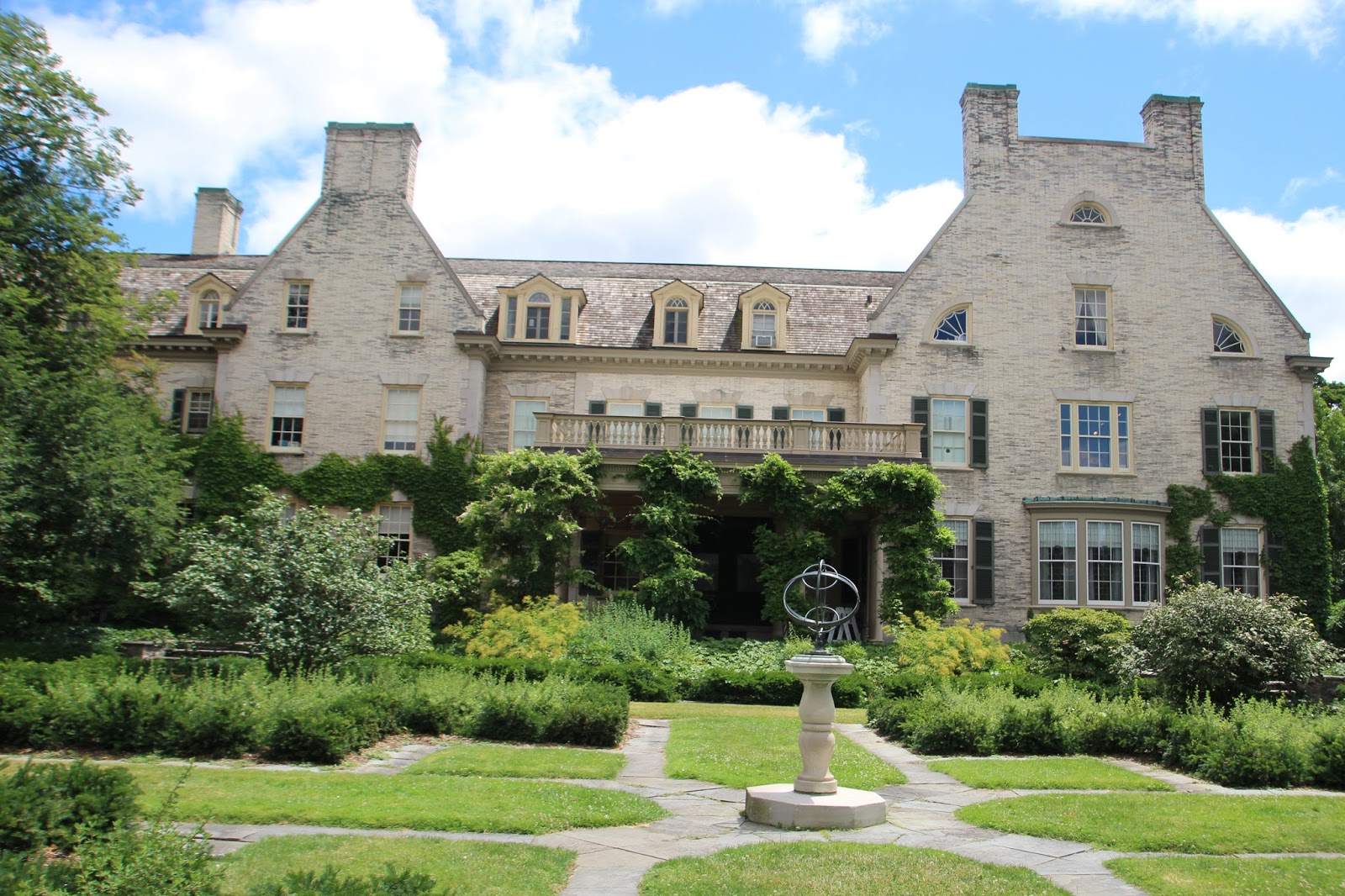
We spent some time  admiring the front of the house.

We eventually found the entrance to the museum with the help of a woman who was arriving to attend the film festival at the theatre. She learned we were Canadians and couldn't stop gushing about our prime minister.


Entrepreneur George Eastman (1854–1932), the pioneer of popular photography, completed his Colonial Revival mansion on East Avenue in Rochester in 1905 and resided there until his death. He bequeathed most of his assets to the University of Rochester, expressing a desire that his mansion serve as the residence for the university president. The large house, measuring 35,000 square feet, proved far too large for this purpose, especially without a large service staff.


In 1947, the Board of Regents of the State of New York chartered George Eastman House Inc. as an independent nonprofit educational institution—specifically, a museum of photography and allied pursuits created as a memorial to George Eastman. The next year, the University of Rochester donated Eastman’s mansion and surrounding property to the museum. The institution altered its name several times over the ensuing decades, but its mission has remained steadfast: to collect, preserve, study, and exhibit photographic and cinematic objects and related technology from the inception of each medium to the present.


At the museum’s opening in 1949, it was one of only two American museums with a photography department and one of only two American museums with a film department (the Museum of Modern Art also had both). In 1951, the museum opened the beautiful Dryden Theatre, with seating for more than five hundred people, to exhibit films.


To celebrate the 100th anniversary of the formation of the National Park Service, the George Eastman Museum presents Photography and America’s National Parks, an exhibition exploring the role of photography in the development of the agency and in shaping our perception and understanding of these landscapes.

An Ansel Adams!!

Ansel Adams was an American photographer who is widely known for his modern day representations that are made on calendars, posters, and in books. He is best remembered as a prominent figure in black and white photography. Adams was a great environmentalist too. The multi-dimensional genius in Adams made him develop the Zone System which determines proper exposure and adjusts the contrast of the final print. Adams was a guiding light in developing the field of photography with his teachings and practices of resolution, clarity and the importance of sharpness in images.


They provided lots of photo ops.


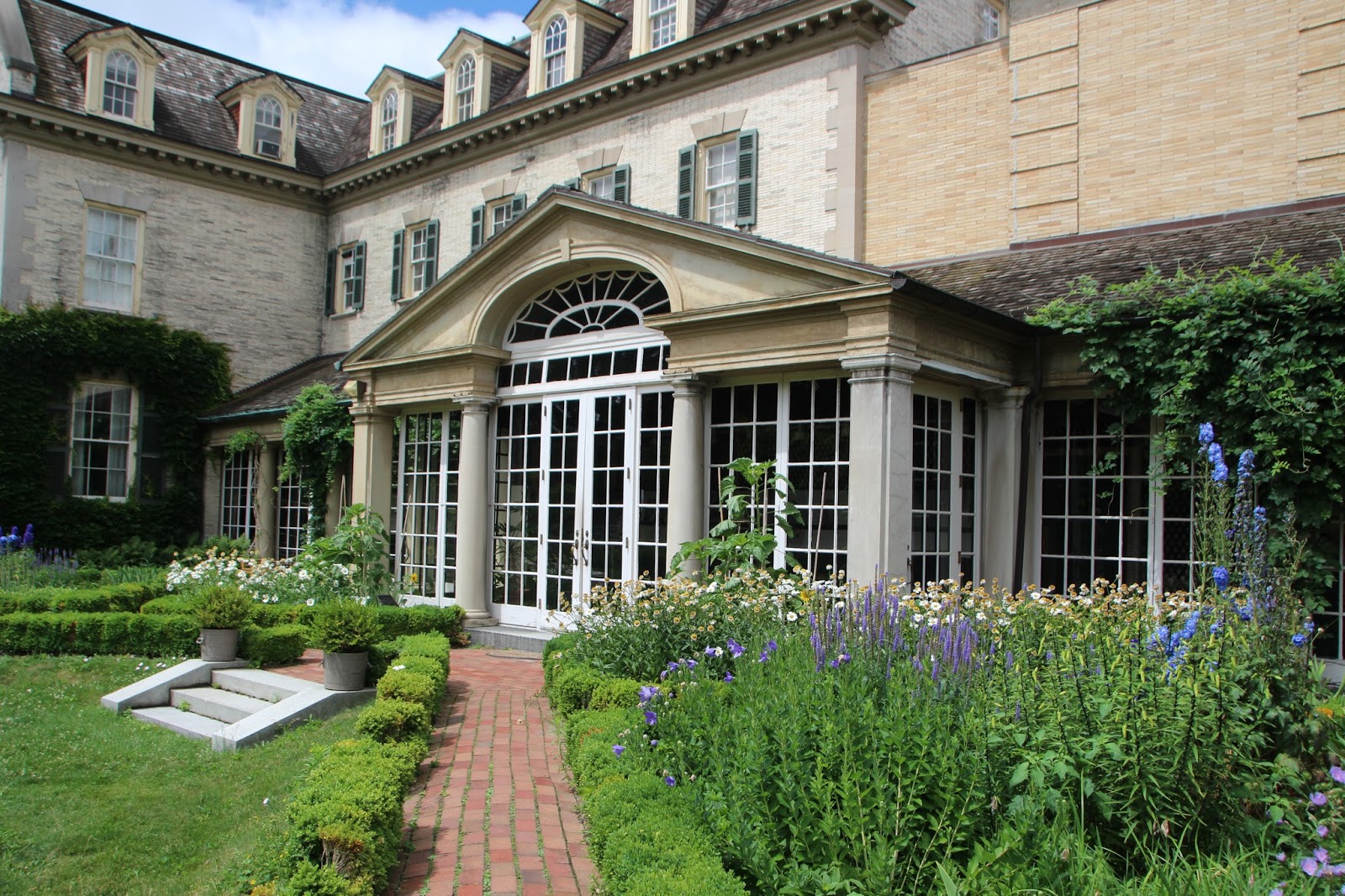
After the galleries and gardens we toured the mansion. I could be happy with a sun room like this.


The security staff were the most pleasant I have ever seen. We couldn't get the door open to the gardens and didn't want to push in case of an alarm, but a guard came along, opened it and even walked a bit with us and pointed out some things about the garden.


The Colonial Revival mansion, built between 1902 and 1905, served as George Eastman’s primary residence until his death in 1932. Today, visitors can explore the historic mansion on their own or on a guided tour, offered daily. Live music performances are offered in the mansion most Sunday afternoons throughout the year.

Eastman remained humble, shy, and unassuming. His reticence and boyish face gave him a low profile for many years, even in his home town of Rochester, New York. When he identified himself, at the peak of his success, to a newly hired gate guard outside his own factory, the watchman scoffed, “Glad to meet you; I’m John D. Rockefeller.” One of his friends observed that George “could keep silent in several languages.” It took 25 years of close collaboration before Eastman and University of Rochester president Rush Rhees began to address each other by their first names. Eastman could be brisk and unemotional, and he never married, though he enjoyed his extended family and a number of close friendships.

On the main floor, visitors enter from the museum through the Palm House and Colonnade, which also provides access to the Schuyler C. Townson Terrace Garden. Past the Colonnade, visitors enter the Dining Room and continue into the Conservatory, the center of the mansion.


Eastman was a stern and no-nonsense businessman, but generous in sharing successes with employees and shareholders. He was a pioneer in creating sick pay, disability compensation, pensions, and hospital benefits. After one highly successful stock offering he set aside a large sum from his personal proceeds and had it distributed to 3,000 startled Eastman Kodak employees with a note reading: “This is a personal matter with Mr. Eastman and he requests that you will not consider it as a gift but as extra pay for good work.” It was one of the first corporate bonuses.


Eastman was a high mix of homebody and adventurer. He would work ceaselessly in Rochester, relaxing only in mundane house and garden duties, then explode into some exotic and extended foreign jaunt. He bicycled across Europe several times (and also enthusiastically bicycled to work much of his life, even in Rochester winters). He would go on music-and-theater jags where he’d attend several performances or plays each day. On African safari once he stood filming a rhino on an early hand-cranked movie camera, and calmly continued as the snorting animal charged directly at him, simply sidestepping and actually brushing the animal as it passed. As the very-large rhino began its second charge, with Eastman still methodically filming, the terrified hunter-guide accompanying him shot the creature dead just a few paces from his intrepid client.


The Billiard Room, Library, Great Hall, and Living Room are all accessible from this large two-story room.


More spoils of the hunt.


George Eastman’s most personal gift blessed Rochester and the world alike. “GE is absolutely alcoholic about music,” wrote one friend, after accompanying him on a 1925 culture trip to New York City. They attended 12 operas and plays in six days, as well as visiting the Morgan Library, the Metropolitan Museum, the Frick Museum, and two movies. (“The rest of the time we loafed,” Eastman summarized in his own account.)

Eastman described listening to music as “a necessary part of life,” and actually installed a large organ in his house and paid an organist to play it every morning as a kind of alarm clock and then breakfast accompaniment. “There are no drawbacks to music: you can’t have too much of it,” he opined. “There is no residual bad effect like overindulgence in other things.”

The charmed donor loved to share beautiful music with others, and made many innovative efforts to expose everyday citizens to great performances. He created elaborate music-instruction programs for the community at large, purchased hundreds of instruments for children, and subsidized the best ensembles to play in Rochester. He insisted tickets at all performances he had anything to do with should be sold first-come/first-served to avoid any “class distinctions.” He required that operas be sung in English so people could understand them. He sent the conductor of the local orchestra to Europe for a year of full-time study and practice, then brought him back to lead a large professional orchestra in popular concerts.


Up the Grand Staircase on the second floor, visitors will see the restored bedroom suite of Maria Kilbourn Eastman (George Eastman’s mother), the north and south organ chambers behind latticework, the Sitting Room, exhibitions related to George Eastman and Eastman Kodak Company, and the Discovery Room, with hands-on image-making activities for kids.


Looking down into the Conservatory.


His mother's quarters.


Kodak sign on building.


George and me.


The third floor, now used for museum offices, once housed Eastman’s screening room and workshop, as well as living quarters for household staff. Museum members can go behind the scenes to the third floor and the basement on the monthly Upstairs/Downstairs tours.


Back outside and the sun is shining.


Morning Reflections