The sign on the cafe reads "1st house liberated in France".
The Gondree Cafe had been used as an aid post, and the cafe owner, Monsieur Gondree, dug up his supply of champagne from the garden and gladly shared it with his liberators.
Today the cafe has become the first stop for any visitor to this part of the battlefield; it is still owned by the Gondree family, and still a cafe.
The museum was amazing and our guide delightful and knowledgeable. Again, the tour did not allow us enough time to browse around.


Brotheridge was killed on the other side of the bridge, just short of the nearby Gondree Cafe. With this bridge, the bridge across the Orne secured by another party from the Oxs and Bucks, Howard had achieved his objectives in ten minutes and sent the radio message 'Ham and Jam' to indicate both positions had been taken intact.
7th Para then arrived, and the crossroads in Benoueville were held for the rest of the day, despite attacks from elements of 21st Panzer Division. Lord Lovat's commandos arrived along the road from the direction of Ouistreham, and the link up was complete.
In 1944 it was renamed Pegasus Bridge in honour of the operation. The name is derived from the shoulder emblem worn by the British airborne forces, which is the flying horse Pegasus.
The village of Ranville was an objective of 6th (Airborne) Division on 6th June 1944, and was captured by units of this formation on the morning of D Day. The churchyard was used for immediate burials, and some soldiers from 6th (Airborne) were laid to rest at this location as the fighting for the Eastern Flank continued. After the Second World War the site was chosen to regroup burials from this part of the battlefield, and graves were brought in from a number of areas, including: Amfreville, Colleville-sur-Orne, Houlgate, Colombelles and Villers-sur-Mer. The cemetery was finally closed in 1946. A very high proportion of the dead here are men from 6th (Airborne) Division. Burials total 2,562 -
contains 2,235 Commonwealth burials 97 of them unidentified. There are also 330 German graves and a few burials of other nationalities.
The graves of 76 Canadians are located in the Ranville War Cemetery near Caen, including nine members of the RCAF, three CANLOAN officers and 57 members of the 1st Canadian Parachute Battalion.
In the grounds of the old church are local graves along with soldiers' graves.
Unknown soldier
A German soldier's grave
Then we crossed over to the British military cemetery.
Back over to the church graveyard.
There are French soldiers buried here who died for France.
Then we crossed over to the British military cemetery.
We then drove to Arromanches, a small seaside town between the Gold and Omaha beaches for a quick lunch break. We were provided with ham and cheese baguettes. we ate quickly so we could wander around.
Arromanches was selected as one of the sites for two Mulberry Harbours built on the Normandy coast, the other one built further West at Omaha Beach. Sections of the Mulberry Harbour at Arromanches still remain today with huge concrete blocks sitting on the sand, and more can be seen further out at sea.
The Mulberry Harbour was built for D-Day in June 1944. The Mulberry Harbour’s purpose was to ease and speed up the unloading process so that Allied troops were supplied as they advanced across France after breaking out from Normandy. The success of D-Day could only be maintained if the advancing troops were supplied and more men landed. The Mulberry Harbour was one of the greatest engineering feats of World War Two.

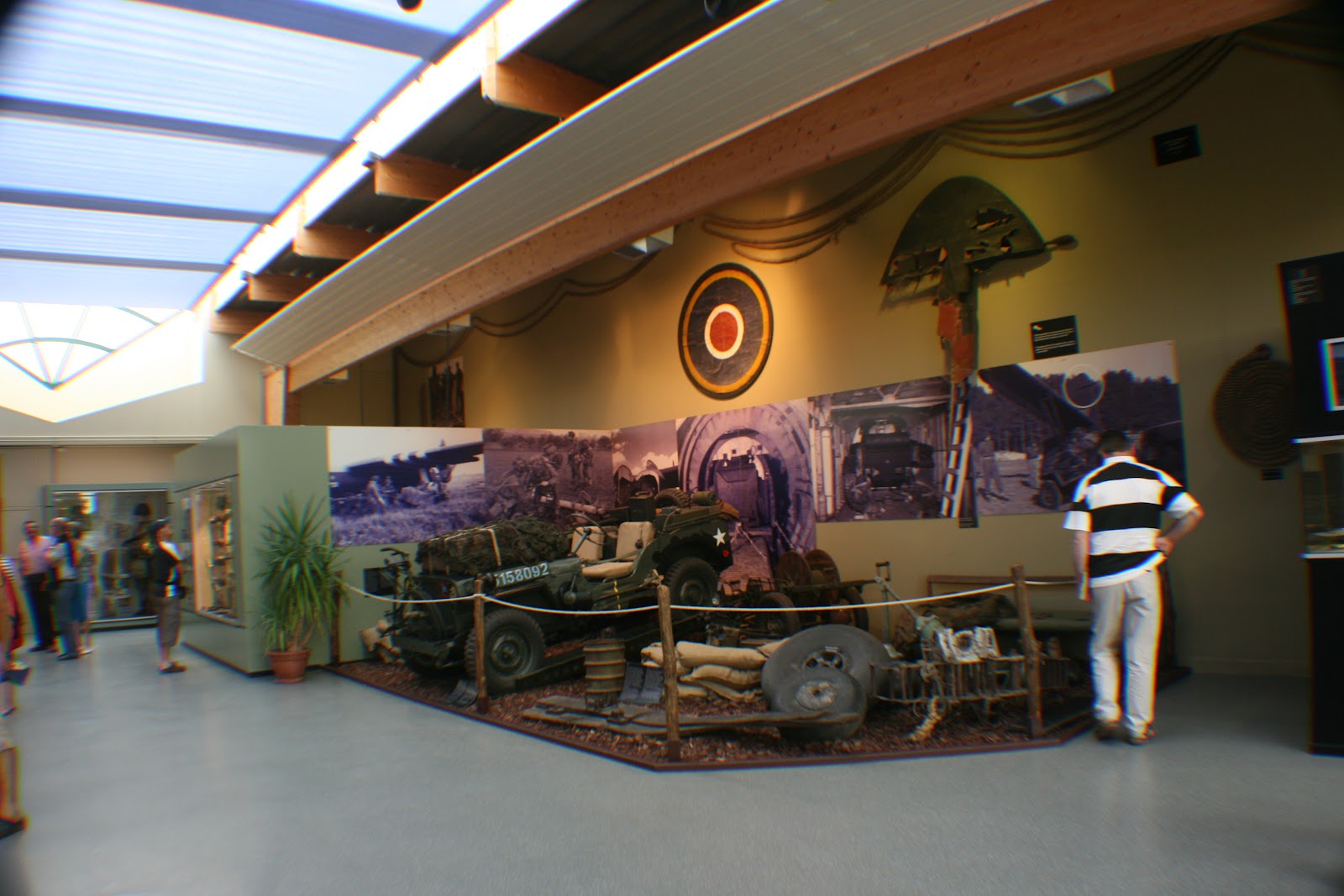
There is a large museum dedicated to D Day.
The Mulberry Harbour was actually two artificial harbours, which were towed across the English Channel and put together off the coast of Normandy. One, known as Mulberry A, was constructed at Omaha Beach and the other, known as Mulberry B (though nicknamed ‘Port Winston’), was constructed off Arromanches at Gold Beach. Put together like a vast jigsaw puzzle, when both were fully operational, they were capable of moving 7,000 tons of vehicles and goods each day.
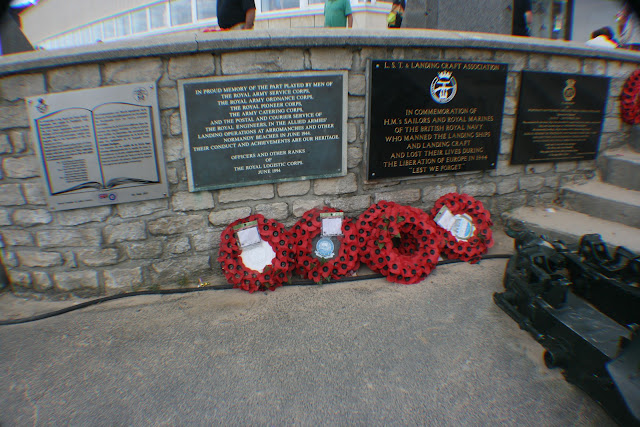


Each of the two artificial harbours was made up of about 6 miles of flexible steel roadways that floated on steel or concrete pontoons. The roadways were codenamed “Whales” and the pontoons “Beetles”. The ‘Whales’ ended at giant pier heads that had ‘legs’ that rested on the seabed. The whole structure was protected from the force of the sea by scuttled ships, sunken caissons and a line of floating breakwaters. The material requirements for any part of either Mulberry A or B were huge – 144,000 tons of concrete, 85,000 tons of ballast and 105,000 tons of steel.
Souvenir shop with code name of D Day campaign.
We made a photo stop further up where we could look down at the landing beach.
Operation Overlord was only one step of a global strategic plan for the complete defeat of Nazi Germany. The Normandy landing was designed to establish a bridgehead from which two armies, the First US Army on the west flank and the Second British Army to the east could be supplied by sea. With the bridgehead firmly secured, the armies were to move on to liberate France and the neighbouring countries. Germany, attacked on three separate fronts, in Northwest Europe, in Russia, and in the Mediterranean, would soon be exhausted and defeated.
On June 6th, 1944, the 3rd Canadian Infantry Division and the 2nd Armoured Brigade were tasked with establishing a bridgehead on the beach codenamed "Juno". This was an eight-kilometre long stretch of beach bordering Saint-Aubin, Bernières, Courseulles-sur-Mer and Graye-sur-Mer. Assault troops were then to move towards the Carpiquet airfield, 18 kilometres inland. The 3rd Infantry Division, under Major-General
R.F.L. Keller, was under command of the Second British Army. It was flanked on the left by the 3rd British Infantry Division that was to land on Sword beach (Lion-sur-Mer, Langrune-sur-Mer). To the right, the 50th British Division had as its target "Gold Beach" (La Rivière, Le Hamel, and Arromanches).


Next we headed to Courselle-sur-mer where the Canadian Museum is located.
The Juno Beach Centre opened on 6th June 2003. It tells the story of the Canadian landings on Juno Beach on D Day, but more than that it looks at Canada's entire role in the Second World War. From Hong Kong and Dieppe, to the fighting in Italy, and the Battle for Normandy and North-West Europe, the experience of Canadian service men and women is moving related in a number of themed areas. The visit begins in the cinema, which in the darkness looks like the inside of a landing craft. Here you view a short film about D Day. You then move on to see the background to Canada on the eve of WW2, before moving into the areas dealing with the fighting. Throughout there are numerous photos, videos to watch and personal accounts to listen to (everything is in English and French) - presented in an easy and user-friendly way, and making the best use of modern technology. The main visit ends with the 'Some Came Back, Others Did Not' area where you can see items connected with individual men and women who served - and some who died, while above you Canada's Roll of Honour for WW2 scrolls on a massive screen.
The Canadian museum at Juno Beach is amazing.
Finally, we visited the Canadian military cemetery. It’s very lovely and very somber at the same time.
It was an unforgettable experience.The guides we had gave us much of the history of the war, and the battles that happened on these beaches, as well as the rest of France. If you are a history or war buff, this is a great place to visit.
After a long day it was time to head back to the boat.


.JPG)

.JPG)

.JPG)

.JPG)


.JPG)

.JPG)

.JPG)

.JPG)



.JPG)


.JPG)


.JPG)
.JPG)
.JPG)
.JPG)
.JPG)


.JPG)