Sep 9 Sydney NS to Port aux Basques (PAB) Newfoundland Labrador (NL)
WEATHER: Sunny TEMP: 13C
TIME: 3:41 PM TORONTO/4:41 PM SYDNEY NS/ 5:11 PM PAB NL (example only)
We were up at 7:15 and had breakfast at the hotel.
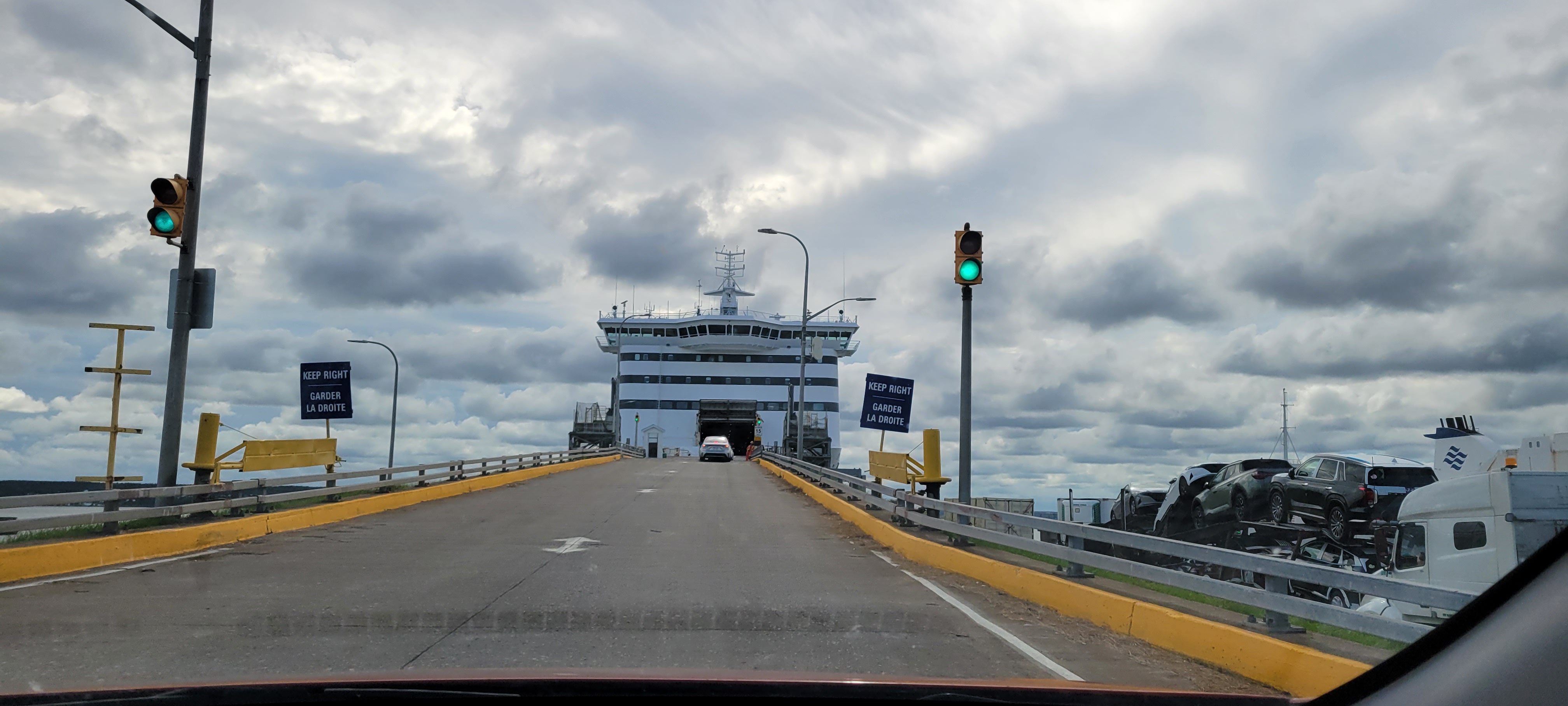
We then packed up and drove to the ferry, five minutes away.
You must get there 2 hours prior to departure time which meant 10:15 for us. So we checked out at 9:30 (as did everyone in the hotel) and drove the short distance to the ferry.
We arrived at 9:45. As we drove up to check in the attendant immediately called John by name, which shocked him. I laughed as they had the license plate on file when I booked. We were given our boarding passes and cabin key.
The weather was incredible. Sunshine and warm.
There are four different ferries that can get you to Newfoundland but the most common path is to go from Nova Scotia to Newfoundland with Marine Atlantic. There are two ferries that depart Nova Scotia for Newfoundland and the most popular is from North Sydney, Nova Scotia to Port aux Basques, Newfoundland.
This ferry runs year-round (although storms can cause delays), travels 96 nautical miles, and takes about 6-7 hours. The ferry basically connects the Trans-Canada Highway of Nova Scotia with the Trans-Canada Highway of Newfoundland.
In general, they all have some sort of cafe and restaurant, as well as a bar, lounge areas, comfortable seating, WiFi, and outdoor viewing areas. You’ll also find nice restaurants, games rooms, a movie theatre, and even a toddler play area.
Once you leave your car, you can’t return until you reach your destination. The entire area is locked off for the safety of everyone.
We packed a carry on with our laptops, phones, cameras, snacks and water. We also included some Gravol and Tylenol, just in case, which we didn't need as it was such a smooth crossing.
It was such a gorgeous day we didn't need layers as you will want to go outside. A hat, gloves and rain jacket are handy.
We boarded around noon and parked on level 5. There are 6 levels for vehicles.
We are on MV Blue Puttees. She is named after the nickname of the Royal Newfoundland Regiment.
Predecessor units trace their origins to 1795, and since 1949 Royal Newfoundland Regiment has been a unit of the Canadian Army. During the First World War the battalion-sized Newfoundland Regiment was the only North American unit to fight in the Gallipoli campaign of 1915. Later in the war the regiment was virtually wiped out at Beaumont Hamel on July 1, 1916, the first day of the Battle of the Somme, but was rebuilt and continued to serve throughout France and Belgium until the armistice, serving as part of the British Army of the Rhine in 1919. In December 1917,
George V bestowed the regiment with the right to use the prefix royal before its name. It was the only military unit to receive this honour during the First World War.
During the First World War Newfoundland was a largely rural Dominion of the British Empire with a population of 240,000 people, and not yet part of Canada. The outbreak of the First World War in 1914 led the Government of Newfoundland to recruit a force for service with the British Army. Even though the island had not possessed any formal army organization since 1870, enough men soon volunteered that a whole battalion was formed, and later maintained throughout the war. The first recruits in the regiment were nicknamed the "Blue Puttees" due to the unusual colour of the puttees, chosen to give the Newfoundland Regiment a unique look and due to the unavailability of woollen khakis on the island.
A puttee (also spelled puttie, adapted from the Hindi paṭṭī, meaning "bandage") is a covering for the lower part of the leg from the ankle to the knee, alternatively known as: legwraps, leg bindings, winingas, or Wickelbänder. They consist of a long narrow piece of cloth wound tightly, and spirally round the leg, and serving to provide both support (as a compression garment) and protection. They were worn by both mounted and dismounted soldiers, generally taking the place of the leather or cloth gaiter.
Level 7 is reception, shops, food and lounges.
We got settled in our cabin. A cabin is an additional expense but 1- we like our comforts and privacy and 2 - we are here for 6 -7 hours and don't want to surrounded by people. We could also have a nap! We had also packed a lunch.
It had a bathroom with a shower, and TV.
Out on deck before we left.
Containers aboard.
We got settled for the rest of the ride.
Photos taken as we reached Port aux Basques NL.
We were directed to our cars by level. They off loaded some trucks and then we were one of the first cars off!
We were one of the first to check into the Hotel Port aux Basques for the evening.


.jpg)
.jpg)

.JPG)


.jpg)
.jpg)
.jpg)
.jpg)


.JPG)

%20mural.JPG)
%20mural.JPG)
%20mural.JPG)
.JPG)






.JPG)