Return to Newfoundland and travel to L'Anse aux Meadows National Historic Site, the first cultural discovery in the world to receive recognition as a UNESCO World Heritage Site. Hear of the Vikings who walked here over a thousand years ago before continuing on to your St. Anthony accommodations for the night. (Breakfast, Dinner)
Day 4 Haven Inn - St. Anthony, Newfoundland & Labrador
We woke in Labrador and headed back to the ferry.
But first we stopped for a photo op at the welcome sign and Karen took everyone's photos.
The ferry had musicians, Karen said she had never seen that before. The ferry was also early so she added a side trip.
Flower's Cove (or Flowers Cove), located on Route 430 in western Newfoundland, is a pretty but unassuming coastal town with a very special attraction—thrombolites. These formations, found along the coast, were created when microbes in the ancient Iapetus Ocean photosynthesized their food. Because the water near the shore contained calcium carbonate from limestone rocks, this photosynthetic process created the unusual formations we call thrombolites.
Thrombolites are typically several feet across and look something like an Italian panini rosette roll made from rock. Scientists describe thrombolites as "clotted" structures because thrombolites lack the layered structuring of strombolites, which are formed in a similar way and date back to approximately 3.5 million years ago. As you look at a thrombolite, it can be difficult to imagine how living organisms could absorb enough minerals from the water to create such a large, rocky formation.
Thrombolites exist in only a few places on Earth. The thrombolites of Lake Clifton, Australia, are similar in appearance to those found at Flower's Cove.
L'Anse aux Meadows (The Bay with the Grasslands) was our next stop, and definitely a highlight of the tour.
It was brisk out but we were dressed for it. We were shown this video on the bus.
At the tip of Newfoundland’s Great Northern Peninsula lies the first known evidence of European presence in the Americas. Here Norse expeditions sailed from Greenland, building a small encampment of timber-and-sod buildings over 1000 years ago Against a stunning backdrop of rugged cliffs, bog, and coastline, discover the fascinating archaeological remains of the Viking encampment, declared a UNESCO World Heritage Site in 1978. You’ll meet costumed Viking interpreters as you tour the recreated base camp and discover original artifacts from this internationally renowned archaeological find.
The one nice thing about bus tours is the convenience. The coach dropped us at the parking lot and would pick us up at the lower level. Otherwise you would have to walk all the way back to the visitors' centre!
In the past four to five thousand years, many people have lived at L’Anse aux Meadows; some stayed longer than others. Among these people was a small group of Norse sailors. The remains of their camp, discovered in 1960 by Helge and Anne Stine Ingstad, is the oldest known European settlement of the New World.
From the visitors' centre we took a 40 minute walking tour with a Parks Canada guide.
What a gorgeous area, looking across at Labrador.
Kevin had a big bushy beard and was wearing his shorts. The staff do rotating jobs so he could be dressed in costume tomorrow so all the men have bushy beards.
Curious about how the Vikings lived and worked? Visit with navigator-adventurer Egil, weaver Thora, the blacksmith Ragnar or other members of the crew and hear tales of trade, Norse society, how to turn bog iron into a nail and cloth into currency. Check out their weaponry, tools, cooking utensils and reproductions of many artifacts representing everyday living.
Hence the busy beards! We were given a test back on the bus. It turns out Kevin, above and these two gentlemen appeared in the first video. And the white haired one would be our musical entertainment that night. Everybody in NL wear multiple hats to make a living.
We made a short stop at a jam and chocolate shop for a jam demonstration (AKA spend money).
In Newfoundland English, a tickle is defined as: “A narrow salt-water strait, as in an entrance to a harbour or between islands or other land masses, often difficult or treacherous to navigate because of narrowness, tides, etc; a 'settlement' adjoining such a passage.”
From there we drove to Fox Point Lighthouse that overlooks Bonne Bay where we will be going tomorrow. However the highlight wasn't the light house because whales were spotted!
Sep 12 Day 3: Port au Choix to L'Anse au Clair, NL
WEATHER Foggy in Newfoundland then sunshine
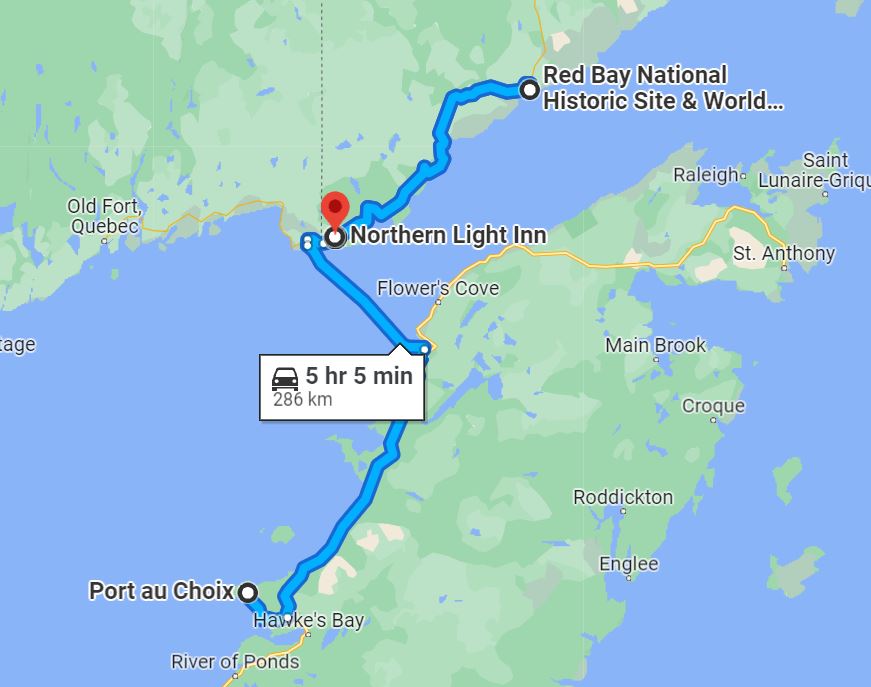
Board the ferry from St. Barbe to cross the Strait of Belle Isle to Labrador. Continue to Red Bay National Historic Site, a UNESCO World Heritage Site, where the Basques had a whaling station in the 16th century. This mystical place takes the essence of Labrador coastal living and transposes it onto a tapestry of rich culture and history. Spend the night in Labrador. (Breakfast, Dinner) Day 3 Northern Light Inn - L'Anse au Clair, Newfoundland & Labrador
An early start - suitcases out by 7, breakfast at 7 and depart at 8.
We have an hour’s drive to St. Barbe to catch the ferry to Labrador by way of Quebec. This makes it an inter-provincial ferry thereby getting funds from the federal government.
We had to be at the ferry an hour before sailing.
St. Barbe – Blanc Sablon (Strait of Belle Isle Area) MV Qajaq W - pronounced Kayak Automobiles: 120 vehicles, including 8 tractor trailers Passengers: 300 Crossing Times: St. Barbe to Blanc Sablon: 1 hour 45 minutes (36 km)
Once we are aboard, 1 hour and 45 minutes, I did some blog writing and sorted some photos. The crossing was gentle although you did need to hold the handrail if you walked anywhere.
Very cute graphics.
While we had great weather, St. John's was being hammered by tropical storm Earl.
We disembark in Quebec at Blanc Sablon and drive to the Labrador border.
We go to L’Anse au Clair (our night time destination) to offload the luggage so it will be in our rooms upon return.
A good day for drying clothes.
RED BAY NATIONAL HISTORIC SITE During the mid-16th century, large numbers of right and bowhead whales drew whalers from the Basque region of Spain and France to the Strait of Belle Isle, where they established a major whaling port at Red Bay. For some 70 years, Basque whalers made the dangerous, month-long journey across the Atlantic to hunt whales and produce the oil that lit the lamps of Europe.
See original Basque artifacts, remains, and restored chalupa at this national historic site and World Heritage Site.
As I was taking this photo a woman walked over and said "I saw you on your computer this morning, I was wondering if you could help me with my Apple phone", I explained that I didn't really know Apple products." She said her gentleman friend said she was a Luddite, and didn't like Apple.
Mural shows how much bigger the whale is than the little boat the Vikings used.
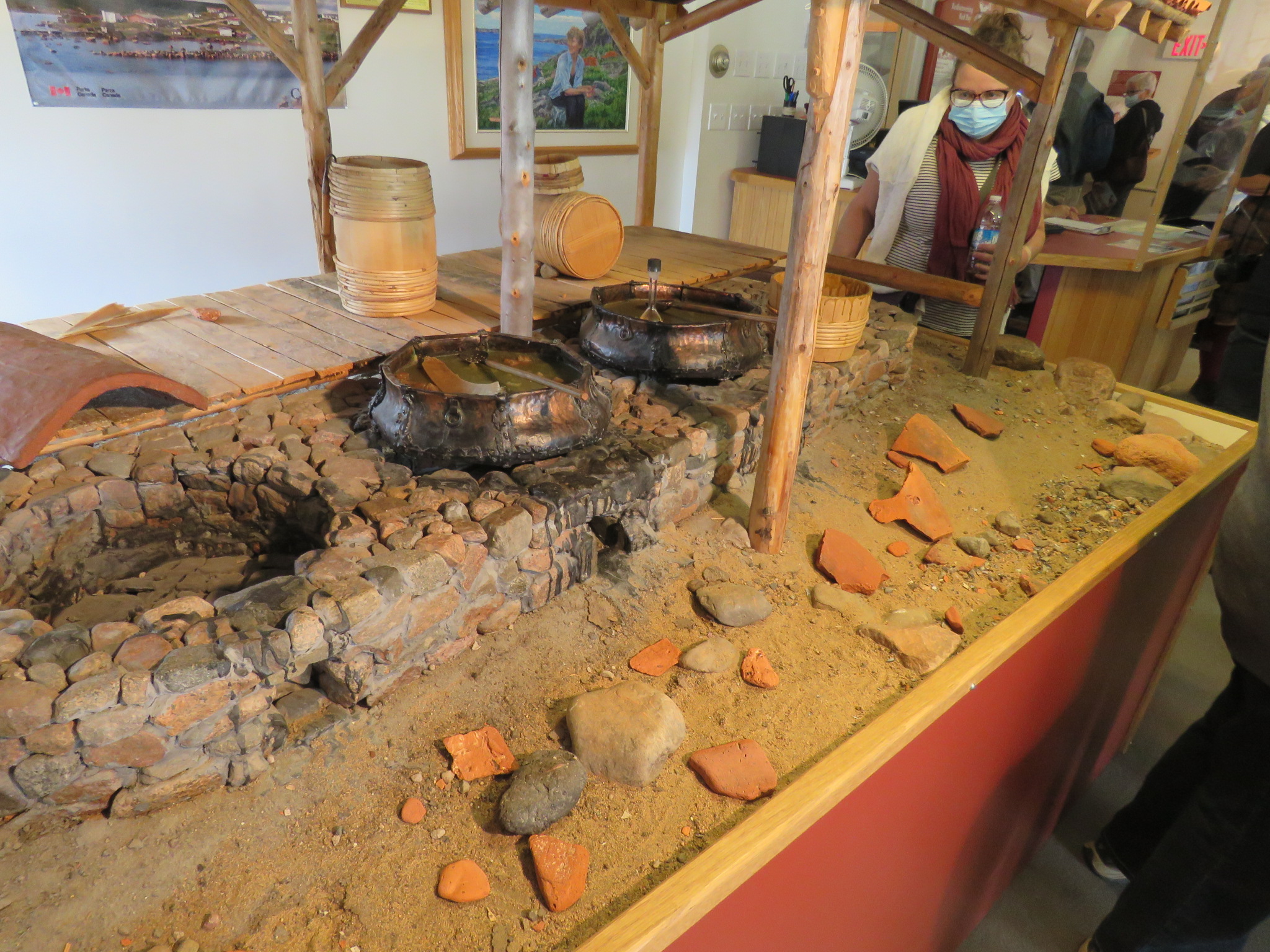
Explaining how the whale oil is extracted.
In wooden ships built with large cargo holds to accommodate sometimes up to 2000 barrels of whale oil, the whalers came in search of North Atlantic and Greenland Right whales. During the peak whaling periods of the 1550s and 60s there were upwards of a thousand men whaling out of Red Bay alone. A barrel of oil could fetch high prices on the market during peak periods and ship owners and outfitters could pay their expenses, pay the crew and make a good profit in the meantime. Whale oil was a valuable commodity in Europe during that time because it was a brighter burning lamp oil and was a serviceable lubricant for leather products and an additive for paints, varnishes, and soap.
We got to smell it and it wasn't vile.
Our Lady of Labrador
Karen showed us a photo from May 2022 of a snow storm in Red Bay and the houses are buried.
The bottom of the trees are bare due to the salt air and the amount of snow they get.
A familiar sight along Newfoundland and Labrador roads, especially in the Northern Peninsula, was an endless string of roadside woodpiles. Individuals pay a government permit to cut wood on public land. Then the wood is hauled to a roadside area for storage, where longer logs are arranged in a pyramid, teepee style, to allow them to dry out. Once seasoned, the wood is chopped to stove length and stacked in neat, standard size rows. Often the telephone number of the pile's owner will be painted on a board and attached to the pile for the convenience of purchasers. Winter lasts six months in Newfoundland, and fuel prices are very high, so most families go through lots of firewood each year.
For convenience, trees are cut in winter for the following year's firewood. Since every family owns a snowmobile, hauling the wood from the cutting location to storage is much easier with a snowmobile-pulled sled. And these are stored along the roadside also.
Lobster season is set by DFO and changes from year to year depending on the lobsters moult cycle. It also varies from area to area, also depending on the moult due to water temperatures. The season typically starts in April-May and closes in June-July.
Our resting spot for the night in L'Anse au Clair.

.jpg)
.jpg)