Showing posts with label historical designation. Show all posts

24 January 2022

Tuesday Treasures

 Tom the backroads traveller hosts this weekly meme.

Toronto ON


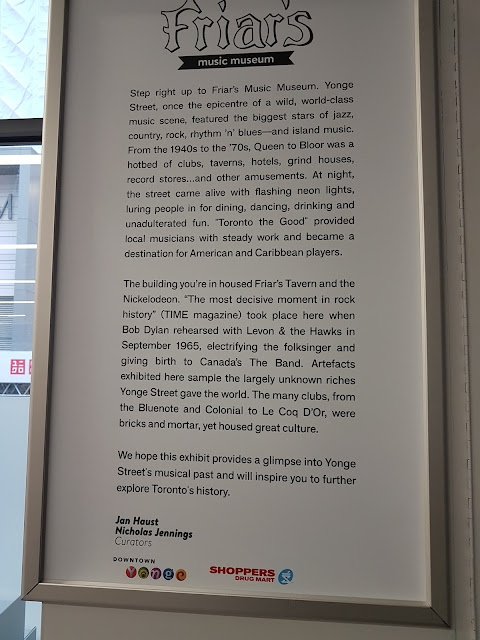
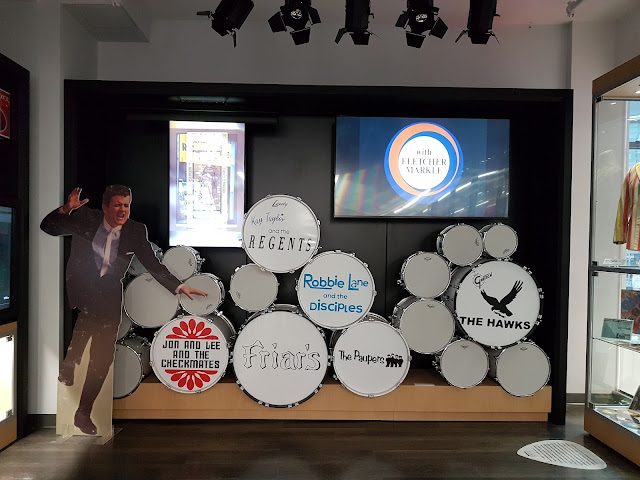
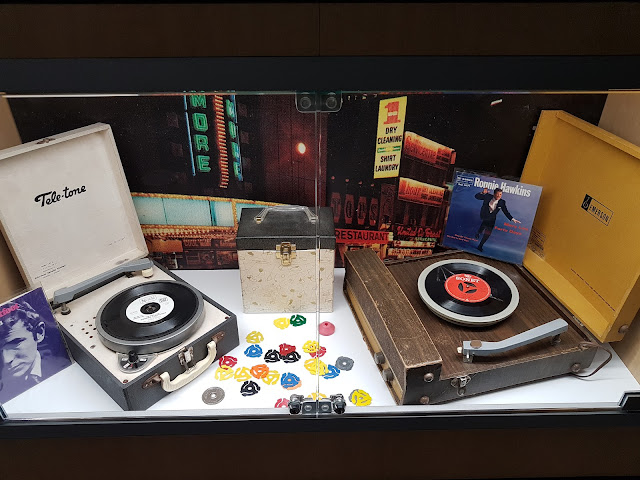
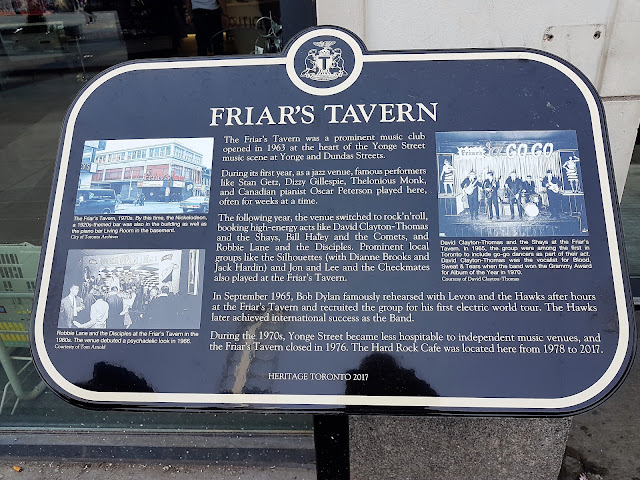
From 1963 to 1976, Friar's Tavern served as one of the Yonge Street strip's most popular nightclubs. When it opened, the tavern boasted that it featured "the finest in food." But its musical offerings were truly superb, ranging from jazz great Oscar Peterson and rock legends Bill Haley & the Comets to local heroes Levon and the Hawks, whose presence at the club brought Bob Dylan to town. 
In 1965, Bob Dylan's world was a-changing. He'd already recorded his electric masterpiece "Like a Rolling Stone" and performed his plugged-in set at the Newport Folk Festival. But he needed his own backup band. Enter Mary Martin, a Toronto woman who was working for Dylan's manager in New York. At Martin's urging, Dylan flew to Toronto on September 15 to check out her favourites, Levon and the Hawks, at the Friar's. 
He first heard them play on the morning of September 16 and for the next two nights, Dylan and the group rehearsed after hours and forged a thrilling, hard-edged sound. After touring the world with Dylan, and making a return appearance at Toronto's Massey Hall in November, Levon and the Hawks relocated to Woodstock, New York, and became famous as The Band. With Dylan, they went on to generate bestselling albums and a sold-out North American tour in 1974 that included two nights at Toronto's Maple Leaf Gardens. But their fruitful partnership had begun at Friar's Tavern, an event that Time magazine declared "the most decisive moment in rock history."

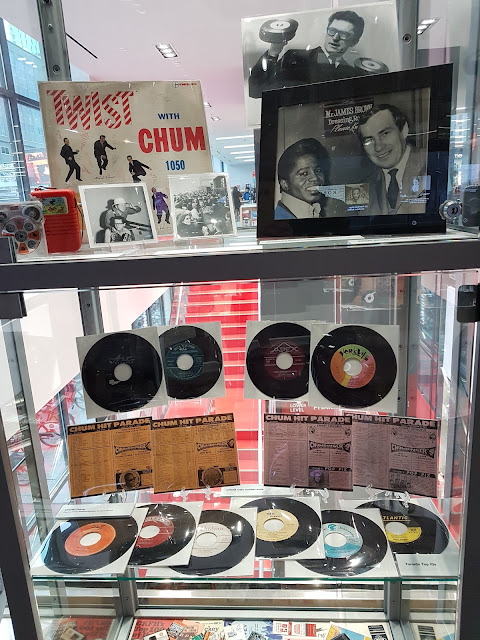
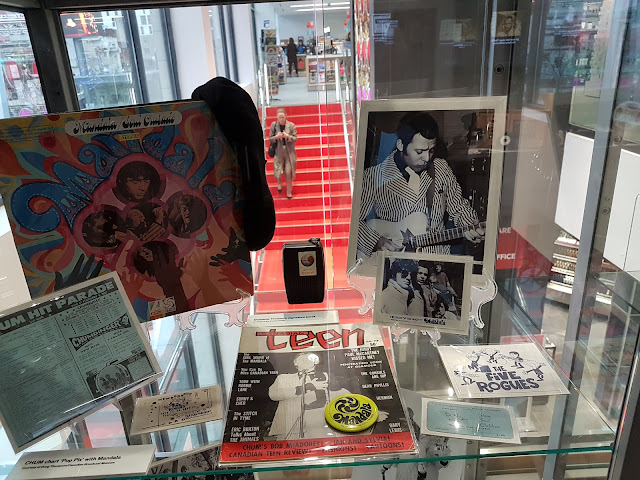
The building now is, sadly, a Shoppers' Drug Mart, but they did create a small museum upstairs.

Photo courtesy of Canadian Encyclopedia


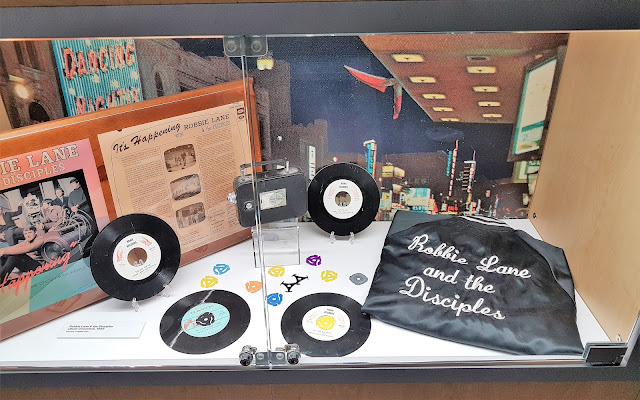
A year later, the music club shifted gears to rock ’n roll where acts included Bill Haley and the Comets, Robbie Lane and the Disciples as well as the Silhouettes.
In the summer of 1965, the historic Friar’s Tavern was the first to feature go-go dancers to accompany the bands on stage. On raised platforms or in gilded cages, dancers in short skirts with rows of fringes dazzled spectators. The stage show and fad caught like wildfire at the local clubs and bands didn’t look complete performing without them. David Clayton-Thomas and the Shays were one of the first groups in Toronto to share the stage with go-go dancers.

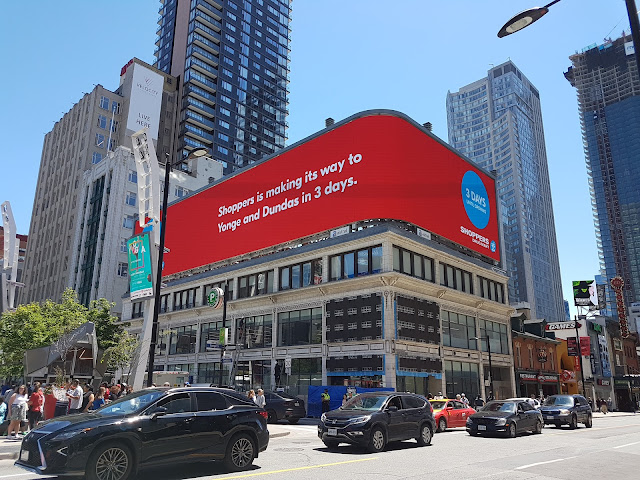
Yonge and Dundas facing South in 1964. You can see part of the Friar's sign in this photo.


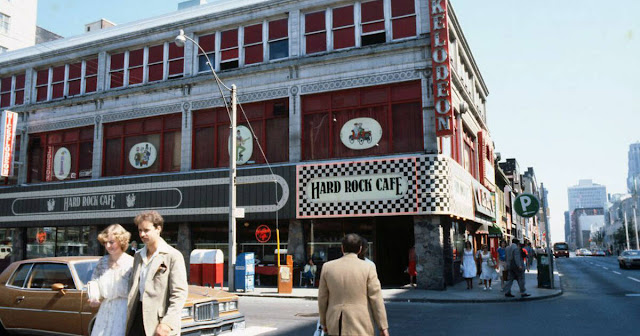
The 3-storey building was constructed in 1918 for the American restaurant chain, Child’s Restaurants. Designed by the restaurant’s New York City architect, JC Westervelt, the Beaux-Arts Classicism style building was home to the restaurant on the main floor with Karry’s Billiards and Bowling on the upper floors.


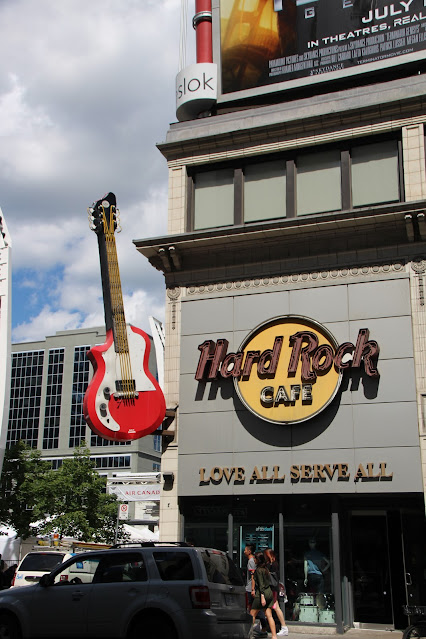
From 1978 until 2017, the building was home to the Hard Rock Cafe – a new Yonge Street landmark. 
Photo from BlogTO when it opened.


Those famous walls were once again filled with music but this time with an extensive collection of rock’n roll memorabilia including musical instruments, autographed photos of famous musicians and even some of the clothing they wore.
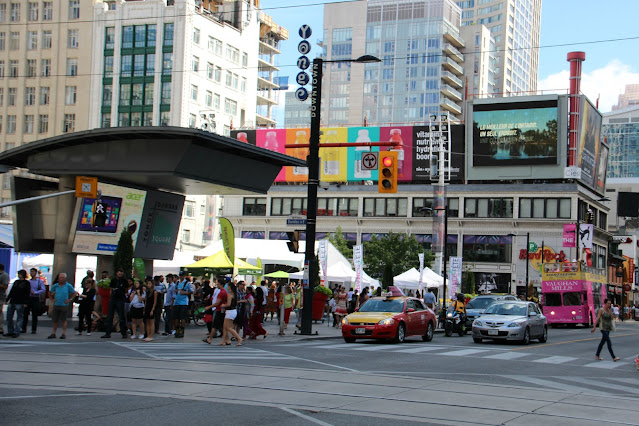
This is how I knew it looking. And no I don't think I was ever in it.


Then Shoppers' moved in.

30 November 2021

Tuesday Treasures

Tom the backroads traveller hosts this weekly meme.

Toronto ON

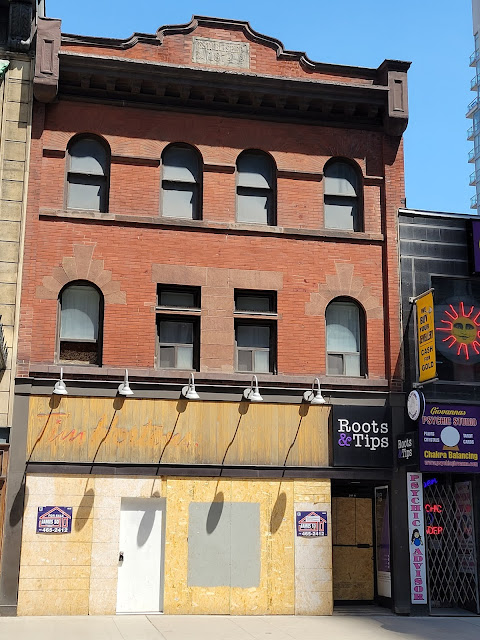
Benjamin Chapman presumably learned the watchmaking and jewellery trade from his father who had established a jewellery business in Dublin, Ireland in 1814. Benjamin worked for 16 years as a jeweller in Belfast before immigrating to Canada in 1864. Ten years later he established his own business at 261 Yonge street in Toronto.

Photo taken May 2021 - not sure what the city plans to do with it.


B. Chapman’s shop offered imported clocks and jewellery from England and Germany. In January, 1890 The Trader & Canadian Jeweller reported that his store had recently installed the “new Edison incandescent electric lighting”, which “shows off their handsome goods to great advantage.”

William James Chapman (1911 – 1999) great grandson of Benjamin, was the last owner of the family business that remained in operation until c, 1983. In 1979 the original building was given heritage status and housed a Tim Horton’s on the main floor until recently.

ONTARIO HERITAGE ACT
In the block between Shuter Street and Dundas Square, the George Pears Stores (1891) at 229 Yonge Street , John Northway Company Building (1928) at 236-242 Yonge Street, Art Metropole Building (1911) at 241 Yonge Street, John William Drummond Store (1868) at 253 Yonge Street, Chapman Brothers Jewellery (pre-1910) at 261 Yonge Street, and Childs Restaurant and Offices (1918) at 279-283 Yonge Street are listed on the City of Toronto Inventory of Heritage Properties. The Pantages Theatre (1920) at 263 Yonge Street is a city-wide landmark that is designated under the Ontario Heritage Act. 

18 February 2020

Tuesday Treasures Around the World

Tom the backroads traveller hosts this weekly meme.
Travel Tuesday
Our World Tuesday
Image-in-ing
My Corner of the World


Toronto ON

As I finish this post, which took a lot of research (note to self, please label/tag photos!) I realized I really enjoyed writing it and will continue with more posts about the University. You could spend days visiting the campus!

We're going to do some wandering around the University of Toronto landmarks this week. The campus is huge - 180 acres!

The University of Toronto (U of T or UToronto) is a public research university  located on the grounds that surround Queen's Park. It was founded by royal charter in 1827 as King's College, the first institution of higher learning in the colony of Upper Canada. Originally controlled by the Church of England, the university assumed its present name in 1850 upon becoming a secular institution. As a collegiate university, it comprises eleven colleges each with substantial autonomy on financial and institutional affairs and significant differences in character and history. 


Maud Leonora Menten (March 20, 1879 – July 17, 1960) was a Canadian bio-medical and medical researcher who made significant contributions to enzyme kinetics and histochemistry. She is primarily known for her work with Leonor Michaelis on enzyme kinetics and co-authored Michaelis–Menten equation in 1913.
Maud Menten was born in Port Lambton, Ontario and studied medicine at the University of Toronto (B.A. 1904, M.B. 1907, M.D. 1911, Ph.D., 1916). She was among the first women in Canada to earn a medical doctorate. She completed her thesis work at University of Chicago. At that time women were not allowed to do research in Canada, so she decided to do research in other countries such as the United States and Germany.


Sir Frederick Grant Banting KBE MC FRS FRSC (November 14, 1891 – February 21, 1941) was a Canadian medical scientist, physician, painter, and Nobel laureate noted as the co-discoverer of insulin and its therapeutic potential.

In 1923 Banting and John James Rickard Macleod received the Nobel Prize in Medicine. Banting shared the honours and award money with his colleague, Dr. Charles Best. As of November 2018, Banting, who received the Nobel Prize at age 32, remains the youngest Nobel laureate in the area of Physiology/Medicine. In 1923 the Government of Canada granted Banting a lifetime annuity to continue his work. In 1934 he was knighted by King George V.


It's not only historical plaques scattered around. There are plenty of sculptures.

Henry Norman Bethune (March 3, 1890 – November 12, 1939) was a Canadian physician and medical innovator. Bethune came to international prominence first for his service as a frontline surgeon supporting the Republican faction during the Spanish Civil War. While Bethune was the man responsible for developing a mobile blood-transfusion service for frontline operations in the Spanish Civil War, he himself died of blood poisoning.

.


But it was his service with the Communist Eighth Route Army during the Second Sino-Japanese War that would earn him enduring acclaim. Dr. Bethune effectively brought modern medicine to rural China and often treated sick villagers as much as wounded soldiers. His selfless commitment made a profound impression on the Chinese people, especially CPC's leader, Mao Zedong. Mao wrote a eulogy to him, which was memorized by generations of Chinese people. Bethune is credited for saving millions of Chinese soldiers and civilians during the Second-Sino Japanese War, and is known worldwide as one of the most influential doctors of all time.


There are historical buildings as well.

When Victoria College federated with the University of Toronto in 1892, only 14 of its 226 students were women. 


But their numbers quickly grew, and within the next decade 63 women earned degrees while attending Victoria. However, the young ladies had trouble finding suitable places to live, so a group of prominent, public-spirited women formed an association to build Canada’s first residence for female university students. Annesley Hall opened in October 1903 with 47 residents.

.


The Toronto Magnetic and Meteorological Observatory is a historical observatory located on the grounds.  The original building was constructed in 1840 as part of a worldwide research project run by Edward Sabine to determine the cause of fluctuations in magnetic declination. Measurements from the Toronto site demonstrated that sunspots were responsible for this effect on Earth's magnetic field. When this project concluded in 1853, the observatory was greatly expanded by the Canadian government and served as the country's primary meteorological station and official timekeeper for over fifty years. The observatory is considered the birthplace of Canadian astronomy.

It is now the Student Union.


By the 1890s, the observatory had become crowded by the rapidly growing university. Electrification of the tramways along College Street just to the south, and the large quantities of metal used in the modern buildings surrounding the site threw off the instruments.

By 1907, new university buildings completely surrounded the observatory; dust from the construction clogged meteorological instruments, and at night electric lighting made astronomical work impossible. The Meteorological Office decided to abandon the site and move to a new building at the north end of campus at 315 Bloor Street West, trading the original Observatory to the University in exchange for the new parcel of land.

The university assumed ownership of the now-disused observatory building and was originally going to abandon it. Louis Beaufort Stewart, a lecturer in the Faculty of Applied Science and Engineering, campaigned for it to be saved for the Department of Surveying and Geodesy. He eventually arranged for the building to be re-constructed on a more suitable site. Demolition work was carried out in 1907: the stones were simply left in place over the winter, and were used the following year to construct a re-arranged building just east of the main University College building (south of Hart House).


Sir John Henry Lefroy, a pioneer in the study of terrestrial magnetism served as director of the magnetic observatory from 1842 to 1853; In 1960, the Ontario Heritage Foundation, Ministry of Citizenship and Culture erected a Provincial Military Plaque in his honour on the University of Toronto campus.


More artifacts of the Toronto Magnetic and Meteorological Observatory, lie on a patch of grass off King’s College Road in the middle of the University of Toronto: a transit pillar used as part of the effort to capture of the 1883 transit of Venus, a line in concrete marking an actual meridian of Toronto, the device that set Toronto time.


Convocation Hall


In the latter half of the 19th century, the university began to see the need for a considerably larger ceremonial auditorium beyond the confines of University College, made more apparent by a fire that damaged much of the college in 1890. The construction of Convocation Hall was mainly financed by $50,000 raised by the University of Toronto Alumni Association and matching funds provided by Ontario government. The cornerstone was laid in 1904 and the construction completed three years later at almost twice the originally estimated cost.


Major additions and expansions to the building occurred in 1912 when a large pipe organ was installed in the auditorium, and in 1947 with an alteration and addition to the examination hall. The building would not become equipped with air conditioning until 1997. In 2006, a major restoration and refurbishment was undertaken by E.R.A Architects with funding from the alumni association. Work entailed refurbishing seats, restoration of grandeur of the circular foyer including decorative finishes, historical millwork, lighting installations, installing accessible washrooms and a fresh coat of paint, and restoration of the historic pipe organ—the fifth largest in Toronto. The next year, Convocation Hall celebrated its centennial.

Over the years, Convocation Hall has served as the venue for major events and performances. Songs on Premiata Forneria Marconi's album Live in USA were recorded at the hall in 1974. Bob Marley & The Wailers performed two shows of the Rastaman Vibration Tour there in 1976. Other popular musical performances during the 1960s and 1970s included appearances by Frank Zappa, Van Morrison, Mahavishnu Orchestra and Captain Beefheart.  The building hosted a recording of musician Hayden's live album, titled simply Live at Convocation Hall, in 2002. In 2007, former Vice President of the United States Al Gore delivered a public lecture on climate change at Convocation Hall and presented his documentary film, An Inconvenient Truth. 
I will finish with this plaque outside Hart House.


In October and November, 1969, activist history was made with the formation of the University of Toronto Homophile Association. This was the first group in Ontario to rally around lesbian and gay rights, and one of the first in Canada to be shaped by the new wave of sexual liberation politics.

Forty-two years later, in the late afternoon of November 2nd, 2011, this remarkable event was commemorated by the installation of a provincial plaque at University College, where UTHA’s first campus meeting was held. The plaque itself was then placed on the east side of the college (facing the Student Union building and Hart House).

26 June 2018

Liberty Village - First Glance

June 2018 - Toronto ON


We chose Liberty Village to scout out this week. We haven't really been around this part of the city but we will definitely be back as we only covered it partially\


On King St. the Palace Arms built in 1890, is not likely to remain an affordable refuge for poor men to live. 

The price: $14-million. The Palace Arms went up for sale last spring, when owner Bernie Tishman decided he’d had enough of the hotel game.

“My family and I have been here for 53 years,” he says. “I think it’s time to retire.”

The Palace has been around, in some form, since 1871. In 1890, Mary Ann White upgraded from the wood-framed inn her late husband George built to the playful Romanesque Revival structure that still stands today. Two wings were added in 1897. Blue-collar workers from factories to the southwest – since converted into lofts and office space – used to stop by the in-house tavern. But now the Palace seems out of place, the peeling, pale-pink paint clashing against the modern glass and steel skyline of Liberty Village.


In the 1850s, both the Toronto, Grey and Bruce Railway and the Great Western Railway laid tracks across the community, cutting it off from rest of the city and altering plans to develop the area for residential purposes. 


This railway underpass is one of the oldest in the City of Toronto. Rail lines were first built through this area in the 1850s, connecting Toronto to the upper Great Lakes and points in-between. By the 1880s, multiple tracks had been constructed to carry passengers and freight to destinations such as London and Chicago and, eventually, to the edges of the continent. Rail traffic was busy enough to cause lengthy stops and dangerous crossings for pedestrians and horse-drawn vehicles travelling between the City of Toronto and the Town of Parkdale. Designed by Charles Sproatt, a City of Toronto engineer, this underpass succeeded in solving the traffic problem, and was an important structure in the development of Toronto's rail and road system.


The area's proximity to the railway tracks led to its growth as an industrial area. In 1884, John Inglis and Company opened a factory to manufacture heavy machinery, boilers, and later, electrical appliances. Inglis' success led to its expansion onto Central Prison lands. In 1891, Massey-Harris (later Massey Ferguson) built a factory to produce agricultural implements. Other companies which established in the late 19th century included Toronto Carpet Manufacturing, St. David’s Wine, and Ontario Wind Engine and Pump.


This office building, constructed in 1883, is the only surviving structure from the Massey-Harris manufacturing complex. Designed by notable Toronto architect E.J. Lennox, the building combines elements of the Queen Anne Revival style (arches, coloured glass, and bay windows) with Classical features (the cornice and pediment). The Massey Manufacturing Company was begun by Daniel Massey in 1847 and merged with rival A. Harris, Son and Company in 1891.

Massey-Harris became the largest producer and exporter of agricultural equipment in the British Empire. Once an employer of 9,000 people, the Toronto plant lined the south side of King Street West between Strachan Avenue and Sudbury Street.

In the decades following the Second World War, the company faced new competition, sales declined, and in 1982, the plant closed. The property was subdivided and sold. The former Massey-Harris office building, designated under the Ontario Heritage Act, was converted into condominiums in 2003.


Instead, Liberty Village became home to several institutions, including the Toronto Central Prison, opened in 1873, and the Andrew Mercer Reformatory for Women (on the site of today’s Lamport Stadium), opened in 1878 for women convicted of "vagrancy", "incorrigibility", or "sexual precociousness." "Liberty Street", for which Liberty Village is named, was the first street both male and female convicts would walk once freed.

Provincial Secretary William John Hanna forced the closure of Central Prison in 1915, and all its buildings were demolished except for the paint shop and chapel.

The chapel, though, has remained vacant for years, an anomaly considering how rapidly the area has gentrified—other nearby historic buildings have been renovated into residences, offices, gyms and cafĂ©s.


The prison’s paint shop, later claimed by A.R. Williams Machinery and now home to the Live in Liberty condo presentation centre also still stands.


Industry continued to flourish during the early 20th century due to the area's excellent railway access and many spur lines, as well as a plentiful labour supply from nearby Parkdale. New companies included Brunswick-Balke-Collender (manufacturer of billiard tables and bowling alleys), Irwin Toy, Canada Metal, Simmons Bedding, Hinde and Dauch Paper, and Sunbeam Incandescent Lamp (later Canadian General Electric).


Brunswick ghost sign.


The Barrymore Building, a former factory in Liberty Village, is loft-lover heaven with its prerequisite soaring ceiling, exposed fixtures, red-brick walls, hardwood floors and reams of natural light. The space is a rambling 20,215 square feet, evenly split between stock and retail space. And still, it hardly seems enough to contain the scores of on-trend design - both sensible and fanciful - throughout.


The Barrymore Building at 109 Atlantic Avenue was completed in 1912 for the firm of Gowans, Kent & Company, manufacturers of china and glassware. Throughout its existence the building has accommodated multiple tenants, including such original occupants as hardware merchant Rice, Lewis & Son, and the Page Wire Fence Company. It later housed lingerie maker J. Henry Peters Company and acted as a wool storage depot. For over fifty years, the Barrymore Furniture Company owned and occupied the building as its factory and showroom.
Originally, the Barrymore Building sat within a triangle made up of the Provincial Lunatic Asylum to the northeast on Queen Street, the Central Prison to the southeast on Strachan Avenue, and the Mercer Reformatory to the west on King Street West. It was part of a neighbourhood that grew up in the latter half of the 1800s as an area of warehousing and light industry related to the nearby Canadian Pacific Railway and Grand Trunk Railway lines. Until 1909, Hanna Avenue was called Pacific Avenue in reference to the railways.

Architecturally, the Barrymore Building is an example of early 20th-century industrial design, consisting of a load-bearing exterior brick envelope and an interior timber structure. Its repetitive window pattern and simple, shallow-arched window construction are typical of this style and era, and of much of the Liberty Street neighbourhood in which it is located.


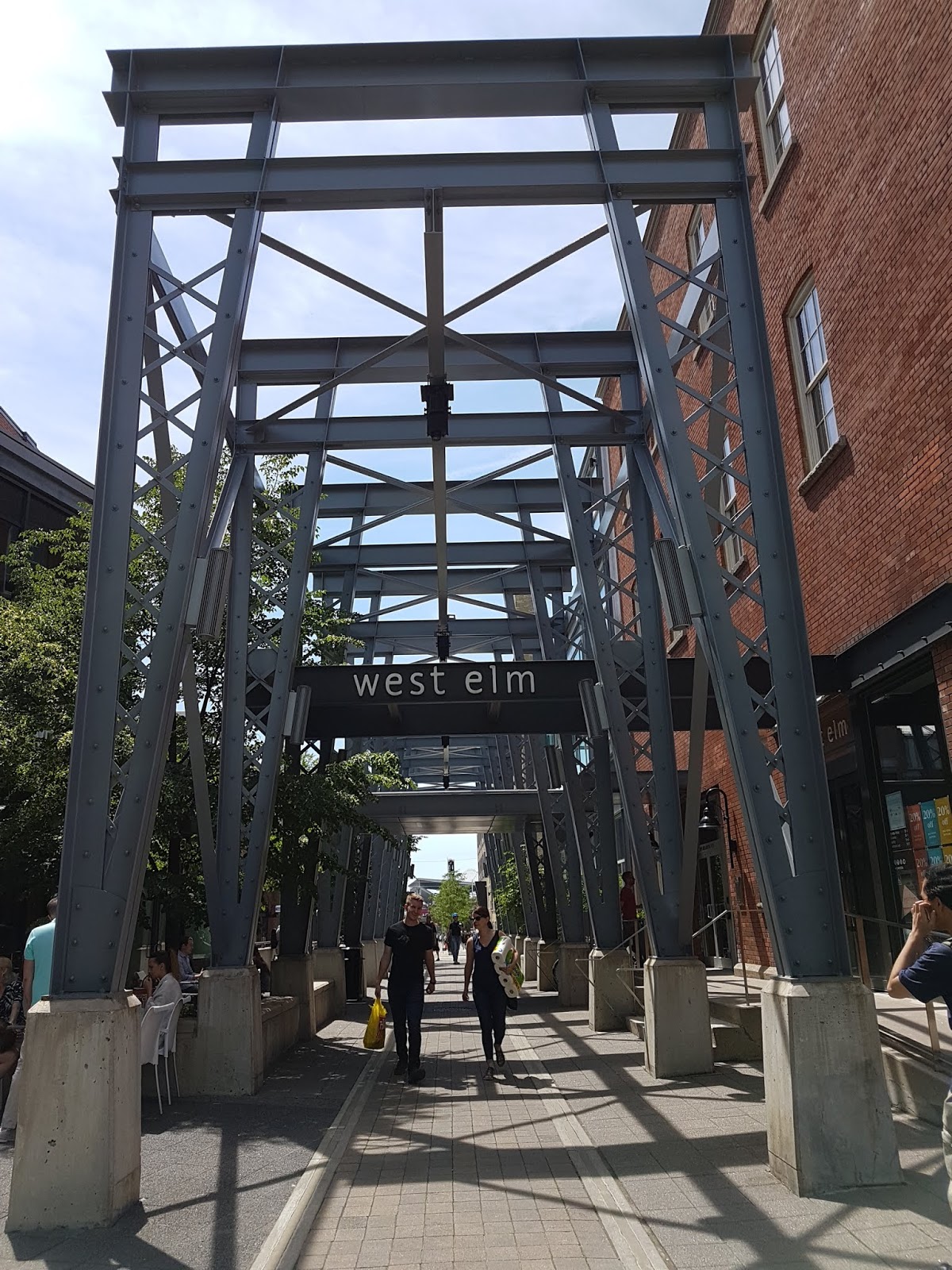
One of the cool industrial structures of Liberty Village is here along Hanna Avenue near West Elm and Mildred’s Temple Kitchen.


Known by the community as the “Castle”, this building was erected in 1912 by the E.W. Gillett Company for the production of Magic Baking Power, Royal Yeast Cakes and perfumed lye. Built in the medieval revival design, it is strikingly similar to another famous Toronto landmark, Casa Loma.


During the late 1970s and early 1980s, manufacturing operations within Liberty Village began to decline due to a shift from rail to road shipping, the need for larger manufacturing facilities, and lower manufacturing costs in suburban or offshore locations. In 1990, the Toronto Carpet Manufacturing plant on Liberty Street shut down, and the Inglis plant (owned by Whirlpool since 1985) ceased operations in 1991. The Inglis factory and Massey-Harris factory (with the exception of 947 King St. West) were demolished.


All gussied up!


For this sculpture, Francisco Gazitua chose to create an object that refers to something natural, in stark contrast to my other project in Liberty Village. Perpetual Motion refers to the area's industrial past, whereas this, Split Rock Gap, refers to the geological and natural history of Canada.


Perpetual Motion" by Chilean artist Francisco Gazitua is a prominent landmark in the neighbourhood. "I spent countless hours researching the history of the Liberty Village neighbourhood and its industrial heritage, specifically the manufacturing of washing machines," said Mr. Gazitua, "The references to water wheels and mechanical components are evident and look back to a time when this area was bustling with industry."


Swiss-born, New York-based artist Olaf Breuning’s Guardians


Sunday Oct 18 Budapest

  Itinerary Oct 12 -13 Toronto - Copenhagen - Vienna Oct 13 - Vienna Oct 14 - Vienna Oct 15 - Vienna Oct 16 - Vienna to Budapest by train Oc...