Showing posts with label Banting. Show all posts

08 August 2022

Canadian Artist of the Day


Mining Town, Northern Ontario, Cobalt
Sir Frederick Banting 1932


Sir Frederick Grant Banting KBE MC FRS FRSC (November 14, 1891 – February 21, 1941) was a Canadian medical scientist, physician, painter, and Nobel laureate noted as the co-discoverer of insulin and its therapeutic potential.

In late 1925, Fred struck up a friendship with A.Y. Jackson of ‘Group of Seven’ fame and also joined the Hart House Sketch Club, University of Toronto.

In 1927, Fred accompanied Jackson on at least 2 sketching trips; one on the South shore of the St. Lawrence and one aboard the Canadian Navy ice-breaker, ‘Boethic’ for a 6 week tour of various RCMP posts in the Arctic. The pair undertook many other such journeys in the following decade.

In 2 decades, Fred produced hundreds of sketches and oil paintings. The exact number is not known but an exhibit of his work held at Hart House, University of Toronto, in 1943, included 241 items; mostly paintings on birch panels (8.5” x 10.5”) but some larger works on canvas (21” x 36”).


16 June 2022

Day 3 London ON

 Tuesday June 2022 - London ON

Day 3
Murals - Old East Village

We checked out of the hotel and took the car to breakfast on Talbot St. just down from the market. 


Old East Village - I would have liked to explore this part of town that they are trying to regentrify.
If you look closely, some of Old East Village’s most iconic artworks are actually mosaics made up of thousands of brightly coloured ceramic pieces. The following ceramic mosaics can be seen in OEV: The Canada 150 Mosaic on the side of London Clay Art Centre, Wayfinding Mosaics at Marshall Street and Elizabeth Street and Gateway Mosaics on several concrete barriers around the neighbourhood. Known as legacy pieces, these large-scale, longstanding works of art will represent Old East Village for years to come.
This is at Marshall St.


Under the stewardship of Diabetes Canada, Banting House National Historic Site of Canada creates public awareness and understanding of the national historic significance of Sir Frederick Banting and preserves the commemorative integrity of Banting House, the birthplace of insulin, for the benefit of the people of Canada.


The museum celebrates not only a great Canadian discovery, but the life and career of Sir Frederick Grant Banting (1891-1941). Come celebrate the most important Canadian medical discovery of the twentieth century and experience the life of the man you thought you knew.
Banting lived at the house in London for ten months, beginning in June, 1920. He attempted a private medical practice and when it was unsuccessful, he began working at the University of Western Ontario; his research for a lecture there was what inspired his 25 word idea that provided the key to discovering insulin, and prevented the certain death of those affected by diabetes. Banting returned to the University of Toronto to begin his research on insulin in the spring of 1921.


Adjacent to the museum is Sir Frederick G. Banting Square, a garden with several information plaques, and three main attractions. Two of the attractions, a full-sized sculpture of Banting writing his life-altering idea down, and the Flame of Hope, were unveiled by Her Majesty Queen Elizabeth The Queen Mother. The Flame of Hope, symbolizing the hope for a final cure for diabetes, was kindled by Her Majesty during her visit. The third attraction is the globe sculpture, which was added more recently in 2010. It represents Canada's gift to the world, and embraces Banting House's visitors from abroad, with the names of every country listed on it.


One of the Gateway mosaics mentioned above.


We had spotted the wood carvings when we arrived in London but didn't stop. We left the same way, however the sun was high in the sky and it was impossible to capture them as we drove. This would be a great walking tour.

The Tree Trunk Tour is a co-operative partnership involving Tourism London, the City of London, STIHL Canada and most recently, the Hamilton Road Business Association. The brainchild of the Woodfield Community Association, the first five carvings were completed with community support and fundraising activities in the Woodfield Community Association.

Recognizing the 'walking tour' potential of tree carvings as public art, Tourism London became involved and with the support of STIHL Canada and the City of London, developed tree carvings within the Woodfield Community Association boundaries. Recently, the Tree Trunk Tour has been expanded along Hamilton Road with the addition of fifteen carvings.


Time to head back to Toronto but we made one more stop. On the way here I had seen an Attractions sign on the highway at Brantford for Whistling Gardens. I had never heard of this and I am an avid garden visitor. 
Whistling Gardens is one of Ontario’s premier horticultural gardens. Since 2012, we have garnered regional, provincial, national and international awards and are home to North America’s largest peony collection, North America’s largest conifer collection and one of Canada’s largest computer run fountain shows. Stroll and explore over 20 acres of gardens displaying over 4,500 different plants including the rarest tree in the world; the Baishan Fir.


Well, it is peony season...


The Fountains
The water theatre at Whistling Gardens was inspired by Andre Le Notre’s 1634 design at the Palace of Versailles. It has over 100 water jets on 3 – 90 foot staircases and the stage floor.
Music is specially written for the fountain program. Owner, Darren Heimbecker works with state-of-the-art digital technology in his home studio to do most of the creative writing, editing, mixing and mastering. The latest in computer technology runs the fountain program.
Whistling Gardens incorporated Canada’s first computerized fountain pumps into its existing program in the fall of 2020. They are directly controlled from a computer without piping of any kind. Whistling Gardens owner Darren Heimbecker composes the music and choreographs the fountains’ shows.


18 February 2020

Tuesday Treasures Around the World

Tom the backroads traveller hosts this weekly meme.
Travel Tuesday
Our World Tuesday
Image-in-ing
My Corner of the World


Toronto ON

As I finish this post, which took a lot of research (note to self, please label/tag photos!) I realized I really enjoyed writing it and will continue with more posts about the University. You could spend days visiting the campus!

We're going to do some wandering around the University of Toronto landmarks this week. The campus is huge - 180 acres!

The University of Toronto (U of T or UToronto) is a public research university  located on the grounds that surround Queen's Park. It was founded by royal charter in 1827 as King's College, the first institution of higher learning in the colony of Upper Canada. Originally controlled by the Church of England, the university assumed its present name in 1850 upon becoming a secular institution. As a collegiate university, it comprises eleven colleges each with substantial autonomy on financial and institutional affairs and significant differences in character and history. 


Maud Leonora Menten (March 20, 1879 – July 17, 1960) was a Canadian bio-medical and medical researcher who made significant contributions to enzyme kinetics and histochemistry. She is primarily known for her work with Leonor Michaelis on enzyme kinetics and co-authored Michaelis–Menten equation in 1913.
Maud Menten was born in Port Lambton, Ontario and studied medicine at the University of Toronto (B.A. 1904, M.B. 1907, M.D. 1911, Ph.D., 1916). She was among the first women in Canada to earn a medical doctorate. She completed her thesis work at University of Chicago. At that time women were not allowed to do research in Canada, so she decided to do research in other countries such as the United States and Germany.


Sir Frederick Grant Banting KBE MC FRS FRSC (November 14, 1891 – February 21, 1941) was a Canadian medical scientist, physician, painter, and Nobel laureate noted as the co-discoverer of insulin and its therapeutic potential.

In 1923 Banting and John James Rickard Macleod received the Nobel Prize in Medicine. Banting shared the honours and award money with his colleague, Dr. Charles Best. As of November 2018, Banting, who received the Nobel Prize at age 32, remains the youngest Nobel laureate in the area of Physiology/Medicine. In 1923 the Government of Canada granted Banting a lifetime annuity to continue his work. In 1934 he was knighted by King George V.


It's not only historical plaques scattered around. There are plenty of sculptures.

Henry Norman Bethune (March 3, 1890 – November 12, 1939) was a Canadian physician and medical innovator. Bethune came to international prominence first for his service as a frontline surgeon supporting the Republican faction during the Spanish Civil War. While Bethune was the man responsible for developing a mobile blood-transfusion service for frontline operations in the Spanish Civil War, he himself died of blood poisoning.

.


But it was his service with the Communist Eighth Route Army during the Second Sino-Japanese War that would earn him enduring acclaim. Dr. Bethune effectively brought modern medicine to rural China and often treated sick villagers as much as wounded soldiers. His selfless commitment made a profound impression on the Chinese people, especially CPC's leader, Mao Zedong. Mao wrote a eulogy to him, which was memorized by generations of Chinese people. Bethune is credited for saving millions of Chinese soldiers and civilians during the Second-Sino Japanese War, and is known worldwide as one of the most influential doctors of all time.


There are historical buildings as well.

When Victoria College federated with the University of Toronto in 1892, only 14 of its 226 students were women. 


But their numbers quickly grew, and within the next decade 63 women earned degrees while attending Victoria. However, the young ladies had trouble finding suitable places to live, so a group of prominent, public-spirited women formed an association to build Canada’s first residence for female university students. Annesley Hall opened in October 1903 with 47 residents.

.


The Toronto Magnetic and Meteorological Observatory is a historical observatory located on the grounds.  The original building was constructed in 1840 as part of a worldwide research project run by Edward Sabine to determine the cause of fluctuations in magnetic declination. Measurements from the Toronto site demonstrated that sunspots were responsible for this effect on Earth's magnetic field. When this project concluded in 1853, the observatory was greatly expanded by the Canadian government and served as the country's primary meteorological station and official timekeeper for over fifty years. The observatory is considered the birthplace of Canadian astronomy.

It is now the Student Union.


By the 1890s, the observatory had become crowded by the rapidly growing university. Electrification of the tramways along College Street just to the south, and the large quantities of metal used in the modern buildings surrounding the site threw off the instruments.

By 1907, new university buildings completely surrounded the observatory; dust from the construction clogged meteorological instruments, and at night electric lighting made astronomical work impossible. The Meteorological Office decided to abandon the site and move to a new building at the north end of campus at 315 Bloor Street West, trading the original Observatory to the University in exchange for the new parcel of land.

The university assumed ownership of the now-disused observatory building and was originally going to abandon it. Louis Beaufort Stewart, a lecturer in the Faculty of Applied Science and Engineering, campaigned for it to be saved for the Department of Surveying and Geodesy. He eventually arranged for the building to be re-constructed on a more suitable site. Demolition work was carried out in 1907: the stones were simply left in place over the winter, and were used the following year to construct a re-arranged building just east of the main University College building (south of Hart House).


Sir John Henry Lefroy, a pioneer in the study of terrestrial magnetism served as director of the magnetic observatory from 1842 to 1853; In 1960, the Ontario Heritage Foundation, Ministry of Citizenship and Culture erected a Provincial Military Plaque in his honour on the University of Toronto campus.


More artifacts of the Toronto Magnetic and Meteorological Observatory, lie on a patch of grass off King’s College Road in the middle of the University of Toronto: a transit pillar used as part of the effort to capture of the 1883 transit of Venus, a line in concrete marking an actual meridian of Toronto, the device that set Toronto time.


Convocation Hall


In the latter half of the 19th century, the university began to see the need for a considerably larger ceremonial auditorium beyond the confines of University College, made more apparent by a fire that damaged much of the college in 1890. The construction of Convocation Hall was mainly financed by $50,000 raised by the University of Toronto Alumni Association and matching funds provided by Ontario government. The cornerstone was laid in 1904 and the construction completed three years later at almost twice the originally estimated cost.


Major additions and expansions to the building occurred in 1912 when a large pipe organ was installed in the auditorium, and in 1947 with an alteration and addition to the examination hall. The building would not become equipped with air conditioning until 1997. In 2006, a major restoration and refurbishment was undertaken by E.R.A Architects with funding from the alumni association. Work entailed refurbishing seats, restoration of grandeur of the circular foyer including decorative finishes, historical millwork, lighting installations, installing accessible washrooms and a fresh coat of paint, and restoration of the historic pipe organ—the fifth largest in Toronto. The next year, Convocation Hall celebrated its centennial.

Over the years, Convocation Hall has served as the venue for major events and performances. Songs on Premiata Forneria Marconi's album Live in USA were recorded at the hall in 1974. Bob Marley & The Wailers performed two shows of the Rastaman Vibration Tour there in 1976. Other popular musical performances during the 1960s and 1970s included appearances by Frank Zappa, Van Morrison, Mahavishnu Orchestra and Captain Beefheart.  The building hosted a recording of musician Hayden's live album, titled simply Live at Convocation Hall, in 2002. In 2007, former Vice President of the United States Al Gore delivered a public lecture on climate change at Convocation Hall and presented his documentary film, An Inconvenient Truth. 
I will finish with this plaque outside Hart House.


In October and November, 1969, activist history was made with the formation of the University of Toronto Homophile Association. This was the first group in Ontario to rally around lesbian and gay rights, and one of the first in Canada to be shaped by the new wave of sexual liberation politics.

Forty-two years later, in the late afternoon of November 2nd, 2011, this remarkable event was commemorated by the installation of a provincial plaque at University College, where UTHA’s first campus meeting was held. The plaque itself was then placed on the east side of the college (facing the Student Union building and Hart House).


24 May 2015

Soldiers' Tower Toronto


May 2015 - Toronto ON


We went to Doors Open on the weekend and happened upon The Soldiers' Tower. It was open to the public.
I found most of the information about the tower at the University of Toronto Alumni Association.


Soldiers' Tower is a bell and clock tower at the University of Toronto that commemorates members of the university who served in the World Wars. Designed by architects Henry Sproatt and Ernest Ross Rolph, the Gothic Revival tower stands at 143 feet (43.6 m) tall and houses a carillon of 51 bells. The University of Toronto is the only Canadian university with a functioning carillon.


After the Great War, university alumni raised $397,141 to erect the tower as a war memorial. Construction was completed in 1924 at a cost of $252,500, with the surplus funds endowed for scholarships in perpetuity. The names of those lost in the Great War (1914–18) are etched on a sheltered stone screen adjacent to the tower's base, while the inner walls of the tower's stone archway are inscribed with the names of those lost in the Second World War (1939–45).


As you climb the rather narrow staircase there are 8 small stained-glass windows that depict men and women of the armed forces at wartime.


The tower features a dramatic 12-panel stained-glass window that is partly a visual interpretation of John McCrae's "In Flanders Fields". Every school child of my generation memorized this poem and can probably still recite it.


This stained glass is magnificent.


Details of the panels.


A museum within the tower showcases a collection of medals, memorial books, portraits, photographs, flags and miscellaneous memorabilia from the period.

......


On the right:
Sir Frederick Banting
Banting was thirty-one in 1923 when he received the Nobel Prize for Medicine along with J. J. R. Macleod, Charles Best, and J. B. Collip. After service as a doctor in Flanders in The Great War, he tried general practice in London, Ontario, without much satisfaction; however, he was intrigued by the relationship between the pancreas and diabetes. His consequent experiments at the University of Toronto led to the discovery of insulin and an effective method of controlling diabetes. Fishing and painting were two outside activities he enjoyed. Some of his happiest times were on sketching trips with A. Y. Jackson. An intensely patriotic man, when the Second World War came, Banting threw himself into war work, and was on his way to England on a secret mission when he was killed in 1941 in a plane crash in Newfoundland.

On the left:
Major Fred Tilston VC
Awarded the Victoria Cross for his persistent courage and outstanding leadership, despite serious wounds, in the critical battle to clear the Hochwald Forest (Germany), March 1, 1945. With the Company reduced to one quarter strength and the enemy repeatedly counterattacking, Major Tilston moved in the open, organizing defence and inspiring his men to hold firm against great odds. He repeatedly crossed ground dominated by intense fire from enemy machine-gun posts to carry ammunition to his troops.

A graduate in Pharmacy from the University of Toronto in 1929, he entered business and became sales manager of the Bayer Company by 1936. He enlisted in 1939, went overseas in 1941, and landed in Normandy soon after D Day. After the war, he rose to become President, and CEO of Sterling Drugs Ltd. By overcoming the loss of both legs and an eye he became an inspiration to young and old.


Among the photographs on this wall is one of the SPS Junior Rugby team, winners of the Mulock Cup in 1915. Every member of this team joined up in 1916 and not all returned. It was donated by H.R. Burton,a member of the team, who drew the crosses marking those friends who did not return. “Bob” Burton, a veteran of both world wars, was Chief Traffic Engineer for the City of Toronto for many years. Among his many accomplishments was the development of this City’s traffic control computer. He died in 1997 at the age of 101.


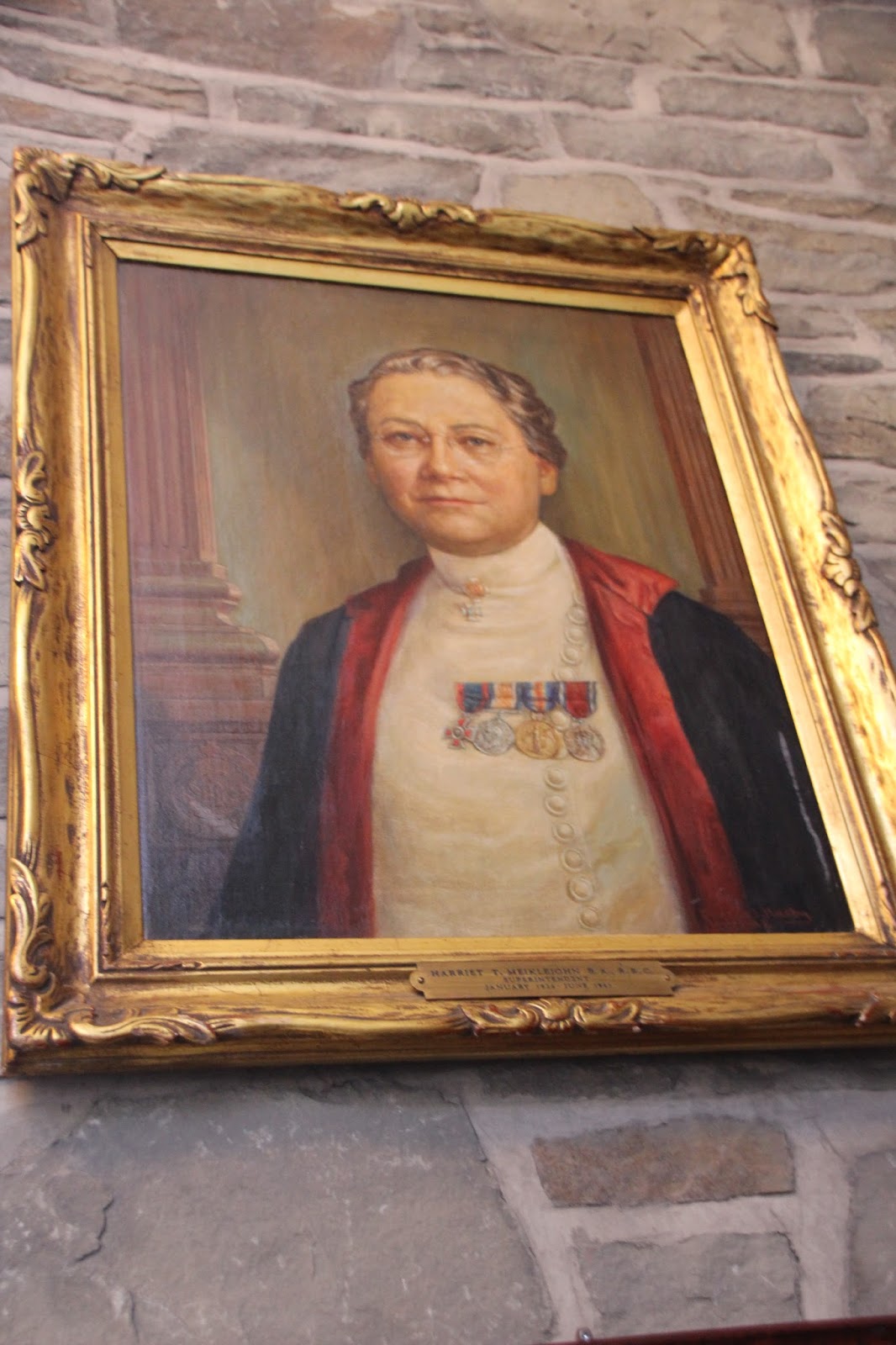
Nursing Sister Harriet Tremaine Meiklejohn


Known for her professionalism and discipline, the legendary Miss Harriet T. Meiklejohn, is frequently mentioned as an inspiration to many nurses who worked at Women's College Hospital prior to the Second World War. She imbued all of her staff with a deep pride in their vocation. When she retired, the alumni set up a scholarship in her name for postgraduate training.

After graduating from McGill University with a BA in 1903, she trained at the Presbyterian Hospital, New York, graduating in 1906, and worked for a few years in the USA. During World War I, she served overseas as a Nursing Sister. She made the trip at her own expense, and was attached to the Canadian Medical Corps in France. She was awarded the Royal Red Cross for distinguished service. She returned to Canada in 1919 and took postgraduate work in Public Health Nursing at the University of Toronto, completing the course in 1921. She was employed for a while in Public Health Nursing in both Ontario and New Brunswick. Miss Meiklejohn served as Superintendent of Women's College Hospital from 1927 to 1943.