September 2017
We headed to downtown Winnipeg because a photo at Portage and Main is on my bucket list. Why? Later...
Winnipeg murals
The University of Winnipeg’s Richardson College for the Environment and Science Complex has the Periodic Table grid on the side of the building. This building has 30 research and teaching labs, a rooftop greenhouse and also a restaurant, aptly named “Elements”.
In 1881, the city’s first HBC retail store was completed at the corner of Main Street and York Avenue. The front section was used for retail business, while the back and upper floors were used for the storage of furs and general merchandise. Additions were built from time to time for office purposes. In 1911, a large, modern, fire-proof building was erected across the street, where the General Offices of the Company, as well as the Wholesale, Land, and Fur Trade Departments were housed. This became known as Hudson’s Bay House.
By 1910, it was already evident that the heart of Winnipeg’s shopping district had relocated to Portage Avenue. HBC’s retail strategy at that time was to invest in the development of large modern department stores to service the growing population of the west. In the case of Winnipeg, this meant building a brand-new store in a brand-new location.
The location of the new store site was extremely fortunate. Not only was it directly on Portage Avenue, but it sat at the corner of Portage and the access road leading to the new provincial Legislature. The Legislature itself opened in 1920, and that same year, the Company decided to defer building until the City’s plans concerning the road access were final. On September 25, 1925, work commenced at the corner of Portage Avenue and Memorial Boulevard.
On November 18, 1926, the new store opened for business on the main, second, and third floors, while work continued on the upper floors.
Just one block north of Portage and Main, the Exchange District comprises twenty city blocks and approximately 150 heritage buildings, and it is known for its intact early 20th century collection of warehouses, financial institutions, and early terra cotta clad skyscrapers.
The Exchange District’s name originates from the Winnipeg Grain Exchange, the former centre of the grain industry in Canada, as well as other commodity exchanges which developed in Winnipeg between 1881–1918, some of which are still active today.
The Great-West Life Building, also known as the Chamber of Commerce Building, is an eight-storey steel, concrete and brick structure erected in two stages between 1909 and 1923.
Bailey's Restaurant & Lounge building has borne witness to the growth and the seasons of Winnipeg. It has stood through the violence of the 1919 General Strike and the ravages of the 1950 Red River flood waters. It has witnessed the evolution of the most famous intersection in Canada, Portage and Main, and has seen the construction of the corporate towers at the heart of Winnipeg's business district.
North Watch by Manitoba artist Ivan Eyre
.
Tree Children is another sculpture in front of the Richardson Building at the .corner of Portage and Main and was installed in 2002. It was created by Leo Mol.
Seal River Crossing
This bronze sculpture by renowned Manitoba artist and sculptor Peter Sawatzky was inspired by his many visits to Canada's North. It was there that Peter was able to observe the majestic Caribou crossing the northern tundra and navigating the fast-moving waters of the Seal River.
Seal River Crossing was commissioned in 2007 by James Richardson & Sons, Limited in celebration of their 150th Anniversary in Canadian business.
The sculpture depict seven caribou crossing the Seal River with the first three starting to climb out of the river.
We use the pedestrian underpass to get over to the Bank of Montreal at Portage and Main.
.
Bank of Montreal
This iconic building at the intersection of Portage Avenue and Main Street was built in 1913 by the American architectural firm of McKim, Mead and White, at a cost of $1,295,000. A monument in front of the building commemorates bank employees killed during the First World War.
The corner is well-known across Canada as the "crossroads of Canada", due to its relative proximity to the longitudinal centre of Canada.
We later see a sign on the Trans-Canada Highway at 96°48'35"W proclaiming it the longitudinal centre of Canada in effect, the north-south line midway between the extreme points of Canada on the east and west, including islands (including Newfoundland since 1949). This is 20 minutes west of the location given by the Atlas of Canada, however.
Portage and Main is the brunt of popular jokes referring to it as the coldest and windiest intersection in Canada. The phrase Portage and Main has come to refer to the city of Winnipeg as a whole. The long-standing cold weather legend is unproven, because there are no official temperature measurements at any street corner in Canada to confirm the coldest intersection.
The national banks have branches accessible from beneath Portage and Main.

...

Back over to the Exchange District.
Designed by Winnipeg architect J. D. Atchison, this building was one of four major banks on “Bankers’ Row” along Main Street. It was the last major office building erected during the city’s early boom period, and served as the Manitoba headquarters of the Bank of Hamilton which merged with the Bank of Commerce in 1923.
Built for James Porter and Co., a crockery and china wholesaler, this functional facility, with its showroom, office, storage and service areas, has adapted well to subsequent uses, including as the L. Galpern Candy Co.'s factory.
Short drive today so we ambled along.
As we're leaving town I spot a cool looking building. Then I saw the sign for the Royal Canadian Mint. And we decided to check it our having no idea if it was open to the public.


For the first fifty years of Canadian coinage (cents meant to circulate in the Province of Canada were first struck in 1858), the coins were struck at the Royal Mint in London, though some were struck at the private Heaton Mint in Birmingham, England. As Canada emerged as a nation in its own right, its need for coinage increased. As a result, a branch of the Royal Mint was authorized to be built in Ottawa in 1901 after being first proposed in 1890.
As you approach The ‘Parade of Flags’ lines the driveway leading into the Mint representing the 75 countries for which the facility has manufactured coins since it opened in 1976.
Tthe Mint’s Winnipeg facility has produced centavos for Cuba, kroner for Norway, fils for Yemen, pesos for Colombia, kroner for Iceland, baht for Thailand, and a thousand-dollar coin for Hong Kong. Other client nations include Barbados, New Zealand and Uganda.
Designed by native Manitoban Etienne Gaboury, we were told he designed it to look like a mountain as Manitoba is so flat.
He was also involved with The Forks as Site Planning Manager and Architectural Advisor, which is the bridge I showed you yesterday beside the Human Rights Museum. It also looks like a mountain.
There is a whimsical loon sitting ourside. Our one dollar coin, the loonie, is named after the bird.
The loon was not the first choice for the one dollar coin, but rather voyageurs in a canoe. The die was stolen somewhere between Ottawa where the original was created and Winnipeg, so rather than risk counterfeits the whole idea was scrapped and replaced with the loon.
Entrance was free as guided tours are in the afternoon. But we were given a quick overview by an employee and then left to roam on our own.
No photos allowed for the security and privacy of the employees and the equipment. But I did find one online.

The Mint has 365 staff with approximately 200 to 250 of those working in the high-security area of the plant, where circulation coins are produced.
The Mint produces and markets a family of high purity gold, silver, palladium and platinum Maple Leaf bullion coins, wafers and bars for the investment market as well as gold and silver granules for the jewellery industry and industrial applications. The Mint also provides Canadian and foreign customers with gold and silver processing, including refining, assaying and secure storage.
Recently, up to two billion Canadian circulation coins are struck each year at the Mint’s facility in Winnipeg. While the effigy of the reigning monarch has appeared on every Canadian coin produced by the Mint since 1908, reverse designs have changed considerably over the years. The Mint often introduces new commemorative designs which celebrate Canada’s history, culture and values.
In March 2012 the Canadian Government decided to cease the production of pennies. The final penny was minted at the RCM's plant on the morning of May 4, 2012 and ceased the distribution of them as of February 4, 2013.
Yet another stop, which included lunch, that was on today's agenda.
.
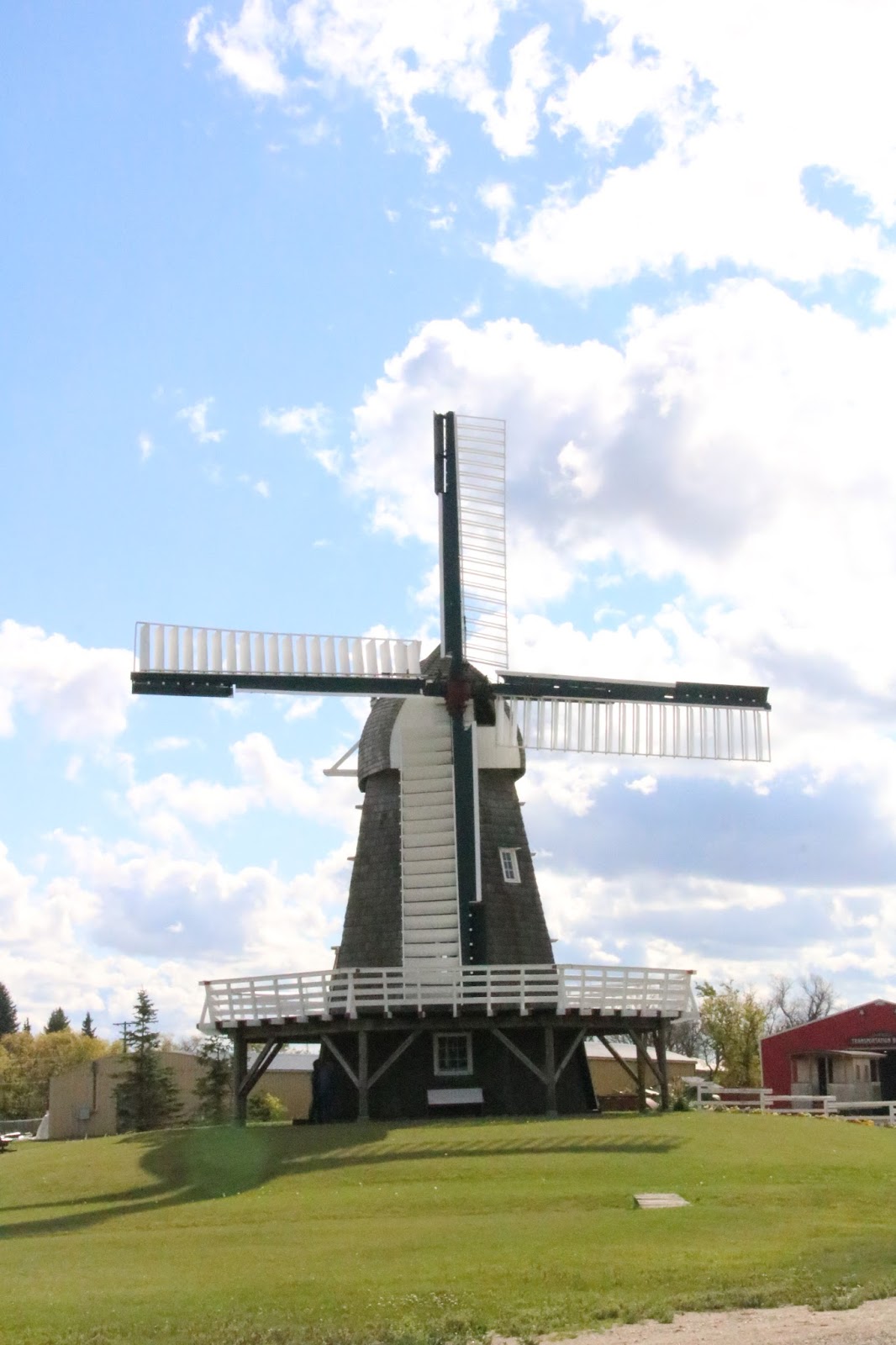
The Mennonite Heritage Village brings to life the Mennonite way of life from the 16th century to the present day.
Click here for lots more photos.The forty acre (17 hectare) site spreads out from a village street, in a pattern reminiscent of Mennonite villages found throughout Southern Manitoba at the turn of the previous century. The north side of the street illustrates the early settlement buildings while the south side shows the gradual shift to various business enterprises.
It is a good thing it is a short drive today!
We soon cross into Ontario!! It is hard to believe that it will take four nights of hotels in Ontario before we get home. We could have done it in three, but that would have meant not seeing what we want.
We spotted many inuksuit built upon the rocks along the highway.
An inuksuk (plural inuksuit) (from the Inuktitut: ᐃᓄᒃᓱᒃ, plural ᐃᓄᒃᓱᐃᑦ; alternatively inukhuk in Inuinnaqtun, iñuksuk in Iñupiaq, inussuk in Greenlandic or inukshuk in English) is a human-made stone landmark or cairn used by the Inuit, Iñupiat, Kalaallit, Yupik, and other peoples of the Arctic region of North America.
The inuksuk may have been used for navigation, as a point of reference, a marker for travel routes, fishing places, camps, hunting grounds, places of veneration, drift fences used in hunting or to mark a food cache.