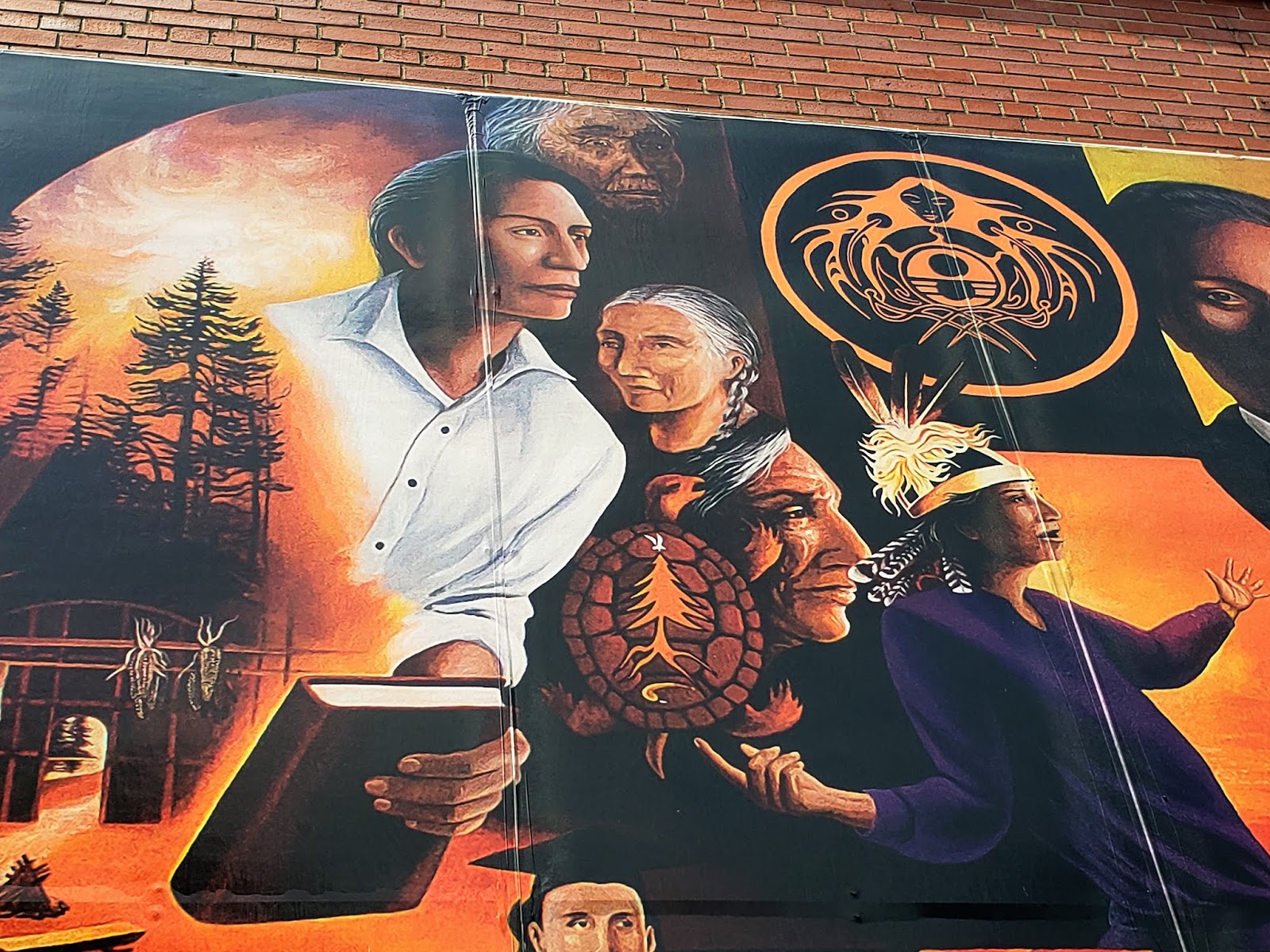
I'm linking up at Monday Mural
July 2019 - Toronto ON
I found this mural last week with my BFF, who happens to be Mohawk and from
Deseronto. This has significance in the story of Oronhyatekha, the key figure in this mural. She was telling me about him and pointing out the details as we observed the mural.
The mural is by artist Joseph Sagaj, Ojibwe from northern Ontario.


It tells a story about Oronhyatekha (10 August 1841 – 3 March 1907), ("Burning Sky" or "Burning Cloud" in the Mohawk language, also carried the baptismal name Peter Martin), was a Mohawk physician, scholar, and a unique figure in the history of British colonialism. He was the first known aboriginal Oxford scholar; a successful CEO of a multinational financial institution; a native statesman; an athlete of international standing; and an outspoken champion of the rights of women, children, and minorities. Once thought to be the first Native M.D. in Canada, a recent book on Dr. Peter Edmund Jones, an Ojibwa from New Credit, has shown Jones to have graduated few months before Dr. Oronhyatekha.While all this would be remarkable in any age, that he achieved it during the Victorian era, when racism and assimilation were commonplace, has made him a figure approaching legend in some aboriginal circles.

Upon his return to Canada, he married the great-granddaughter of Joseph Brant and they had two sons and a daughter. He completed and received his medical degree at the University of Toronto in 1867 and was one of the first Aboriginal doctors in Canada. He practiced in Frankford, Stratford and London. From 1896 he lived on Carlton Street until his death on March 3, 1907. At his death, he lay in State at Massey Hall.
Born 10 August 1841 on the Six Nations of the Grand River near Brantford, Ontario, he was the sixth son of Peter Martin and Lydia Loft (from Tyendinaga), and one of up to eighteen children. He first attended the Mohawk Institute residential school and learned the shoemaker trade.
Oronhyatekha was selected at the age of twenty by the Six Nations Iroquois Confederacy to give the welcoming address to the Prince of Wales during his visit to the New World. Legend has it that Prince Edward was sufficiently impressed that he urged the young Oronhyatekha to attend the University of Oxford, where he himself had attended, but correspondence between Oronhyatekha and the Prince's physician Henry Acland suggests it was really Acland's idea. Acland taught at Oxford and became Oronhyatekha's mentor and friend for the rest of their lives.
Returning to Canada, he married Ellen Hill or Karakwineh (meaning “moving sun”), and enrolled in the Toronto School of Medicine in 1863. He graduated with his B.M. in 1865 and his M.D. in 1866. In 1866, he also served in the Queen's Own Rifles during the Battle of Ridgeway, one of the armed conflicts of the Fenian Raids that year.
After graduation, he practiced at Frankford, Stratford, Napanee, Buffalo, NY, and London, Ontario. As his medical practice grew, he also became a figure of increasing importance in Victorian Canada. In 1871, he became a member of Canada's National Rifle Team which competed at Wimbledon, and in 1874, was elected the President of the Grand Council of Indian Chiefs, a provincial organization largely made up of Anishinabe and Iroquoian communities in southwestern Ontario.
In 1878, while living in London, he applied to become a member of the Independent Order of Foresters, a fraternal and financial institution. The Foresters' statutes explicitly limited its membership to white men and Orangemen, but Oronhyatekha was an Orangeman. By 1881 he had become Supreme Chief Ranger of Foresters, the organisation's international CEO, a position that he held for a record 26 years. In 1889, he moved to Toronto, where the IOF headquarters had relocated. During his tenure as SCR, he transformed the order into one of the wealthiest fraternal financial institutions in the Victorian world; today, it counts more than one-million members in North America and the European Union. Oronhyatekha was an active Orangeman and served as County Grand Master of Middlesex Country Orange Lodge.
You can see the International Order of Foresters medals.

He belonged to the International Order of Good Templars, several branches of the Masonic Order, the Ancient Order of United Workmen, the Knights of the Maccabees, and the Orange Order. He was the Worshipful Master of Richardson Masonic Lodge in Stouffville, Ontario in 1894.
In the 1890s, he purchased an island across from Deseronto which he renamed Foresters' Island. Here, he built a second family home, an IOF meeting and dining hall, a bandstand, the Isle Hotel and cottages for guests, and a wharf at which boats from the mainland could dock. While the hotel seems to have been open for all guests, not just IOF members, he hosted huge IOF gatherings each summer to celebrate its anniversaries.

Colour postcard of "Orphans' Home, Foresters Island near Deseronto, Ont.", published by Valentine & Sons Co. Ltd.
Ironically, the one achievement of which Oronhyatekha was most proud was the enterprise his contemporaries regarded as his only significant failure. In 1904, he created an orphanage on the Bay of Quinte, Ontario, It opened for operations in 1906, and Oronhyatekha described it as his life's crowning achievement. He did not live to see it be sold in 1908 due to his death after stopping off to visit President Theodore Roosevelt in Savannah, Georgia a year earlier.
Dr. O has a lane named for him.
The mural is located outside Miziwi Biik Aboriginal Employment and Training centre in Toronto which also has a medicinal garden.