After breakfast, transfer to the airport for your flight home. (Breakfast).
Our flight is late afternoon 5 PM. Check out is 11 AM.
So after breakfast we finalize our packing and dress for the puffin tour.
PUFFIN BOAT TOUR 10 AM 1 HR SAME MEETING SPOT AS WHALES
Meeting time: 30 minutes before tour departing time
Meeting location: The Whale Safari ticket office at Ægisgarður (the Old Reykjavík Harbour, downtown Reykjavik).
The tour takes you to one of three islands (Engey, Akurey or Lundey) known for their abundant birdlife depending on the tides and conditions. While we don’t land on the islands, the captains expertly navigate close to the shores, allowing for an up-close experience with the puffins without disturbing their nesting areas. In addition to puffins, you’ll have the chance to see other bird species, such as eider ducks, arctic terns, guillemots and cormorants.
We were surprised to be directed to a boat, so I could let go of my trepidation about it taking place on a RIB boat. It was very full, so we stayed outside on the deck.
While puffins nest near Reykjavik, getting very close to them can be tricky. Puffin watching tours from Reykjavik's old harbor take you near the puffin colonies, but access to the nesting sites is often restricted during the breeding season.
With 8 to 10 million puffins inhabiting the island, Iceland is home to more than 60% of the world’s entire Atlantic puffin population.
The breeding season for puffins in Reykjavik, Iceland, primarily occurs during the summer months, specifically from May to August. The peak time for observing puffins, including their nesting and breeding activities, is generally in June and July. During this period, puffins return to land to nest, and you can find them on small islands just a few minutes from Reykjavik, such as Akurey and Lundey, which we went to.
We probably should have brought our big cameras for better photos, but honestly, the boats don't get that close.
WHAT WE LEARNED
Thanks to their funny appearance, puffins have been nicknamed ‘sea parrots’ and ‘clowns of the sea’! Their waddling walks make them look a little comical. The Icelandic nickname of the puffins is “prófastur” which means preacher. Due to their “dressing”.
They change their color during the year. At the end of the breeding season, some of the special characteristics of their plumage are lost when they molt. Their white feathers become dark gray and their beaks also change, becoming narrower, with a tip that is bright. The birds develop their brighter colors once again during the spring. Their winter dress is, though, seldom seen by humans!
This is because puffins spend the winter – more precisely, the larger part of the year, some eight months – out at sea. They spend most of their lives resting on waves, coming ashore only to breed and raise their young, known as pufflings. Each female produces a single puffling every year.
While at sea, the birds spread out widely across the North Atlantic Ocean. Each bird has more than a square kilometer to itself, so it is very unlikely that anyone will spot a puffin on the open sea in winter.
In late spring, thousands of puffins form large colonies on coastal clifftops, coming together for the breeding season.
Puffins are monogamous. They usually mate for life and a couple can stay together for over 20 years!
To make their nests, known as burrows, they dig out a burrow in the turf or soil where they lay their single egg. Each year they return to the same burrow.
The male and female share parental responsibilities, they take it in turns incubating the egg. It takes 36-45 days for the baby “puffling” to hatch.
The chick grows rapidly, after about six weeks it is fully developed and capable of caring for itself.
Atlantic puffins have incredible skills. They can dive to depths of about 60 meters and fly at a speed of 88 km/h (24m/sec) by flapping their wings 400 times per minute!
The reason why they need to flap their wings so fast is that their bones are not hollow so they are heavier than other birds. This is also the reason why they can dive down as far as they do.
In bird terms, puffins live long lives. The oldest recorded puffin was ringed in the Westman Islands and died at the age of 38. However, the average lifespan of a puffin is 20 to 25 years.
After the tour we grabbed a quick lunch across the street, delicious fish and chips. Pricey, yikes.
Delicious, though! They also have a spot on Rainbow St.
Then we stopped for a twisted donut and coffee, the donut is $20 EACH!! We had been here on the Food Walk. At this point we just laugh at the prices.
We strolled before heading back to the hotel to change and pick up our luggage before heading to the bus stop for our pickup.
Unfortunately we both misread the instructions. We took it as a 2PM pickup and didn't notice the fine print of arriving 30-40 minutes ahead of time. This pickup takes you to the bus terminal (10 minute ride) where you transfer to a bigger bus for the 45-50 minute ride to the airport.
We walked to the nearest hotel and they called us a cab for the 45 minute ride.
Once we checked in, we went through security and headed to the Saga Lounge.
KEF airport at the gates was a zoo, so noisy and disorganized. You have to be bussed to the plane, so there isn't any seat assignment order for boarding making the process onerous.
Date24 Jun 2025
AirlineIcelandair Flight/ClassFI603 A
OriginReykjavik, Keflavik International
DestinationToronto, Lester B. Pearson International
Departing1705 Arriving1910
Estimated Time6 Hrs 5 Mins
Seats 1D, 1F
Miles 2,605
We left late, the earlier plane was late and there was an airport shortage of workers.
Once seated, in our little cocoon, we were served prosecco. We had a VERY good looking flight attendant, all smiles and very efficient.
This was a delicious meal service.
We both had this with panna cotta for dessert.
Icelandair does not have gates directly in terminal 3 at YYZ. Passengers are bussed and in this case we were bussed directly to security which would have been great except the plane is so far away it took an hour for the first piece of luggage to arrive.
So even though we landed at 7:30 it was after 8:30 and our Uber was cancelled so we had to get another one.
After breakfast at your hotel, continue your exploration of the region around Reykjavik during a full day at leisure. You can also opt for one of the optional tours available at the destination, ranging from traditional sightseeing to soft adventure activities. You can explore the vibrant Laugavegur and Rainbow Street for shopping and street art, hike up Mount Esja for stunning city views, relax at the Sky Lagoon with its geothermal waters and ocean views, and take an immersive flight over Iceland's landscapes. Overnight at your hotel in Reykjavik. (Breakfast)
We had originally decided not to make any plans for today and just play it by ear as it is our last day. However, we then split the whales and puffins boat tour. And we made a further change to our plans as we hadn't done the Golden Circle tour yesterday.
So we geared up and went to the puffin tour office for 9:30 and were pleased that they didn't mind moving our tour to tomorrow (Tuesday, our transit day). So I immediately booked The Golden Circle Direct Tour with pick up at Stop 14. However, I guess we were too late for the transfer (payable) schedule so instead we took a taxi to BSI Bus Terminal.
BSI is the main bus terminal in downtown Reykjavik, and it serves as a starting and ending point for many tours and adventures in Iceland. Most airport transfer services between Keflavik International Airport and Reykjavik arrive and depart from BSI. BSI stands for "Bifreifastod Islands," or the Automobile Station of Iceland.
We grabbed a bite to eat at the bus terminal.
Our tour was on a small bus and the driver/guide was Inga, who was excellent. It was interesting that there were no Americans on this tour, other than us, all European.
Departure time was 12:30, a passenger arrived at 12:35 and we left. The driver hadn't left the terminal when she got a call to return for a late passenger. As we waited that last passenger, said, oh, I think that call was for me, I had rang them. Passenger then called office and the dispatcher came to the door and waved us off. Laughs all around.
Inga did an amazing job giving us an overview of the geothermal energy used to provide water and heat to all homes and businesses. They even heat the streets and sidewalks of Reykjavik in winter!!!
Geothermal Heating:
Iceland's abundant geothermal resources provide a clean and cost-effective way to heat buildings.
Hot Water Supply:
Hot water, ranging from 100°C to 300°C, is extracted from the ground and piped to homes.
Direct Use:
This hot water is used directly for heating homes, eliminating the need for traditional heating systems.
Snow and Ice Removal:
The geothermal hot water is also used to heat pavements and car parks, keeping them snow-free in the winter.
Renewable Energy:
Geothermal energy is a key component of Iceland's renewable energy strategy, contributing to over a quarter of the country's electricity production and a significant portion of its total energy supply.
Sulfur Smell:
While the hot water is clean and safe, it often has a distinct sulfur smell due to the minerals in the geothermal water.
We passed some suburbs from the 50s and 60s, the roads are built around the town and the school is in the middle so that every child can walk to school.
Hveragerði, Iceland, known as the "flower town", is famous for its greenhouses that utilize geothermal energy to cultivate flowers and other produce year-round. The town's unique geothermal environment, with hot springs and steam vents, allows for the heating of greenhouses, enabling the growth of a variety of plants despite Iceland's harsh climate.
The skyr-making factory, Skyrgerðin in Hveragerði, was built in 1930 and was the first of its kind in Iceland. The unique Icelandic dairy product Skyr was the main product, but also the first yogurt in Iceland was produced there, called healthy milk. Today, Skyr is still made there the old-fashioned way, and it is used in cooking, baking, and mixed drinks at the restaurant Skyrgerðin.
In addition to vegetable and flower production, one of the largest ice cream producers in the country is in Hveragerði, the family company Kjörís, which started operations in 1969.
Icelanders say that if you see three trees it is a forest. The common joke about trees in Iceland plays on the country's reputation for having very few trees. The punchline is often: "If you're lost in an Icelandic forest, stand up." This highlights the scarcity of forests and the small stature of the trees that do exist in Iceland.
The Golden Circle in Iceland includes a geothermal power plant called Hellisheiðarvirkjun, which is the largest geothermal power plant in Iceland and the second largest in the world. It is located near the town of Hveragerði, not far from the other Golden Circle attractions like Þingvellir National Park, the Geysir geothermal area, and Gullfoss waterfall.
It was 90 minutes to our first, and the furthest stop, the Geysir Geothermal Area, home to the Strokkur geyser, which erupts every 4-8 minutes, shooting water up to 30 meters (98 ft) into the air.
We were given an hour to visit.
.
.
The valley is alive with steaming vents, bubbling hot springs, and vibrant pools, creating an otherworldly atmosphere that showcases Iceland’s volcanic power.
From the parking lot, you’ll walk along a path and first pass Little Geysir, which is as cute as it sounds. Be sure to stick to the path and obey any signs or barriers put up. The water in this area can be scalding.
Before long, you’ll reach the main attraction, Strokkur. Strokkur is an active geyser that goes off every few minutes, usually erupting 15–20 metres (49–66 ft) in the air.
It reminded me of Old Faithful in Yellowstone National Park. To answer John's question, Old Faithful Geyser typically erupts to a height of 106 to 184 feet (32 to 55 meters), according to the National Park Service. The average height is around 130-140 feet. Eruptions last between 1.5 and 5 minutes.
Old Faithful and Iceland's Geysir are both famous geysers, but they differ in their predictability and eruption characteristics. Old Faithful, known for its consistent and regular eruptions, is a cone geyser, meaning it erupts from a cone-shaped mound. These Geysirs, on the other hand, are hot water pool geysers, erupting from a pool.
This area of the Haukadalur Valley became active with geysers over a thousand years ago. It’s most famous geyser, The Great Geysir, is said to have erupted up to 170 metres (558 ft) and has given this area its name.
Now, here’s the thing about Geysir. It is straight up the geysir that ALL OTHER geysirs are named after.
Geysir itself stopped erupting in 1915, but it must have been a sight to see as it went up to 70 metres into the air, but Strokkur is much smaller, still very majestic.
Icelanders tried reviving it by throwing soap into Geysir and forcing an eruption and from time to time it erupted.
Unfortunately, Great Geysir is very unreliable. In the year 2000 after a big earthquake, it erupted non-stop for two days to a height of 120 metres.
Then, for three years afterward it erupted up to 8 times a day, but it has gone very quiet since then.
Some of the pools bubbling. Take care that this is a high-temperature geothermal area and stay within the boundaries and don't touch the water as it is boiling HOT.
.
The glacier in background. Langjökull, Iceland's second-largest glacier
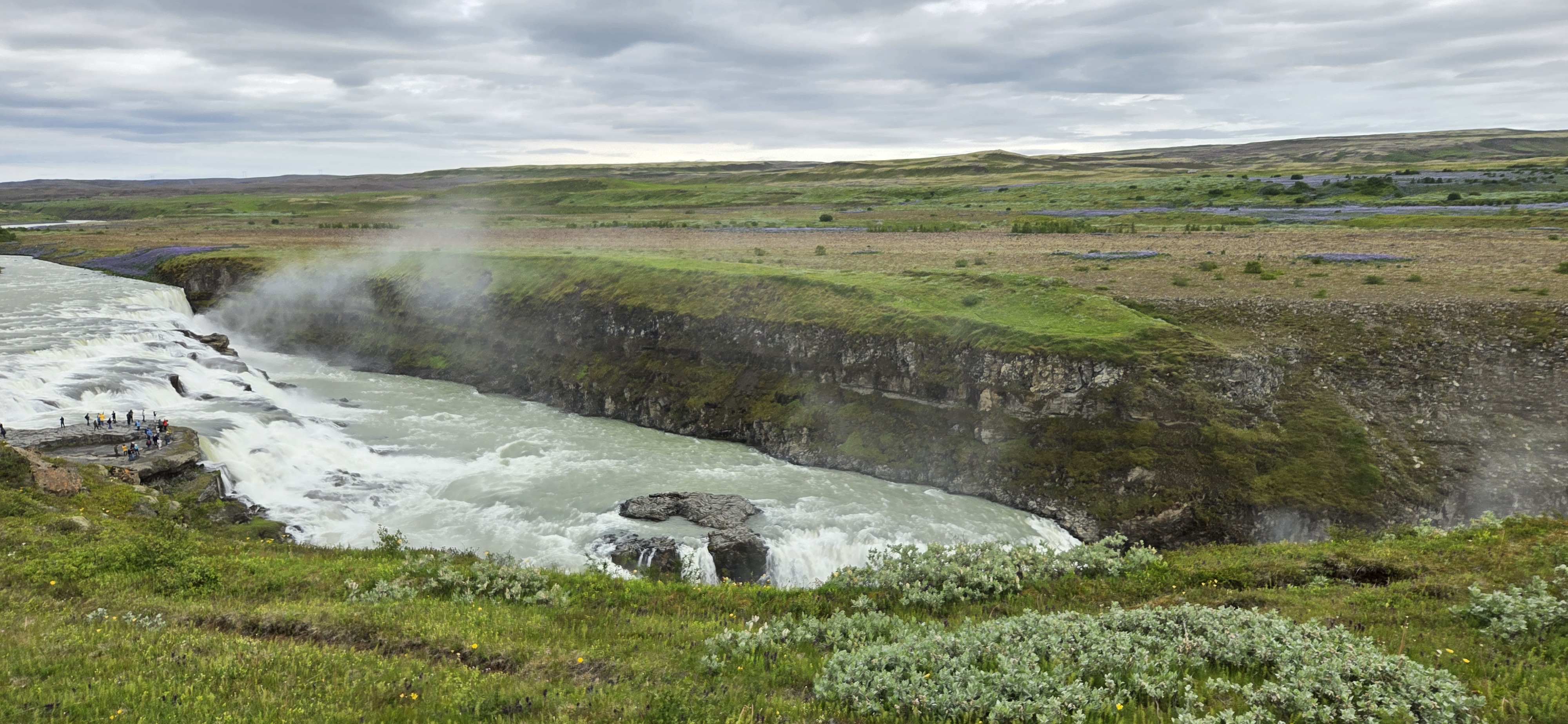
Next stop is the majestic Gullfoss waterfall, where the powerful Hvítá river plunges in two stages into a dramatic, deep canyon.
Photos on the way.
For over 1,000 years, the Icelandic horse has been purebred in Iceland. Considered a symbol of fertility, the horse played a pivotal role in Norse culture and history.
When the first Norse Viking settlers arrived in Iceland, they brought their Viking horse breeds and belief system with them, and so the Icelandic horse became ingrained in the very fabric of Icelandic culture.
Throughout history only the best horses were chosen for breeding – picked according to specific characteristics, such as color and equine conformation – meaning that the modern Icelandic horse is the result of many centuries of selective breeding.
Today, to keep the species purebred, an Icelandic horse can only leave the country once, meaning that those horse owners who emigrate face a weighty decision.
.
Before we arrived Inga told us the recent history of the waterfall which is quite interesting and startling at the same time, as the waterfall was contracted to foreigners and almost harnessed.
The daughter of the farmer who owned this land, Sigríður in Brattholt (1871-1957), put up a fight to save Gullfoss and threatened to throw herself into the waterfall if a hydroelectric power station were to be constructed.
This is a long story spanning over many years, but to make it short Sigríður saved Gullfoss and we are really grateful to her for that. It is a state property these days.
We had 45 minutes here. And it was a LOT colder than at the Geyser.
Gullfoss translates to golden waterfall. “Foss” means waterfall in Icelandic. So anytime you see the word “foss,” you’ll know you’re headed to some falls.
Gullfoss is the best-known waterfall in Iceland and it is breathtakingly beautiful, 32 metres high, with two cascades, the first one is 11 metres high, and the second one is 21 metres high; they fall into the 2.5 km gorge which is up to 70 m deep.
The waterfall runs in the glacial river Hvítá (White River) which runs from the Langjökull glacier just above Gullfoss.
As you walk along the edge of the falls, droplets of water from them splash against your face and clothes, and you have to be careful not to slip on the wet rocks. The combination of the roaring falls, mist, and crowds of people reminded me a lot of Niagara Falls – though Gullfoss is certainly a lot less developed.
As the water roars over the edge, mist rises into the air, often creating stunning rainbows on sunny days. This iconic waterfall is one of Iceland’s most breathtaking natural wonders, with its sheer force and beauty captivating visitors year-round. The sight and sound of Gullfoss are unforgettable, a true testament to Iceland’s raw and untamed nature.
The biggest building in town is the impressive Héraðsskólin, a former school designed by the same architect who was behind Hallgrímskirkja. Today, the school has become a charming and bustling boutique hostel that has kept many objects and artefacts from the building’s former life. There’s a restaurant serving local lamb, fish, and reindeer meatballs, as well as a relaxing library.
Finally, discover Thingvellir National Park,(aka Þingvellir National Park) (pronounced Thing-vell-eer). The park was established in 1930 and in 2004, was recognized as a UNESCO World Heritage Site.
As we near Þingvellir National Park, where we start to see the North American and Eurasian tectonic plates separating.
We were told to check out the most beautiful bathrooms in Iceland!
We stopped off at the perfect place to experience both: Almannagjá gorge. Here, stand on two continents at once, and walk along the gorge which marks the edge of the North American plate.
It’s also a perfect stop for Game of Thrones fans, as Almannagjá served as a filming location for the Eyrie!
The tectonic plates are actually visible above ground at Þingvellir, and you can really experience the continental drift.
The land in between the 2 tectonic plates is a 3rd plate, the micro-tectonic plate Hreppaflekinn. You can read more about it on the website of Þingvellir.
Almannagjá gorge forms the eastern boundaries of the North American Plate.
With a storied history as the “heart of Iceland,” Thingvellir is most well known today for its beautiful views, being home to the largest natural lake in Iceland, and as the meeting place of the North American and Eurasian tectonic plates.
This is also where the world’s oldest parliament met for centuries on the shores of Iceland’s largest lake.
This area serves significant historical significance to Icelanders – the name itself translating to mean “Parliament Plains” – where the Alþing general assembly was established around 930 A.D. and other major events have taken place – this being the first formal parliament of the country.
We then had a 45 minute drive back to Reykjavik where she would drop off some passengers who had paid for pick up and drop off then back to the terminal with the remaining passengers. She was fine with us getting off at the church as it was an easy walk for us.
I had made reservations for dinner at the Grillmark for 8 PM which I cancelled as I wasn't sure what time we would get back.
Instead we opted for a drink in a Viking bar. ÆGIR brugghús is a craft brewery situated in the Grandi district in Reykjavík. ÆGIR opened it‘s doors in 2017 and has always aimed at making a fresh high quality product, produced with the best ingredients possible.
We went to Tres Locos, Mexican theme, but like most restaurants there is some fusion. We ordered two tacos each using Icelandic ingredients (cod and lamb) and we shared. Yes, that is the price for 2 tacos, divide by 10 to get the approximate CAD price.
Great mural on the back wall.
We headed back out into the evening. It’s 10 p.m., but it’s lighter outside than it was when we came into the restaurant.

.JPG)
.jpg)