30 September 2017

inSPIREd Sunday


Sally and Beth host inSPIREd Sunday! 

December 2016 - St. Augustine FL


The Cathedral Basilica of St. Augustine is a historic cathedral constructed over five years (1793–1797), it was designated a U.S. National Historic Landmark on April 15, 1970. Originally established in 1565 and re-built in the 18th century, it is the oldest church in Florida.


One possible misconception of the history of the Cathedral of St. Augustine is the well-known bell tower that graces the top of the building. This was not the first time in the U.S. that an exposed bell tower had been placed on a church, or Spanish type of religious structure. In fact, by this point, Spanish missions had already moved far west, and had built cathedrals in Arizona, New Mexico, California, Texas, and Mexico. The bell tower was placed on the Cathedral of St. Augustine because the exposed bell at the front of the cathedral had become a well known symbol of the Spanish mission. Despite the technique being used elsewhere, a certain grandeur was still associated with this specific cathedral. As such, four bells were placed at the Cathedral of St. Augustine; one of which is still thought to be the oldest bell in the United States to this day because it is thought to have been salvaged from a previous church. As for the other bells, one of the more ironic features of the cathedral, one of the bells was taken from a British cathedral, the very empire that had burned this church more than once in the past.


The cathedral's eclectic facade is a combination of Spanish mission and Neoclassical styles. Spanish mission features include curving bell gables, limited fenestration, clay roof tiles, a semicircular tympanum, prominent statuary niche, and comparatively unadorned walls.


29 September 2017

Weekend Reflections

Click to see the rules and to take a badge for yourself.

Posting at Weekend Reflections.

August 2017 - Burlington ON

Royal Botanical Gardens


Friday Finds

Starts with M
Cloth
Everyday Things


The first will be the same, except we’ll work our way through the alphabet. The second and third will be different each time.
Hosted by Friday Finds and this is V4 or round 4!!!

Also playing along at ABC Wednesday


Eh to Zed


For this round of the alphabet I am going to celebrate Canada's 150 birthday by showcasing towns across the county.
To date I've been in the Maritimes and Ontario with my letters. Now we've gone to Alberta in the west and back east to Quebec.

Montreal, Quebec
Thanks to Wikipedia.

Montreal is the most populous municipality in the province of Quebec and the 2nd-most populous in Canada. Originally called Ville-Marie, or "City of Mary," it is named after Mount Royal, the triple-peaked hill in the heart of the city. The city is on the Island of Montreal, which took its name from the same source as the city, and a few much smaller peripheral islands, the largest of which is Île Bizard. It has a distinct four-season continental climate with warm to hot summers and cold snowy winters.


CLOTH taken at Chilhuly Glasshouse and Gardens last week in Seattle.


EVERYDAY THINGS also taken last week in Victoria BC at Craigdorrach Castle.
This is a maid's room, full of everyday things. In the evening she would do mending, clean silver etc.


28 September 2017

Day 21 - Medicine Hat AB to Regina SK

September 2017


John has an oil change scheduled so it was 11 before we got going.

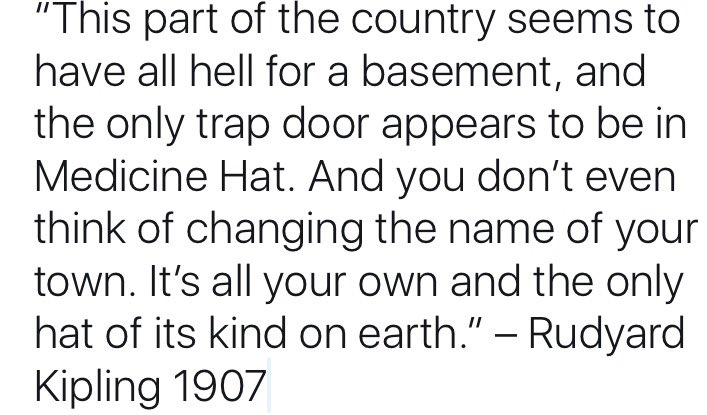
While I waited I remembered there was a connection between Medicine Hat and Kipling.


In the year 1910 Medicine Hat almost renamed itself Gasburg.
Whoever came up with this name obviously wasn't thinking about the fart jokes of the future, but rather the city's newfound natural gas industry.

According to Philip Pype, the archivist with the Esplanade Archives in Medicine Hat, the city dodged that bullet thanks to the author of the Jungle Book, Rudyard Kipling.

At the request of the residents, the British writer penned a convincing letter to the editor of the Medicine Hat News.

"He basically said that if such a place as Medicine Hat were to rename itself and turn its back on its own heritage and on its own values, it might as well rename it Judasville."


Ironically it was the city's Blackfoot name that lured the famous author to the boonies of the British Empire.

"He was actually intrigued by the name itself and received an invitation during his trip across North America. So, he came here by train, he and his wife, and took a tour of our city and became a big fan of Medicine Hat," said Pype. Kipling wrote for Collier’s magazine in 1908, saying Medicine Hat is “The Town that was Born Lucky.”

Image result for medicine hat rudyard kipling


A monument commemorating the efforts of local soldiers during World War I is taking shape on the side of Robertson Hill.
Project 175 is meant to recognize the Third Canadian Mounted Rifles and the 175th Infantry Battalion.
3CMR and 175 are written out using white painted stone.
Two 40 foot maple leafs will flank either side of the lettering and use around 7,000 bricks donated from the old IXL brick plant in Redcliff. Many of the bricks date back over 100 years and took a team of volunteers 12 days to clean.


We go to Costco for some snacks and to their liquor outlet, taxes are so low in Alberta that single malt scotch is $20 cheaper than in Ontario.


This internationally-recognized monument, arguably Medicine Hat’s most prominent landmark, is known as the Saamis Teepee. Standing at 65.5 metres, the Saamis Teepee holds the record for being the tallest teepee in the world.


The Saamis Teepee was originally built for the 1988 Winter Olympics in Calgary. Designer Steve Illes had the teepee painted “white for purity, red for the rising and setting sun, and blue for flowing waters”. It stood in Calgary’s McMahon Stadium, where it housed the Olympic Flame during the opening and closing ceremonies.


There will be a separate post on the teepee as it was beautiful.


Are those cows? No! Pull over!


We have marked this drive as the most boring day of the trip. Spotty radio reception as well.
AND Saskatchewan does not have any restrooms at their rest areas, seriously??


The land is so flat, the locals say if your dog ran away, it would be days before the wagging tail would disappear over the horizon.


There are salt lakes and rivers throughout Saskatchewan, and when you come upon them it looks like snow covering the ground.


The highway runs straight, not having to navigate around natural obstacles. 


The recurring grain elevators here symbolize the vas agricultural capacity of this land, and are the larger-than-life milestones indicating towns alongside the railway.


As we appraoch Moose Jaw I google attractions and discovered that Moose Jaw is the mural capital of North America! Who knew?


The Moose Jaw City Hall is home to the Moose Jaw City Council an and is designated as a municipal heritage property. The building was originally designed and built by the J. McDiarmid Company for the Government of Canada to house a post office, Royal Canadian Mounted Police station and other government offices. In 1965 the building was sold by the federal government to the City of Moose Jaw and converted into a city hall.

Moose Jaw Police Service Headquarters is located in a building attached at the rear of the building.


Hammond Building 1912

Image result for moose jaw historical buildings

The Land Titles Building was constructed in 1910 and until 1998, held the distinction of being the only one of eleven surviving Land Registry facilities in the province to maintain its original function. This building replaced a temporary Land Titles facility established here around 1907—a time when Moose Jaw and area were experiencing accelerated population and development growth. The building of a new Land Titles Registry was prompted by the rapid population growth that Moose Jaw experienced in the early part of the twentieth century. Moose Jaw’s reported population increased from 1,558 in 1901 and 6,249 in 1906, to 13,823 in 1911. This growth, together with its evolution into an important regional commercial and administrative centre justified and necessitated the establishment of this substantial Land Titles Building.


J.N. McDonald founded the Times as a weekly in 1889. One of its early owner-editors was Thomas Walter Scott in 1894-1895. Scott would later become the first Premier of Saskatchewan. The paper converted to a daily in 1906, changing its name to the Evening News; in 1920 it purchased its rival the Daily News and in 1923 established the Times Morning Herald, though this morning edition was discontinued a few years later.

In 1949, Roy Thomson purchased the Times-Herald. Thomson Newspapers published it until October 1995, when it was sold along with its sister papers the daily Prince Albert Daily Herald and the weekly Swift Current Booster to Hollinger Inc. Those three Saskatchewan papers were then sold to CanWest in 2000 and later to Montreal-based publisher Transcontinental in 2002. In May 2016, Transcontinental sold its 13 newspapers in Saskatchewan to Star News Publishing of Alberta.

We come across Walter Scott in Regina.

Toronto has a Roy Thomson Hall - item to check out.


Regina and we are booked, again on points, in a Sheraton Four Points, very nice and pleasant staff.


Day 1 - Toronto to Chesterton IN
Day 2 - Chesterton IN to Rochester MN
Day 3 - Rochester MN to Lincoln NB
Day 4 - Lincoln NB to Denver CO
Weekly recap with more photos
Day 5 - Denver CO to Rapid City SD
The Curtis Hotel Denver CO funky themed floors
Day 6 - Rapid City SD Mount Rushmore City of Presidents
Day 7 - Rapid City SD to Billings MT Crazy Horse and Little Big Horn
Day 8 - Billings MT to Driggs ID
Day 9 - Jackson Hole WY and Grand Teton NP
Day 10 - Yellowstone National Park
Day 11 - Driggs ID to Spokane WA

Morning Reflections