Showing posts with label trains. Show all posts

17 October 2026

Friday October 16 Vienna - Budapest

Itinerary
Oct 12 -13 Toronto - Paris - Vienna
Oct 13 - Vienna
Oct 14 - Vienna
Oct 15 - Vienna
Oct 16 - Vienna to Budapest by train
Oct 17 - Budapest
Oct 18 - Budapest to Zagreb Croatia

Fri, Oct 16 | Vienna ➔ Budapest 

Steps 9,000 Train 

We were in Budapest in 2012  for another river cruise so we are skipping the touristy things we did on that trip.

The day began with a final breakfast in Vienna before packing our bags and checking out of our railway base. By 01:00 PM, we completed the effortless short walk from our hotel lobby straight onto the platforms of Vienna Central Station (Wien Hauptbahnhof).

.


We boarded our pre-booked high-speed ÖBB Railjet train, slipping into our First-Class carriage seats just as the doors slid shut. Definitely not first class!! Not even a water service! 

.

We had the carriage to ourselves at first, other than the HUGE suitcases from the berth in front of us, with Dubai tags, he huffed and puffed putting them up there as the conductor insisted.

One stop and a guy got on. another stop and two women. Then the next stop, where Dubai guy tried to con a guy, with an assigned seat, from sitting, but he was having none of that. Another woman joined us. The heat was unbearable, it was hot!


By 03:45 PM, our train glided beneath the massive, historic iron-and-glass roof of Budapest-Keleti station. Stepping onto the platform, we grabbed a cab, no credit cards but he would take euros ($25) to hotel. Within minutes, our driver navigated the inner-city traffic to drop us off at our home base for the next two nights: the Hilton Garden Inn Budapest City Centre.

Check in was amazing, with Ruth.

In an effort to reduce plastic the Hilton has a water dispenser on each floor (water bottle in room), with still and sparkling water.


After dropping our luggage and checking into our room at 04:30 PM, we blinked and immediately headed out to catch the autumn golden hour light. 

Stepping out of our hotel and turning left, we can see St.Stephen's! Brought us into the grand neoclassical plaza surrounding St. Stephen's Basilica, where locals and travellers alike were spilling across the lively cobblestone square. We finally grabbed lunch.


The restaurant vibe near St. Stephen’s Basilica was an unforgettable mix of historic grandeur and lively European charm. 
As the late afternoon sun began to dip, it washed the massive 96-meter neoclassical dome of St. Stephen’s Basilica in a warm, golden glow. The outdoor terraces were alive with a vibrant energy.


We happened upon the Fat Policeman, on our agenda for tomorrow!

The lights were just coming on! Looking towards Buda.

,


The Four Seasons Hotel.


Continuing our walk 15 minutes northwest toward the banks of the Danube River, we arrived at the water's edge to witness one of Europe’s most moving monuments: The Shoes on the Danube Bank.

.


e stood in quiet reflection before the 60 pairs of rusted, period-correct iron shoes sculpted directly into the concrete bank. The memorial honors the thousands of Hungarian Jews who were ordered to strip down on the river's edge before being tragically shot into the freezing river by fascist Arrow Cross militiamen during the winter of 1944–1945. Looking down at the iron laces and tiny children’s boots while the sun set directly behind the silhouette of Buda Castle across the river was a moment we won't soon forget.


We stood in quiet reflection before the 60 pairs of rusted, period-correct iron shoes sculpted directly into the concrete bank. The memorial honors the thousands of Hungarian Jews who were ordered to strip down on the river's edge before being tragically shot into the freezing river by fascist Arrow Cross militiamen during the winter of 1944–1945. Looking down at the iron laces and tiny children’s boots while the sun set directly behind the silhouette of Buda Castle across the river was a moment we won't soon forget.

The Hungarian Parliament Building (Országház) is the majestic seat of the National Assembly of Hungary, standing proudly as the country's largest building and a world-famous architectural icon. Resting directly on the Pest banks of the Danube River, this breathtaking landmark is widely considered one of the top tourist destinations in Europe and is a designated UNESCO World Heritage Site.


The Hungarian Parliament Building stood as a breathtaking titan on the Pest banks of the Danube River, its massive Neo-Gothic silhouette instantly stealing the spotlight of the Budapest skyline. Modeled loosely after London’s Westminster but infused with grand Baroque symmetry and a Renaissance dome, the sheer scale of the palace felt almost mythic. Walking up to the façade, it was impossible not to stare at the dizzying forest of 88 turrets and 242 stone statues of historic rulers staring back down at the square. Inside, the opulence only magnified, boasting nearly 700 rooms laced with a staggering 40 kilograms of 23-carat gold leaf and a grand central dome rising exactly 96 meters high to honor the nation's 9th-century roots. Stepping into the Dome Hall, where guards stood in silent vigil over the ancient Holy Crown of Hungary, the weight of centuries of history felt completely tangible—making it far more than just a seat of government, but a golden monument to the soul of the country itself.

.


On our way back.


Fat Policeman behind me.


Dessert - apple crepes with cream.


06 August 2026

RANDOM REPOST - Halton County Radial Railway Museum

 September 2021 - Milton ON


On September 19 we had tickets for 11 AM at the Halton County Radial Railway Museum. It was on my to do list and as I checked their website I saw that they were only open on weekends to the middle of October. Due to COVID you had to buy timed tickets ahead of time.


The Halton County Radial Railway (HCRR) is a full-size operating electric railway and museum, featuring historic electric railcars operating on two kilometers of scenic track.

The HCRR and OERHA formed in 1954 by a group of men who wanted to save Toronto Transit Commission (TTC) streetcar 1326 from being sent to the scrap yard. After the donation of this streetcar, the dream grew. Land that used to be a part of the Toronto Suburban Railway in Nassagaweya Township was acquired, and subsequently, a number of other street and radial cars were eventually rescued. The museum’s grand opening to the public took place in 1972.

 The tracks conform to the TTC's track gauge of 4 ft 10+7⁄8 in (1,495 mm), which is 60 mm (2+3⁄8 in) wider than 1,435 mm (4 ft 8+1⁄2 in) standard gauge. Vehicles from other systems must be altered to accommodate the tracks, and cars intended for third-rail power must be reconfigured for use with overhead wire.

Toronto has a small train museum in the heart of the city, at the foot of the CN Tower.


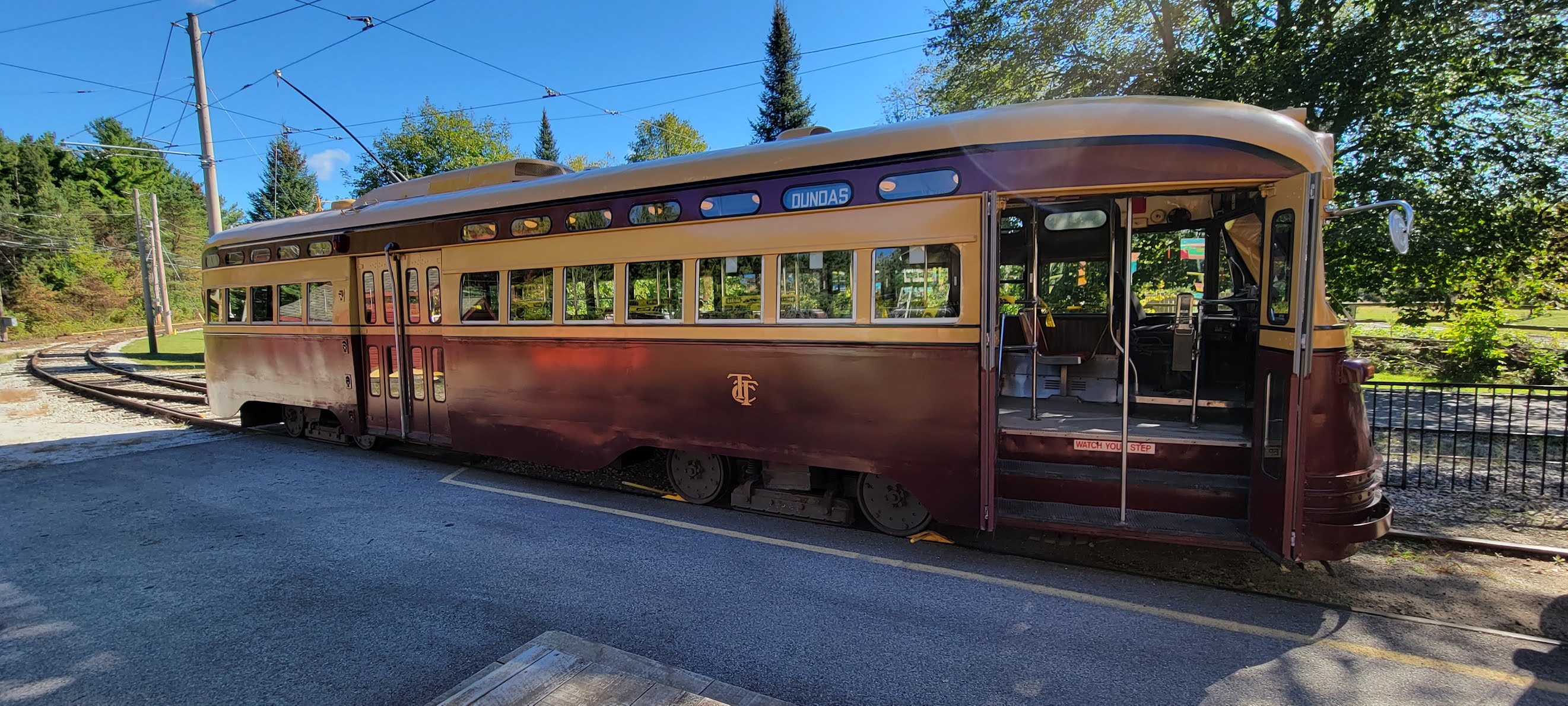
The three cars that are outside are available to ride all day long.

Toronto Transit Commission 2894
Fleet Number: 2894 Built: 1923
System: Toronto Transit Commission Retired: 1963
Builder: Ottawa Car Company Acquired: 1986
Type: SE-DT Streetcar Status: Restored & operational
Used as a tour tram from 1973 until 1986. Last car to operate on Dupont route in 1963.


Toronto Transit Commission 4600 
Fleet Number: 4600 
Built: 1951 
System: Toronto Transit Commission 
Retired: 1995 
Builder: Canadian Car & Foundry Acquired: 1996 
Type: SE-DT 
Operational Prototype class A-15 Rebuild car. Rebuilt in 1986 from Class A-8 car 4505.


This first thing we did was get a front row seat for a ride on #327.

Gotta love social distancing! Due to COVID every other row was blocked off and no strangers sit next to you.


The original streetcar #327 was built by the Toronto Railway Company in 1893 and retired in 1915, and left to decay in dead storage until it was scrapped by the TTC in 1921. A replica of #327 was built by the TTC using the streetcar’s original truck and some components in 1934 for Toronto’s Centennial.
Odd numbers were used for open cars (summer) and even numbers for closed (winter). 


This bell was for the driver and conductor to communicate, not for a stop. The driver said they didn't really stop only slowed down for people to hop on and off.


Considering this is what I would have been wearing I doubt I would be hopping on or off!

Photo taken - Toronto Mechanics Institute, Church St., northeast corner of Adelaide St. East. ; Interior, Reference Library


Replica of the Meadowvale station. The original is in the museum.


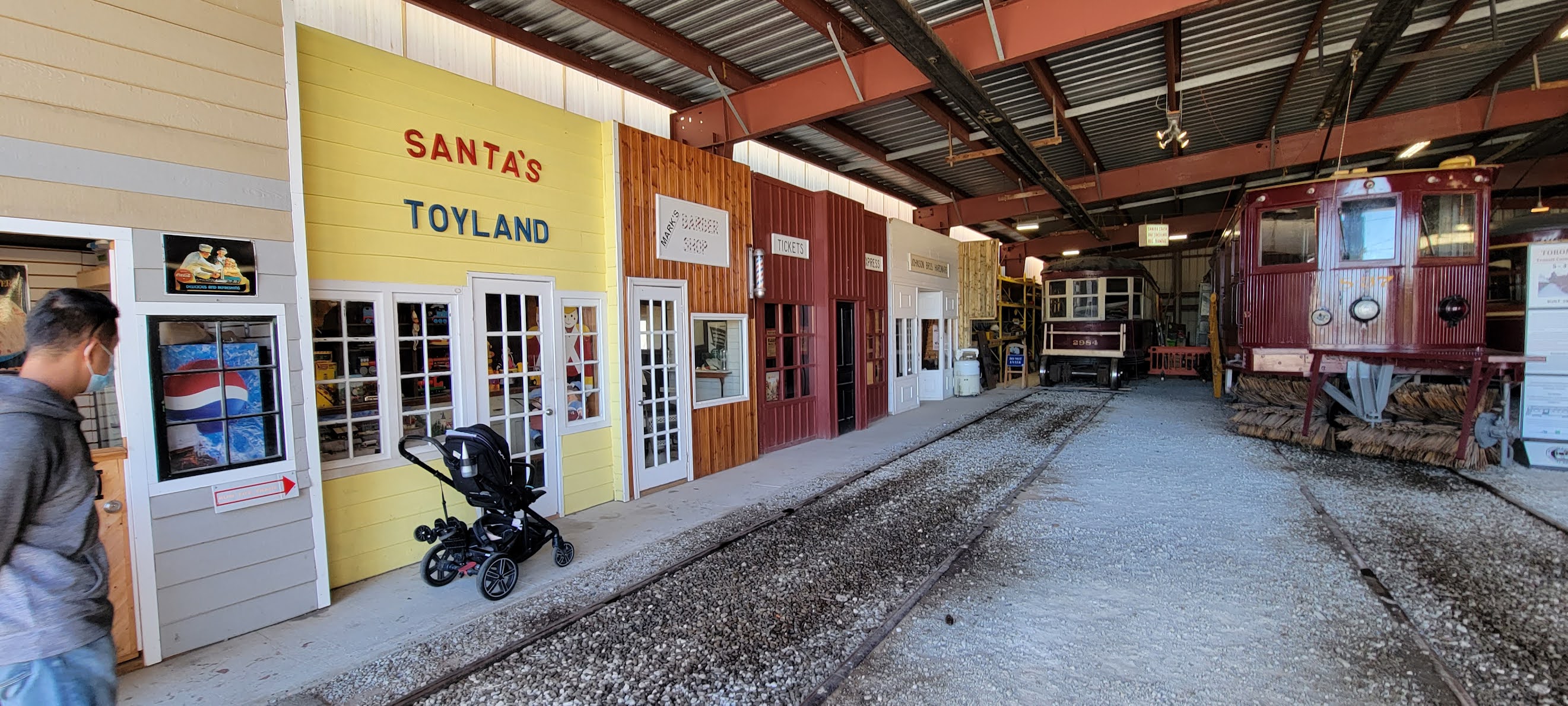
Back at the station and we headed to the indoor museum.


Pit jacks are used for lifting up tramway cars by the bogies for accessibility of the axles for maintenance and adjustment of the car body.


Fleet Number: 300 
Built:
System: London & Port Stanley Railway 
Retired:
Builder: Acquired: 2019
Type: DT boxcar Status: Unrestored
Was first used by New York Central and purchased by L&PS after WW2


Fleet Number: 2424 
Built: 1921
System: Toronto Transit Commission 
Retired: 1962
Builder: Canadian Car & Foundry 
Acquired: 1962
Type: SE-DT Streetcar Status: Restored & operational
From the TTC’s first order for new Large Peter Witt cars in 1921 (2300-2498).

Rebuilt for one man operation.


Fleet Number: TP-11 
Built: 1945
System: Toronto Transit Commission 
Retired: 1976
Builder: National Steel Car Acquired: 1978
Type: SE-DT Snow Plow 
Status: Under Restoration
Snow Plow. Equipped with high speed interurban trucks.
Equipped by TTC. Largest street railway snowplow in Canada.


Fleet Number: 4204 
Built: 1987
System: Toronto Transit Commission 
Retired: 2019
Builder: Can-Car Rail 
Acquired: 2019
Type: SE-TT Streetcar 
Status: Operational
This “bendy” streetcar was designed as an articulated version of the TTC’s Canadian Light Rail Vehicles. The ALRV has 3 trucks and seats 61.


Fleet Number: 55 
Built: 1915
System: Toronto Civic Railway 
Retired: 1954
Builder: Preston Car & Coach 
Acquired: 1954
Type: DE-ST Streetcar 

TCR #55 was the second car acquired in 1954, and was restored from TTC scraper car #2210 back to it’s original passenger service design.


Fleet Number: W-30, W-31 
Built: 1946
System: Toronto Transit Commission 
Retired: 1999
Builder: Pullman Standard 
Acquired: 2002
Type: SE-DT Rail Grinder 
Status: Unrestored – Operational
Rail Grinding train. Converted from All Electric MU PCC cars 4631 and 4668, formerly Cleveland Transit system 4206 and 4243.


Fleet Number: W-28 
Built: 1917
System: Toronto Transit Commission 
Retired: 1976
Builder: Preston Car & Coach
 Acquired: 1976
Type: SE-ST Rail Grinder 
Status: Restored & operational
Rail Grinder. Converted from snow scraper 2214, Formerly passenger car 2214, originally Toronto Civic Railway #57.
.


Fleet Number: 2786 
Built: 1923
System: Toronto Transit Commission 
Retired: 1963
Builder: Canadian Car & Foundry 
Acquired: 1973
Type: SE-DT Streetcar 
Status: Unrestored – Operational
Operated occasionally for special events. Small Peter Witt type.


Fleet Number: M-4 
Built: 1915
System: Lake Erie & Northern Railway 
Retired: 1962
Builder: ERICO 
Acquired: 1962
Type: SE-ST Rail Bonder 
Status: Restored & operational
Self propelled welding car.

Equipped with Westinghouse mill motor and mechanical clutch. Believed to be only surviving ERICO Bonder.


Fleet Number: M-6 
Built: 1934
System: Lake Erie & Northern Railway 
Retired: 1962
Builder: Ford 
Acquired: 1963
Type: Line Truck 
Status: Awaiting restoration
2t truck equipped with flanged wheels.
Equipped with crew cab & ladder for line work.

Formerly a Pepsi Cola delivery truck.


CP 437123 no info available.


Fleet Number: 78653 
Built: 19–
System: Canadian National Railway 
Retired: 1980
Builder: Acquired: 2019
Type: Caboose 
Status: Unrestored – Operational

Originally a box car used by Grand Truck Railway before CN rebuilt it into a caboose in 1948. It was retired around 1980, moved to a private property in Newtonville in 1984 and completely restored. It was then relocated to Richmond Hill in 1999, and eventually acquired by our museum.


Fleet Number: 107 
Built: 1912
System: Montreal & Southern Counties Railway 
Retired: 1955
Builder: Ottawa Car Company. 
Acquired: 1956
Type: DE-DT Suburban 
Status: Restored & operational
Multiple unit Suburban Combine. First interurban car.
Regauged by National Steel Car.


Fleet Number: 23 
Built: 1901
System: London Street Railway 
Retired: 1935
Builder: Montreal Park & Island Railway 
Acquired: 1983
Type: SE-DT Streetcar 
Status: Restored & operational

Acquired as a body from Wonderland Park in London. Restored to running condition. Uses Curtis D-2 Trucks from Toronto.


.


Fleet Number: 1326 
Built: 1910
System: Toronto Railway Company 
Retired: 1951
Builder: Toronto Railway Company 
Acquired: 1954
Type: SE-DT Streetcar Status: Restored
The last wood streetcar retired by the TTC and first artifact in our collection.


Fleet Number: W-4 
Built: 1904
System: Toronto Railway Company 
Retired: 1974
Builder: Toronto Railway Company 
Acquired: 1974
Type: SE-DT Flatcar 
Status: Unrestored – Operational

Flat Motor. Equipped with cab at one end. Used for carrying materials.


As we left.


Foto Tunes

Tom the backroads traveller  hosts this weekly meme May 2019 - Paris France Dedicated to the One I Love  - Jakob Dylan an...