September 2016 - Milwaukee WI
On our way to Minneapolis on this rainy morning but we I was so pleased that we managed to get this on our agenda.
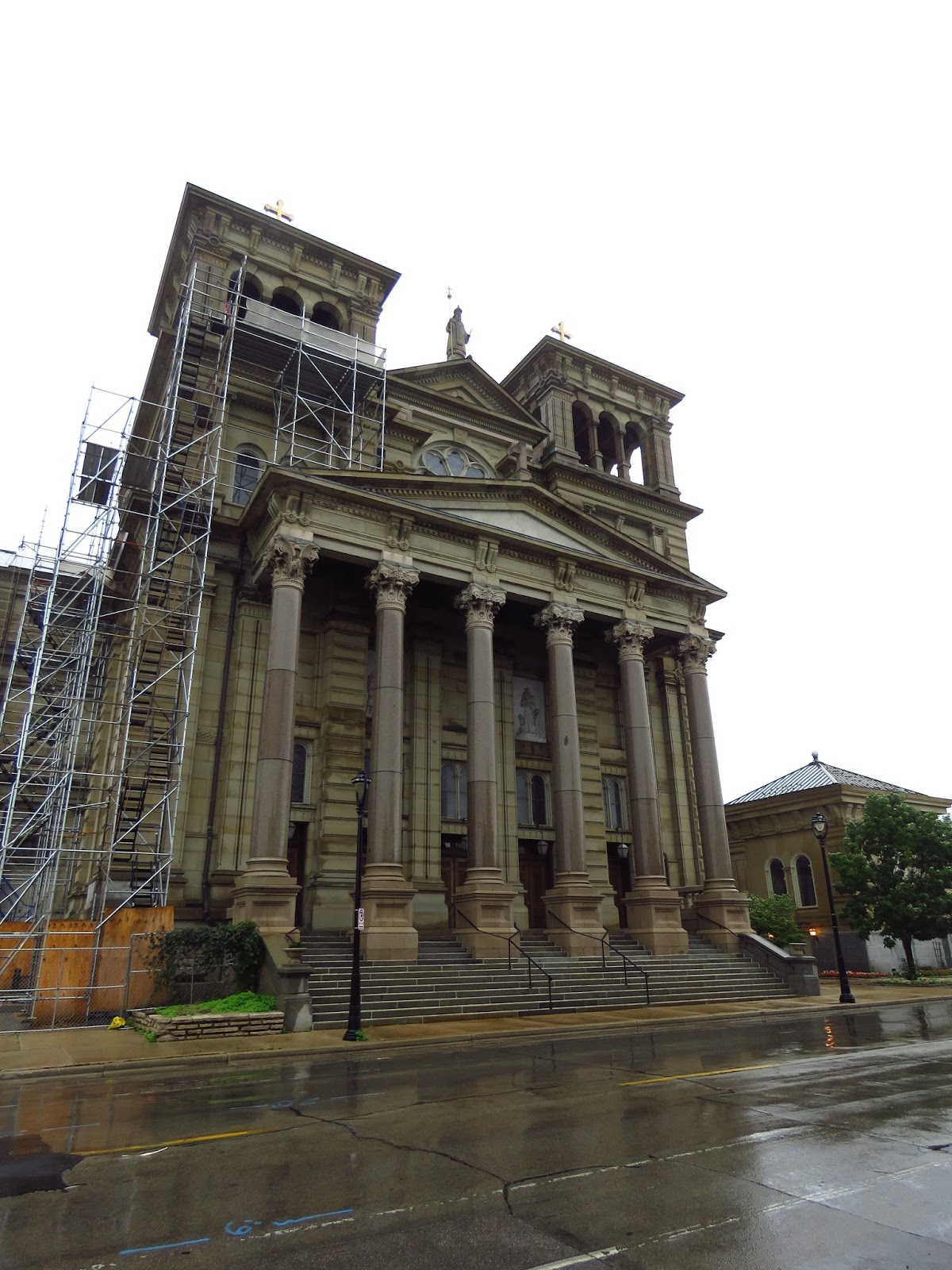
The Basilica of St. Josaphat is a ministry of the Conventual Franciscans on the South Side of Milwaukee in Historic Lincoln Village.
This church and parish are named for St. Josaphat, an Archbishop in the Kingdom of Poland in the early 1600s. The parish was founded in l888, and its first home was a modest building that burned to the ground in 1889. The parish built a second church but it was too small for the growing congregation of 12,000 parishioners.
By the late 1800s, Polish immigrants were streaming into Milwaukee by the thousands, quickly becoming the second largest ethnic group in the nation’s most German city. In 1866, thirty Polish families established Saint Stanislaus Parish on Milwaukee’s South Side as the first urban Polish parish in the United States.
Saint Josaphat Parish was formed in 1888 as an offshoot of Saint Stanislaus Parish and subsequently became the largest Polish parish in Wisconsin. Its first home was a modest building that burned to the ground in 1889. The parish built a second church but it was too small for its needs.
As always, John dodged puddles and traffic to get the big picture!
We entered through the Pope John Paul II Pavilion on the west side of the Basilica, the visitor center is open Monday through Saturday, 9:00am to 4:00pm.
Father Wilhelm Grutza, the pastor, had hired a German-born architect named Erhard Brielmaier to design what is, in essence, a smaller version of St. Peter’s in Rome. The church would have the same cross-shaped floor plan and huge central dome that distinguish St. Peter’s.
When the plans were nearly complete, Fr. Grutza learned that the Chicago Post Office and Custom House needed to be razed and he was able to purchased it for $20,000. The building(pictured below) was dismantled and the salvaged materials were loaded up on 500 railroad flatcars and brought up to Milwaukee. They were stockpiled on a vacant lot across the street.

Into the basilica. In the Catholic Church, basilica status is reserved for the largest, most beautiful, and most historically important churches. In 1929, St. Josaphat Church was named the third basilica in the United States. Today there are over sixty in the United States. It is as close as we get to a European Cathedral. It is the largest church in Milwaukee, with a seating capacity of over 1,000 on the main floor, hundreds more can be accommodated in the galleries.
On the east confessionals are bronze bas-reliefs of The Need for Forgiveness (Septuagies septies; Seventy-seven times) and The Lost Sheep (Salvare quod perierat; Saving what had been lost.) Above the confessionals are the first seven Stations of the Cross, carved from marble. The stations are inscribed in Polish.
The Grand Pulpit, carved from white Italian marble, contains the images of Jesus the Good Shepherd and the four evangelists: St. Matthew (man), St. Mark (lion), St. Luke (ox), and St. John (eagle). The statues between the images, St. Thérèse of Lisieux, Our Lady of Guadalupe, St. Jude, and St. Francis of Assisi — were added recently to replace original statues removed in the 1960s.
The High Altar, carved of marble, holds the Tabernacle. Built over the altar is the baldachino (canopy), covered with 23k gold leaf. Inscribed in Latin is “Behold God’s dwelling place among men!” In the base of the altar is a high-relief marble image of the Last Supper, based on the painting by Leonardo da Vinci. The painting behind the altar is the Martyrdom of St. Josaphat. To the left is a painting of St. Andrew of Bobola and to the right, St. Vincent de Paul. In the apse (semidomed ceiling) above the baldachino is The Glorification of St. Josaphat, containing over twenty-five figures.
The baptismal font, cradles a hammered copper bowl with a marble rim refashioned from a piece of the original communion rail.
The St. Joseph Altar survived the fire of the first church. The statue of St. Joseph is flanked by St. Peter (right) and St. Paul. The death of St. Joseph is depicted in the mural above the altar.
The Organ utilizes a compilation of pipes from the original Basilica organ and numerous others. It has 46 ranks of pipes ranging from the size of a pencil to over 16 feet long.
The Rose Window above the Organ Gallery, surrounding the “ever-watchful eye of God” are images of the four Evangelists: (clockwise from top) St. John (eagle), St. Matthew (man), St. Mark (lion), and St. Luke (ox).
The Inner Dome
The eight angel paintings surrounding the Eastern European crystal window in the center of the dome, represent eight of the nine divisions of the angels. The ninth, the archangels are painted on the ceiling above the Sanctuary. The eight roundels depict Prophets from the Old Testament who foretold the coming of the Messiah. The eight lunettes contain paintings of Evangelists, Apostles and Doctors of the Church. The eight rectangular paintings in the drum of the dome depict the seven Sacraments and the Adoration of the Magi. Between these paintings are the Madonna windows depicting Eastern European shrines dedicated to the Blessed Virgin. The inscription at the base of the dome in Old Polish, is from 1 Kings 9:3 - “I consecrate this house you have built, I place my name here forever; my eyes and my heart will be here for all time.”
The Undercroft:
• History Exhibit
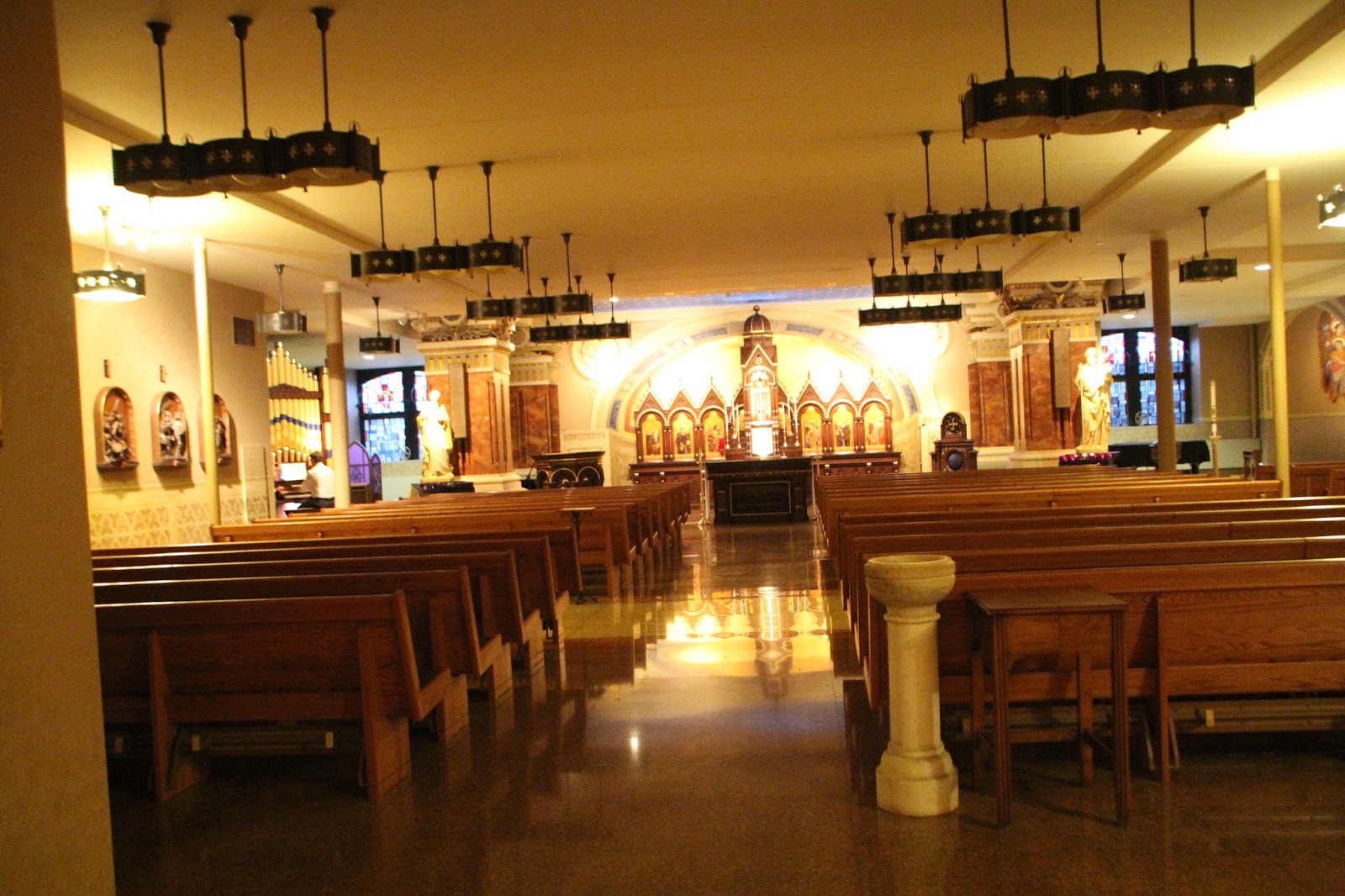
Lower Church (used for daily Mass, Eucharistic Adoration, other gatherings)
Lourdes Chapel, mural by P. Bianchi
Reliquary Chapel


.JPG)