Tom the backroads traveller hosts this weekly meme.
Travel Tuesday
Our World Tuesday
Image-in-ing
My Corner of the World
September 2018 - Toronto ON
This has been languishing in my Drafts holder, no idea why I didn't publish it.
I've never been much of a designer label kinda gal. I guess I am becoming more like my father as he could never understand why someone would pay money to wear someone's product name.
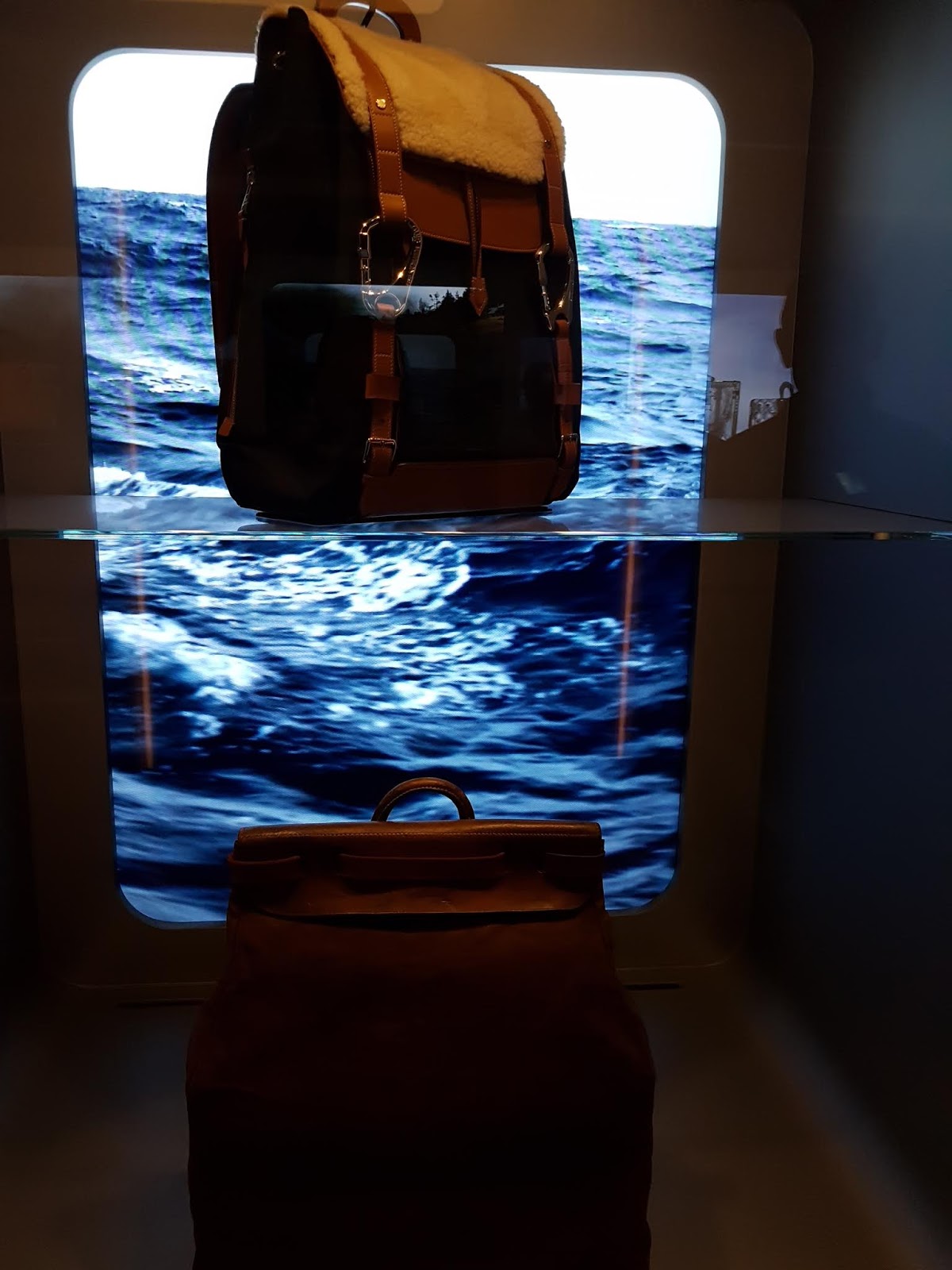
BUT I changed my mind about the Louis Vuitton name when I visited the pop up museum at Union Station.
Louis Vuitton Malletier, commonly referred to as Louis Vuitton (French: [lwi vɥitɔ̃]), or shortened to LV (was a Roman Numeral question on Jeopardy), is a French fashion house and luxury retail company founded in 1854 by Louis Vuitton. The label's LV monogram appears on most of its products, ranging from luxury trunks and leather goods to ready-to-wear, shoes, watches, jewelry, accessories, sunglasses and books.
Designer and entrepreneur Louis Vuitton was born on August 4, 1821, in Anchay, a small hamlet in eastern France's mountainous, heavily wooded Jura region. Descended from a long-established working-class family, Vuitton's ancestors were joiners, carpenters, farmers and milliners. His father, Xavier Vuitton, was a farmer, and his mother, Coronne Gaillard, was a milliner.
Vuitton's mother passed away when he was only 10 years old, and his father soon remarried. As legend has it, Vuitton's new stepmother was as severe and wicked as any fairy-tale Cinderella villain. A stubborn and headstrong child, antagonized by his stepmother and bored by the provincial life in Anchay, Vuitton resolved to run away for the bustling capital of Paris.
On the first day of tolerable weather in the spring of 1835, at the age of 13, Vuitton left home alone and on foot, bound for Paris. He traveled for more than two years, taking odd jobs to feed himself along the way and staying wherever he could find shelter, as he walked the 292-mile trek from his native Anchay to Paris. He arrived in 1837, at the age of 16, to a capital city in the thick of an industrial revolution that had produced a litany of contradictions: awe-inspiring grandeur and abject poverty, rapid growth and devastating epidemics.

The teenage Vuitton was taken in as an apprentice in the workshop of a successful box-maker and packer named Monsieur Marechal. In 19th century Europe, box-making and packing was a highly respectable and urbane craft. A box-maker and packer custom-made all boxes to fit the goods they stored and personally loaded and unloaded the boxes. It took Vuitton only a few years to stake out a reputation amongst Paris's fashionable class as one of the city's premier practitioners of his new craft.
On December 2, 1851, 16 years after Vuitton arrived in Paris, Louis-Napoleon Bonaparte staged a coup d'etat. Exactly one year later, he assumed the title of Emperor of the French under the regal name Napoleon III. The re-establishment of the French Empire under Napoleon III proved incredibly fortunate for the young Vuitton. Napoleon III's wife, the Empress of France, was Eugenie de Montijo, a Spanish countess. Upon marrying the Emperor, she hired Vuitton as her personal box-maker and packer and charged him with "packing the most beautiful clothes in an exquisite way." She provided a gateway for Vuitton to a class of elite and royal clientele who would seek his services for the duration of his life.
Napoleon III, Eugenie and their only son.
Louis Vuitton had observed that the HJ Cave Osilite trunk could be easily stacked. In 1858, Vuitton introduced his flat-bottom trunks with trianon canvas, making them lightweight and airtight. Before the introduction of Vuitton's trunks, rounded-top trunks were used, generally to promote water runoff, and thus could not be stacked. It was Vuitton's gray Trianon canvas flat trunk that allowed the ability to stack with ease for voyages. Many other luggage makers imitated LV's style and design.
Picnic basket
Click here to see and read about the DJ Trunk.
Case made for Lauren Bacall




.JPG)
.JPG)
.JPG)
.JPG)
.JPG)
.JPG)
.JPG)
.JPG)
.JPG)
.JPG)
.JPG)
.JPG)
.JPG)
.JPG)
.JPG)
.JPG)
.JPG)
.JPG)
.JPG)
.JPG)
.JPG)
.JPG)
.JPG)
.JPG)
.JPG)
.JPG)
.JPG)
.JPG)
.JPG)


