My birthday weekend! It started with a basket from John with my kind of goodies (he doesn't like), smoked salmon and salmon pate, wine, prosecco etc.
Heading out to Stratford Saturday morning (of a long weekend) we didn't think traffic would be bad. WRONG! It was the worst, and no matter what way we tried, 401, then 407, then QEW it was awful.
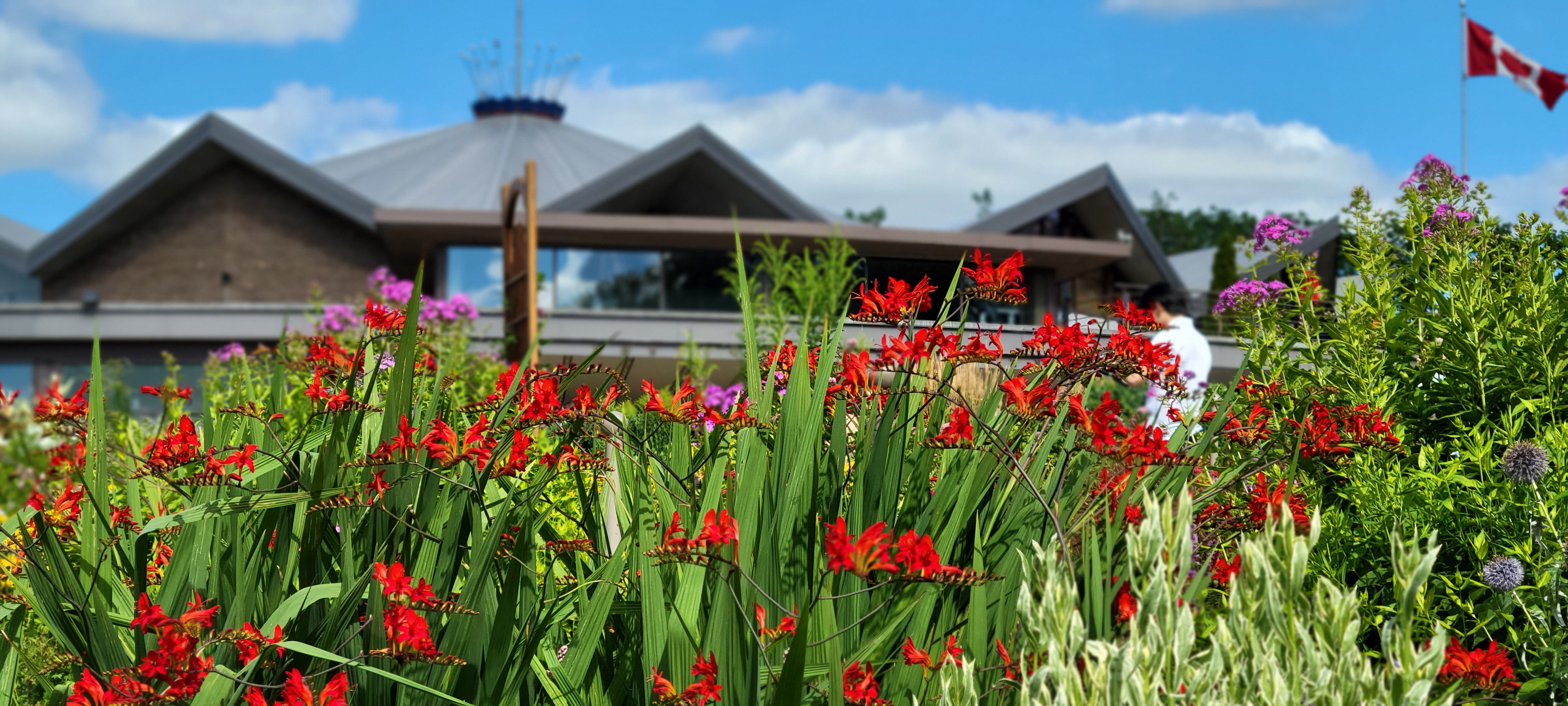
We had thought we could stop for fish and chips before the 2PM show. But we were delayed about 35 minutes so went straight to the theatre to get parking ($20) early. Gardens outside the theatre. I have shown the gardens and sculpture before, click here.
The red flowers are crocosmia.
Inside the theatre we were able to get a glass of wine and a charcuterie plate and a protein (hummus, egg, pita, nuts and cranberries) plate - perfect.
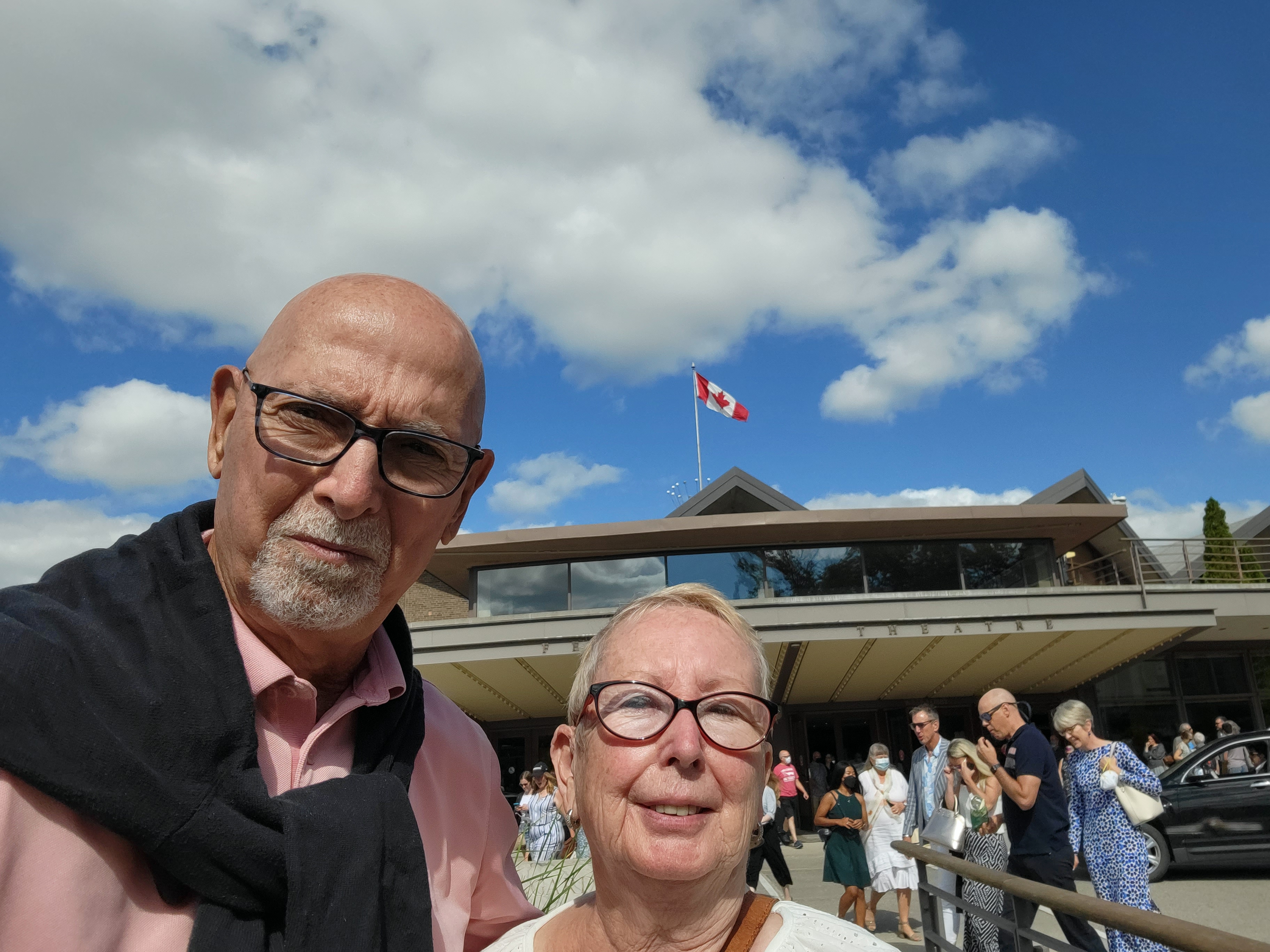
John snapped a couple of photos before it started. We were seeing Chicago!
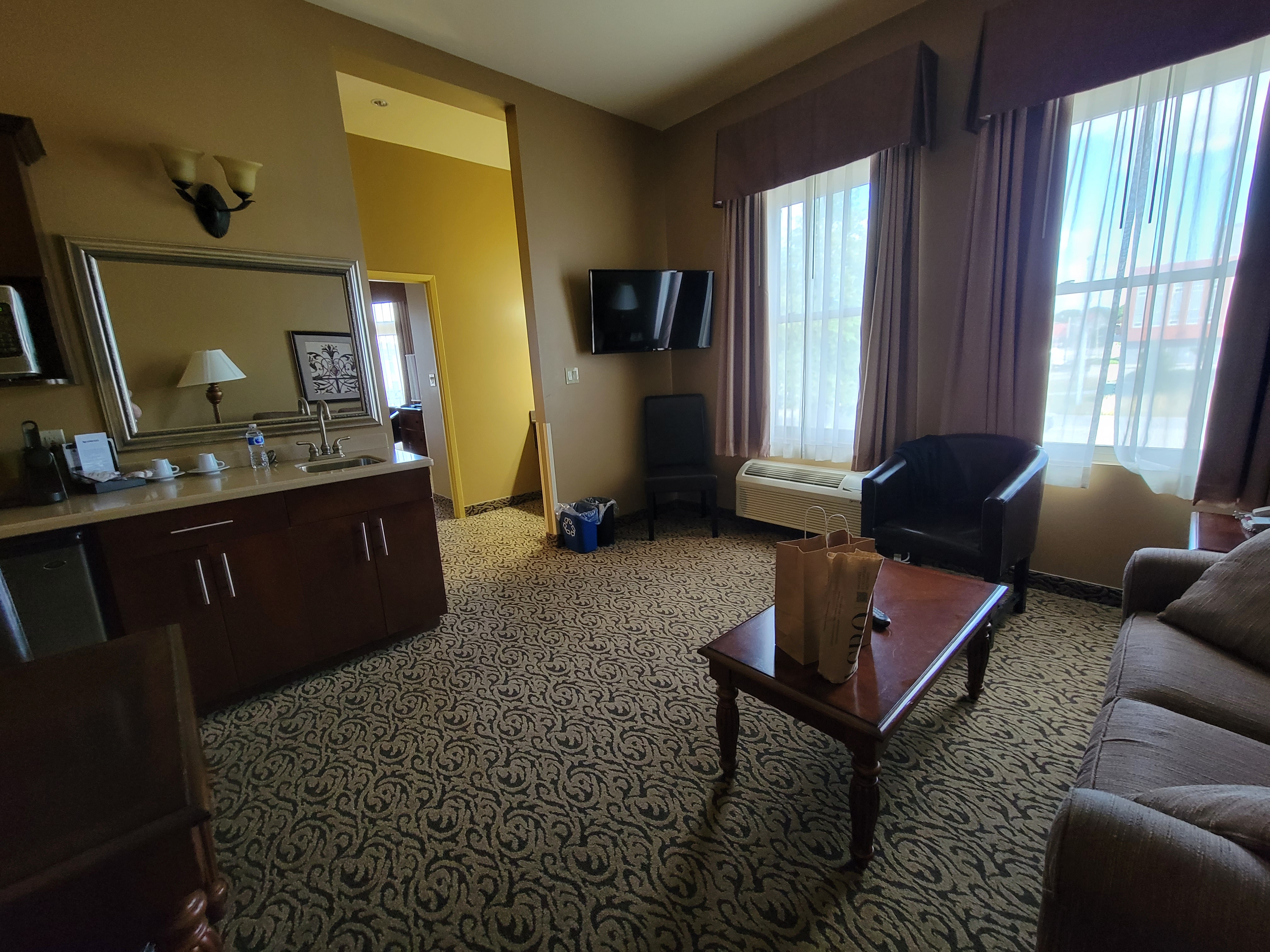
We then checked into the Parlor Inn. I am not a big fan of Choice hotels but this impressed me. Free parking!! In fact, we liked it so much that it will now be our place to stay in Stratford. Hotel images from their website.
The Parlour Inn, originally called The Mansion House, was built in 1871 to serve the Grand Trunk Railway and repair facility nearby. At the time, the hotel had a special ladies waiting room where women were required to wait while their husbands finished business and social meetings. We’ve come a long way baby!
Our room - my photos.
BTW our beloved Kenneth Cole weekend bag on bed, the zipper finally broke this weekend. So sad, it has travelled a lot of miles.
We went to the LCBO (liquor store right across the street) and got chocolate and then rested in our room before going for a drink and dinner.
Avon Theatre, one of 4 Stratford festival theatres, all within walking distance of town.
Dinner at Foster's Inn. We had eaten here in 2018 and I should have read my review before I made my reservation.
We shared a shrimp salad, rather limp.
John would have had pasta but they didn't have a gluten free option. How hard is it to have a couple of boxes of gluten free and a dedicated pot to boil it in??
John's sirloin was awful and his fries were drowned in au jus. He commented to the server and she said he wasn't the only one to complain and comp'd his meal.
My salmon was good but the potatoes were also drowned in a mediocre tomato sauce. She took $10 off my meal. So overall she compensated us $50!
But we enjoyed ourselves never the less!
Sunday morning we ate in the hotel restaurant and should have eaten here last night. Prices are comparable and the menu better.
I notice Picard's at the last moment, we need to get peanuts.
Spotted a yellow ducky.
Back home and met up with a friend upstairs in the club.
This boat washed up a couple of weeks ago during a strong wind. Not sure who is responsible for getting it moved.
Monday, a holiday, John golfed. I stayed home and enjoyed puttering around. John had reserved a birthday lunch for Thursday but I said we should cancel, we've been out and about and didn't need to spend the money.
Tuesday I went for a haircut while John relaxed at home. we binged on Top of the Lake although I had already seen it!
No haircut on Wednesday either. John played his best game of the season 82 with 2 birdies!
I sorted through some photos in the trunk and threw out this pile. More to do. I also found some travel photos from the 80s that somehow were never scanned so I need to do that too.
No haircut Thursday either. John did a Costco run which meant we had to put it all away. The beer fridge needed defrosting.
We decided we needed a new printer, the small one we bought isn't an all in one. Scanning on my phone is fine for one offs but not for a pig job.
I went through some of the CDs and reformatted a bunch to throw out. More to do. We had kept John's old laptop as it has a CD reader.
Friday I did some more CDs.
Some things made it into the charity bag, a plastic container, a basket shelf and a cookbook.
Friday John golfed. I went for some groceries and went to Winners.
W have been away the last two weekends so it will be nice to be home this weekend.
According to Google this was our July.
WATCHING
We watched Crime, created by Irvine Welsh (a favourite Scottish writer of mine).
Thirteen Lives is a 2022 American biographical survival film directed and produced by Ron Howard. The film stars Viggo Mortensen, Colin Farrell, Joel Edgerton, and Tom Bateman. The film chronicles the events of the 2018 Tham Luang cave rescue that saw a junior football team and their coach trapped in a cave for a period of 18 days.
And I can tell you that you will spend an hour of the running time experiencing the primal terror of being underground, underwater, and suffering the agony with every scrape of helmet on rock and panicked squeak of a cylinder running low on oxygen.
We loved it.
I'm watching the latest season of Great British Bake Off - season 12 here.
COOKING
Saturday - Stratford
Sunday - ordered Swiss Chalet
Monday - slow cooker beef stew
Tuesday - spaghetti Caesar salad focaccia
Wednesday - pork belly bites tacos
Thursday - rotisserie chicken nachos
Friday - steak, broccolini mushrooms and onions
My new cookbook came, the one I raved about last week!
READING
I am binging on Claire Allan's books set in Derry, Northern Ireland. I finished The Liar's Daughter, dark and twisty, it spills dark family secrets. It was a little predictable towards the end but I still enjoyed it.
I started another of hers, Ask No Questions. I am reading her books out of order, there are recurring characters, but it doesn't matter to me.
While we were in Stratford on the weekend we took a drive west to visit St. Mary's.
BTW there is a lot more to do in St. Mary's. There is a quarry to swim in and many other historic homes on side streets.
The first European settlers arrived in St. Marys in the early 1840s, attracted by the area's natural resources. At the new town site, Trout Creek met the Thames River and cascaded over a series of limestone ledges, providing the power to run the first mills.
The first thing you see as you drive in is the Water Tower on the southeast corner of Queen and James Streets. The limestone and steel water tower was constructed in 1899.
This is illustrated through the slogan written on the tower. Although originally painted for the Old Boys Reunion in 1927 to read: “St. Marys, a Fine Place to Live,” visitors and residents are now welcomed into the town with: “St. Marys, The Town Worth Living In.” The Water Tower is a fine example of industrial architecture constructed at the turn of the century in Southwestern Ontario. The cylindrical tower is built of solid local limestone with a steel tank. It has an Italianate design typical of many other buildings erected in St. Marys during this period. The construction of a water tower was a very significant investment; this coupled with a water tower's public function resulted in early waterworks facilities having excellent architectural design. This can be seen in the tower's arched windows and decorative banding on the base and by the silver-grey painted steel tank. Another noteworthy feature is the peaked roof.
The Grand Trunk was incorporated in 1853 to run from Sarnia to Portland, Maine. Although it took in existing lines, new ones had to be built, including the Toronto to Sarnia section which was undertaken by the Canadian firm of Gzowski and Company and completed in 1859. This station is a rare example in stone of the stations built by the Gzowski firm for the Grand Trunk. Erected between 1854 and 1856, the station served for a time as the western terminus of the line and later became an important junction on the railway.
St. Mary's Junction Railway Station (Grand Trunk) National Historic Site of Canada portrays the Italianate design for a First Class Way Side Station created by British architect Francis Hopkins for stations of the early Grand Trunk Railway line.
Whispers on the Path is currently a duo of painters: Metis indigenous artist Annette Sullivan, and allied supporter Angela Found, both residents of London Ontario. The pair focuses on the intersection of reconciliation, equality and identity exploration. Their approach is transformational through mutual allyship with growth and expansion of heart and mind being driving factors. In the initial meeting the topic of reconciliation was foremost of importance and declared paramount in this artistic process.
The collaborative journey started in 2019, when Annette Sullivan and Angela Found began in depth discussions about the possibilities and the process of creating art focusing on spiritual connections. An artist union was forged in a sacred ceremony honoring Turtle Island (North America), the ancestors, the natural elements, and creative energies.
We parked to walk around. It was hot and Sunday morning (of a long weekend) so it was pretty quiet.
The Opera House was constructed 1879-1880 for the Independent Order of Oddfellows. There were stores on the first floor, an 800-seat theatre on the second floor and meeting rooms for the Oddfellows on the third. Declining membership in the Lodge and losses from the theatre caused the Oddfellows to sell the building in 1904.
3 years later the firm of harness makers who bought the building went bankrupt and mill owner George Carter, Son & Co acquired the building. The entire block was converted to a flourmill in 1919, and functioned as such until 1973. In 1987, it was restored and now contains stores and apartments.
In the riverbed and along the banks, limestone was close to the surface and could be quarried for building materials. Many 19th century limestone structures still remain including but not limited to churches, commercial blocks, and private homes. They have given St. Mary's its current nickname: Stonetown.
This building is one of the first limestone blocks built in town. The site of this
store may be significant as the place where the first general store existed, a log structure built by John Ingersoll in 1841. It was certainly the most
important intersection in the newly founded village.
William Veal Hutton, a prominent early businessman, was the first owner of the
current building. Originally, this block was two storeys and housed two separate
stores on the lower level and office space on the upper level. A further two-storey
rear wing was added along Water Street sometime after 1880. The third storey with
a mansard roof was added to the block between 1882 and 1885. Two one-storey
sections have since been added to the rear of the block.
The original frame paneling of the store front windows and doors and the other
wooden decorative features of this remarkably well-preserved facade are ample
reason for its designation. Furthermore, this building is the best example of the
Second Empire Style in St. Mary's. This style, very rare in the town, is typified by
the sloping mansard roof line with the decorative slate tiling and the boldly
projecting, pedimental dormers that light the third storey. The fireplace on the
second floor, which is intact and probably dates from the time that the original two
storey block was built (1852-1857), is also included in this designation.
This building with its clock tower has been a landmark on Queen Street in St.
Mary's since it was constructed for William Andrews, a local jeweller, in 1884. It
was designed by St. Mary's architect William Williams in the Second Empire style.
Its façade is richly ornamented with features in the Italianate style.
While the building was owned by four succeeding generations of the Andrews
family (1884-2004,) the Town of St. Mary's supported the maintenance of the clock
– often referred to as the Town Clock. The building has almost miraculously
retained all of its important original exterior and interior features. As an ensemble,
it is unique in St. Mary's and a rarity in the entire province.
I cannot find any information on this water fountain.
In 1891, after the frame town hall on this site burned, Town Council ran a
competition for the design of the new town hall. Toronto architect George Wallace
Gouinlock’s plans for a Richardson-Romanesque building were chosen. Work on
the new municipal building got underway in 1891.
It was built of St. Marys limestone with contrasting red sandstone for window
arches and checkerboard effects in the façade. The massive entrances on the south
and west façades and the two towers on the south emphasize the intent of the Town
Council to erect a building of lasting and permanent character. The structure was
completed at the cost of about $15,000. Contractors were local craftsmen: John
Elliot (masonry), Jacob Near (carpentry), John Willard (painting and glazing), Fred
Patterson (plastering) and J.C. Gilpin (galvanized iron).
Many decades later, this building remains a landmark for this town.
5 buildings in the row with the pharmacy sign.
This attractive series of brick store fronts, dating from 1910 and earlier, serves,
through successive graduations in height, to carry the line of the block down the
gradual slope of the street. Through their charm and simple design the store fronts
bring a unity to the impressive streetscape and present a significant addition to the
downtown core.
The buildings were originally owned by early St. Marys businessmen James Eaton
(145), Robert Eaton (147,149) and George Carter (151, 153). Currently they
remain well maintained retail and commercial outlets.
This two-and-a-half storey building is one of the best preserved limestone
commercial buildings in St. Mary's and is also one of the earliest. Built of coursed
St. Marys’ limestone before 1859, the cast iron window supports, doors, and
cornice of their building are all original.
The second storey windows, squared with flat stone arches, originally had six
panes in each sash. The dormers are flanked by classicizing, flattened pilasters.
This building is one of only a handful of limestone buildings in St. Mary's that is
still almost perfectly preserved. It has been a commercial outlet for its entire
history with a variety of retail tenants.
The Grand Central Hotel with the balcony.
The Grand Central Hotel is associated with early St. Mary's prominent, local businessman and politician, T.B Guest. Built for Guest, in circa 1850, the Grand Central Hotel is the earliest surviving hotel in the town. Guest built the first general store in St. Mary's and due to the trade generated by the store, the potash trade became a substantial part of the town's identity. He was also responsible for building and operating many other stores in the downtown and was an ambitious politician, serving as the first Reeve of Blanshard Township, the first Reeve of the Village of St. Mary's and later the first Mayor of the Town of St. Mary's. Guest was also an elected member of the Ontario Legislature for South Perth.
The Grand Central Hotel is representative of early hotel architecture in the Town of St. Mary's. The three-storey, flat-roofed building was originally constructed as a wood frame building. The present buff-brick and cornice was added in 1894. The symmetrical second and third-storey, features eleven windows with radiating voussoirs and a small veranda, which is accessed by two small doors visible above the main entrance. Most notable on the façade is the entablature reading “Grand Central Hotel”, which is topped with a cornice that is supported by decorative wooden brackets.
The first-storey of the hotel originally housed two shops whose storefronts were remodelled in the 1920s, when the original carriageway was removed, to make room for a third shop.
This three-storey limestone building is associated with the early commercial
development of the Town of St. Marys. Early retail in the town was spearheaded
by three men: John Ingersoll, Lauriston Cruttenden and James McKay. These men
opened stores on Queen Street, establishing it as the main commercial centre of
town.
This property is believed to have been the site of a log cabin, likely built by
Cruttenden or McKay, that functioned as one of the earliest retail establishments in
St. Marys. The log structure was replaced by two storeys of the current limestone
structure before 1859 with the third storey added a few years later.
It has functioned as a commercial building since its construction and is
remembered as Parson’s Fair, then Cy Cline’s clothing store, then Humphry’s
Fashions and, for some year, the St. Marys Journal Argus building.
Still a retail outlet, its limestone facade contributes to the vernacular architecture of
downtown St. Marys.
Several log and timber bridges had been built to cross the river at this location but
had been hard to maintain to a safe standard. In August 1864, Town Council
authorized the signing of a contract with Alexander McDonald “for the construction
of a stone arched bridge across the Thames on Queen Street,” according to the plan
submitted by Mr. Niven, P.L.S. The cost was $4450.
The bridge served the town well for 120 years, the stone arches withstanding many
floods and ice jams. But in the 1980s, it was deemed inadequate for new Ministry of
Transportation standards. Demolition was threatened – and, in fact, the original
stonework was removed. However, the new bridge (completed November 1984) was
designed to replicate the 1865 design and this was apparently sufficient for the
Ontario Heritage Trust to recognize the Victoria Bridge with a Heritage Easement.
These sculptures were in the parking lot by the river behind the opera house.