DAY 13, Monday - Farewell in Paris
LUGGAGE OUT - 7 AM
DEPART - 8 AM
Sunrise in Amboise.
Hallelujah! We'll be on our own by this afternoon!
It was a great tour and we've seen some incredible places. We did 1,800 km by bus. We couldn't have had a better tour guide than Laura.

Photo in the hotel hallway of the grand hall in Chateau de Chenonceau that we visited yesterday.


Begin by crossing the Loire River and head back to the capital city of Paris for time at leisure to independently discover this city with its never-ending surprises.
We were given a surprise photo op before our final drive back to Paris.


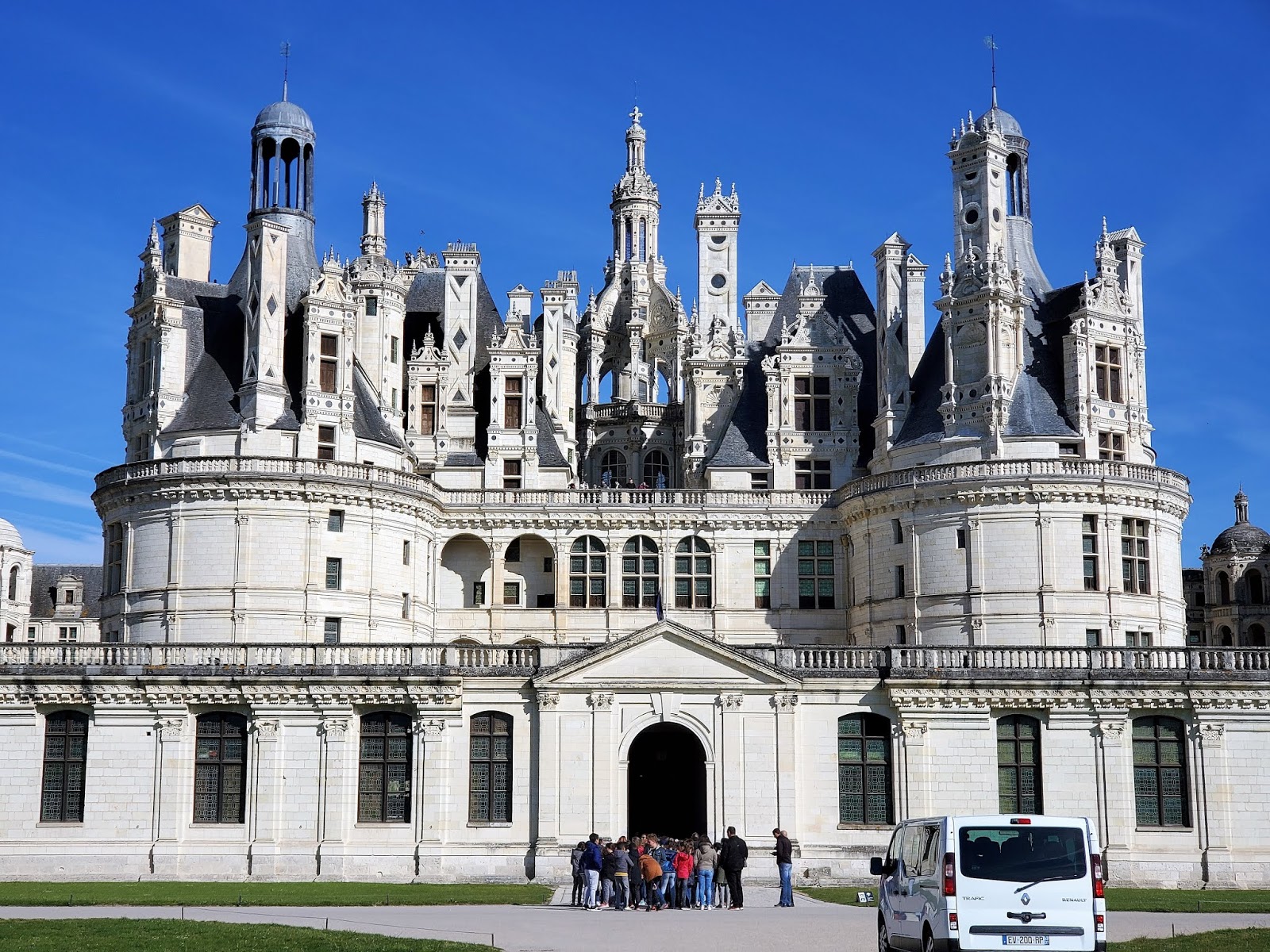
We were given a surprise photo op before our final drive back to Paris. However, Francois, our driver also got a surprise when he got to the road to the chateau and it was closed for construction. That meant he had to drive around the Chambord estate to another entrance. This immense property, dominated by woods, sprawls over 13,000 acres and is entirely secured by an imposing enclosure wall that is 20 miles long.
Now this is a chateau I would like to visit, it's too bad it isn't included in the tour.
One of the architectural highlights is the spectacular open double-spiral staircase that is the centrepiece of the château. The two spirals ascend the three floors without ever meeting, illuminated from above by a sort of light house at the highest point of the château. There are suggestions that Leonardo da Vinci may have designed the staircase, but this has not been confirmed. Writer John Evelyn said of the staircase "it is devised with four [sic] entries or ascents, which cross one another, so that though four persons meet, they never come in sight, but by small loopholes, till they land. It consists of 274 steps (as I remember), and is an extraordinary work, but of far greater expense than use or beauty".
The Château de Chambord is one of the most recognizable châteaux in the world because of its very distinctive French Renaissance architecture which blends traditional French medieval forms with classical Renaissance structures. The building, which was never completed, was constructed by King Francis I of France.
Chambord is the largest château in the Loire Valley; it was built to serve as a hunting lodge for Francis I, who maintained his royal residences at the Château de Blois and Amboise where we stopped yesterday.
The original design of the Château de Chambord is attributed, though with some doubt, to Domenico da Cortona; Leonardo da Vinci may also have been involved.

The church and city hall.


Chambord was altered considerably during the twenty-eight years of its construction (1519–1547), during which it was overseen on-site by Pierre Nepveu. With the château nearing completion, Francis showed off his enormous symbol of wealth and power by hosting his old archrival, Emperor Charles V, at Chambord.
In 1792, in the wake of the French Revolution, some of the furnishings were sold and timber removed. For a time the building was left abandoned, though in the 19th century some attempts were made at restoration. During the Second World War, art works from the collections of the Louvre and the Château de Compiègne were moved to the Château de Chambord.

Yikes! There were hordes of school kids visiting.
The roofscape of Chambord contrasts with the masses of its masonry and has often been compared with the skyline of a town: it shows eleven kinds of towers and three types of chimneys, without symmetry, framed at the corners by the massive towers. The design parallels are north Italian and Leonardesque. Writer Henry James remarked "the towers, cupolas, the gables, the lanterns, the chimneys, look more like the spires of a city than the salient points of a single building."


Back on the bus and Laura doesn't want to make any stops before Paris as she wants to get there by 12:30.
An interesting building just outside Paris, I am trying to find out what it is.

Laura has repeatedly said our rooms would not be ready but we could leave our stuff at the hotel. Some people were taking the optional tour and others were spending the afternoon on their own.
Perhaps join the optional tour of the Louvre Museum where you will enjoy the expertise of a professional guide.
Mercure Paris Centre Tour Eiffel
But the hotel had all our rooms ready and we dropped our hand luggage in our room. Our luggage would be delivered later.

We had no intentions of going to the included farewell dinner, so done with this crowd and group dinners. Our plan was to spend our last day in Paris on our own.
Fifteen people took the optional tour of the Louvre which we declined as we've done the Louvre. So they hustled off. Even if you were not going on the Louvre tour Laura would drop anyone who wanted in the area.
The dinner plan was to be picked up at the hotel at 6 PM otherwise meet outside the Pantheon at 6:30. Laura was extremely flexible this way.
We got ourselves settled in our rooms and then grabbed a taxi up to Sacre Coeur Chapel. Taxi rides in Paris are so different than home. The cars are spacious, clean and have sun roofs.
John is dumbfounded as we hit the world's craziest roundabout. Here is a YouTube video I found.
From our first trip to Paris in 1992 Sacre Coeur has mesmerized us.
The Sacré-Coeur, consecrated in 1919, is one of the most iconic monuments in Paris. At the top of the Butte Montmarte, it has one of the most beautiful panoramic views of the capital, from 130 metres above ground. In a Roman-Byzantine style, the Sacré Coeur is recognizable by its white colour.
Don't judge us, we didn't go inside. It was such a glorious day outside with the sun finally shining and the line was long...
Plus we've been lining up with a tour group for the last 12 days......


No schedule, no plans, just strolling.
We had a late light lunch in the sunshine.


Montmartre, otherwise known as The Mountain Of Martyrs is a real melting pot of art, religion and strip joints!

Pigalle was formerly associated with hazy dark rooms, art, music and exotic performances, and is home to the iconic Moulin Rouge, birthplace of the modern can-can.

We went to a dinner and performance at Moulin Rouge on our 2012 trip. ✅ done and no need to do it again.


Montmartre Cemetery is a cemetery in the 18th arrondissement of Paris that dates to the early 19th century. Officially known as the Cimitière du Nord, it is the third largest necropolis in Paris, after the Père Lachaise cemetery and the Montparnasse cemetery.

Interesting. Voting booths set up on the street for Sunday's European elections.

Church of Saint-Jean-de-Montmartre


Place Vendôme was built on the orders of Louis XIV, as a grandiose setting that would embody absolute power in the very heart of Paris. Napoleon replaced the statue of the king, dismantled in 1792, with a bronze column made from 1,200 enemy canons. During the Second Empire, however, the octagonal square – a marvel of classical urban design – gradually became a showcase for luxury goods rather than political power. The world’s great jewellery brands have turned Place Vendôme and the adjoining Rue de la Paix into one continuous stream of window displays filled with sparkling diamonds, rubies and emeralds.


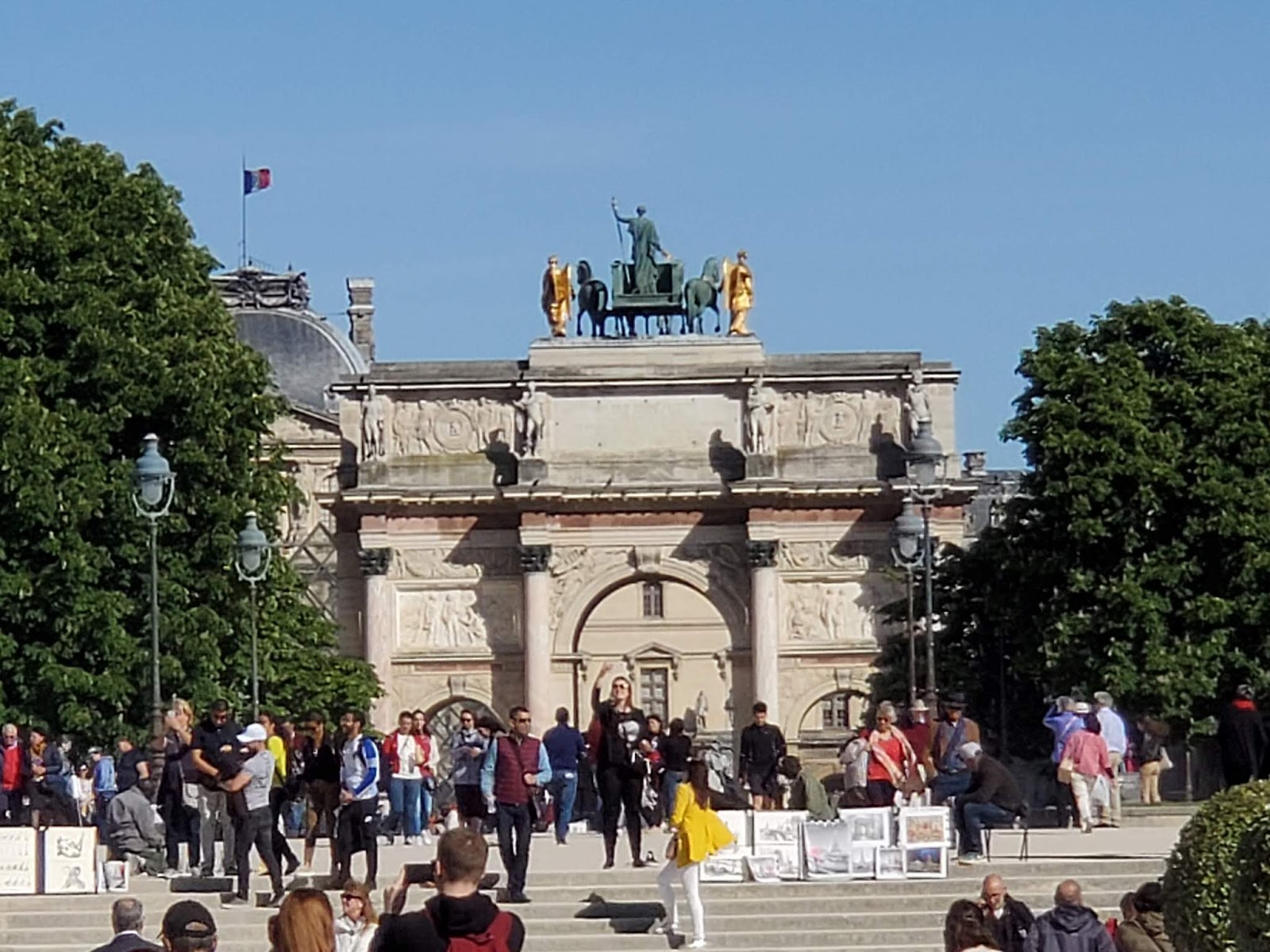
The Arc de Triomphe du Carrousel delineates the Louvre Palace from the Tuileries gardens.
The imposing triumphal arch commemorates the victory of Napoleon at the Battle of Austerlitz in 1805 and is a replica of the Arch of Septimus Severius in Rome.
Six of the monument's low reliefs depict Napoleonic victories.

Goats tending the lawns of the Tuileries Garden, near the Louvre.


Just before the Solferino Bridge is a stairway, on the left, leading to an elevated walkway that offers an overview of the Tuileries Garden. At the east-end of this promenade is a haunting sculpture called, "Cain and His Sons".

Many web sites state Les Fils de Cain was produced in 1906, however, according to the official website for the artist, Paul Landowski, this was produced in 1903 representing a shepherd, poet and blacksmith.

An entrance to the Louvre.


There isn't a lineup for Saint Chapelle so we go through security and buy tickets.
The Sainte-Chapelle is a royal chapel in the Gothic style, within the medieval Palais de la Cité, the residence of the Kings of France until the 14th century, on the Île de la Cité in the River Seine.
Construction began some time after 1238 and the chapel was consecrated on 26 April 1248. It was commissioned by King Louis IX of France to house his collection of Passion relics, including Christ's Crown of Thorns – one of the most important relics in medieval Christendom, later hosted in the nearby Notre-Dame Cathedral until the 2019 fire, which it survived.


To exit we have to pass through the Palais' courtyard.

Enough pomp and ceremony, it is time for a drink and dinner in the Latin Quarter.

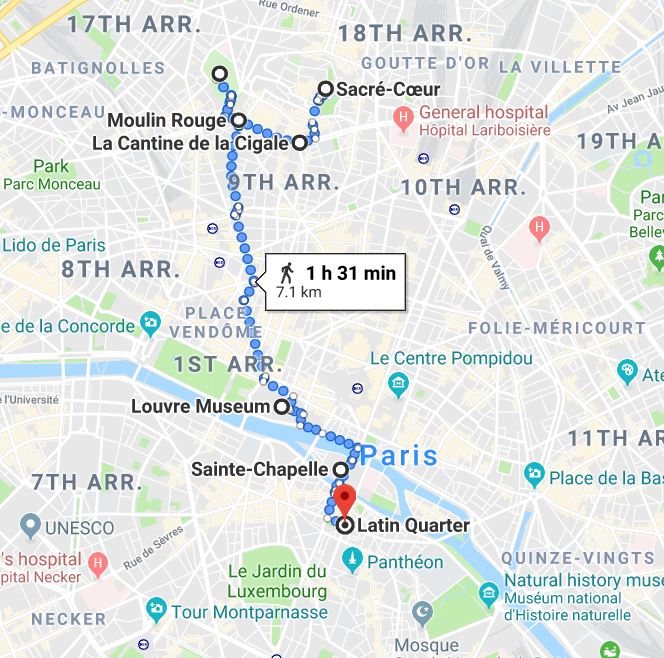
An overview of our walk today not including forays down laneways and other stops. Not bad considering we spent the morning on a bus from Amboise and then taxied to and from the hotel.

TIME 6 at hotel or 6:30 outside the Pantheon -Tonight, gather together for a Farewell Dinner in a Parisian bistro, including wine as you bid au revoir to your new-found friends and a fascinating journey through France.
Optional: Louvre Museum Tour (PM)
Overnight: Paris
Meals: Breakfast, Dinner
We then chose a French bistro for dinner, they played typical French music in the background.

Farewell dinner was included in a restaurant near the Pantheon, we skipped it.
However, John ran into the group on their return and received numerous hugs. Then S and B came to our room with a bottle of wine and we had a great time chatting about everyone!
Click here for our day's details.
Steps 19,382 14.43 km
Links to previous posts about this trip:

The church and city hall.


Chambord was altered considerably during the twenty-eight years of its construction (1519–1547), during which it was overseen on-site by Pierre Nepveu. With the château nearing completion, Francis showed off his enormous symbol of wealth and power by hosting his old archrival, Emperor Charles V, at Chambord.
In 1792, in the wake of the French Revolution, some of the furnishings were sold and timber removed. For a time the building was left abandoned, though in the 19th century some attempts were made at restoration. During the Second World War, art works from the collections of the Louvre and the Château de Compiègne were moved to the Château de Chambord.

Yikes! There were hordes of school kids visiting.
The roofscape of Chambord contrasts with the masses of its masonry and has often been compared with the skyline of a town: it shows eleven kinds of towers and three types of chimneys, without symmetry, framed at the corners by the massive towers. The design parallels are north Italian and Leonardesque. Writer Henry James remarked "the towers, cupolas, the gables, the lanterns, the chimneys, look more like the spires of a city than the salient points of a single building."

Back on the bus and Laura doesn't want to make any stops before Paris as she wants to get there by 12:30.
An interesting building just outside Paris, I am trying to find out what it is.

Laura has repeatedly said our rooms would not be ready but we could leave our stuff at the hotel. Some people were taking the optional tour and others were spending the afternoon on their own.
Mercure Paris Centre Tour Eiffel

We had no intentions of going to the included farewell dinner, so done with this crowd and group dinners. Our plan was to spend our last day in Paris on our own.
Fifteen people took the optional tour of the Louvre which we declined as we've done the Louvre. So they hustled off. Even if you were not going on the Louvre tour Laura would drop anyone who wanted in the area.
The dinner plan was to be picked up at the hotel at 6 PM otherwise meet outside the Pantheon at 6:30. Laura was extremely flexible this way.
We got ourselves settled in our rooms and then grabbed a taxi up to Sacre Coeur Chapel. Taxi rides in Paris are so different than home. The cars are spacious, clean and have sun roofs.
John is dumbfounded as we hit the world's craziest roundabout. Here is a YouTube video I found.
From our first trip to Paris in 1992 Sacre Coeur has mesmerized us.
The Sacré-Coeur, consecrated in 1919, is one of the most iconic monuments in Paris. At the top of the Butte Montmarte, it has one of the most beautiful panoramic views of the capital, from 130 metres above ground. In a Roman-Byzantine style, the Sacré Coeur is recognizable by its white colour.
Don't judge us, we didn't go inside. It was such a glorious day outside with the sun finally shining and the line was long...
Plus we've been lining up with a tour group for the last 12 days......


No schedule, no plans, just strolling.
We had a late light lunch in the sunshine.


Montmartre, otherwise known as The Mountain Of Martyrs is a real melting pot of art, religion and strip joints!

Pigalle was formerly associated with hazy dark rooms, art, music and exotic performances, and is home to the iconic Moulin Rouge, birthplace of the modern can-can.

We went to a dinner and performance at Moulin Rouge on our 2012 trip. ✅ done and no need to do it again.


Montmartre Cemetery is a cemetery in the 18th arrondissement of Paris that dates to the early 19th century. Officially known as the Cimitière du Nord, it is the third largest necropolis in Paris, after the Père Lachaise cemetery and the Montparnasse cemetery.

Interesting. Voting booths set up on the street for Sunday's European elections.

Church of Saint-Jean-de-Montmartre


Place Vendôme was built on the orders of Louis XIV, as a grandiose setting that would embody absolute power in the very heart of Paris. Napoleon replaced the statue of the king, dismantled in 1792, with a bronze column made from 1,200 enemy canons. During the Second Empire, however, the octagonal square – a marvel of classical urban design – gradually became a showcase for luxury goods rather than political power. The world’s great jewellery brands have turned Place Vendôme and the adjoining Rue de la Paix into one continuous stream of window displays filled with sparkling diamonds, rubies and emeralds.


The Arc de Triomphe du Carrousel delineates the Louvre Palace from the Tuileries gardens.
The imposing triumphal arch commemorates the victory of Napoleon at the Battle of Austerlitz in 1805 and is a replica of the Arch of Septimus Severius in Rome.
Six of the monument's low reliefs depict Napoleonic victories.
Goats tending the lawns of the Tuileries Garden, near the Louvre.


Just before the Solferino Bridge is a stairway, on the left, leading to an elevated walkway that offers an overview of the Tuileries Garden. At the east-end of this promenade is a haunting sculpture called, "Cain and His Sons".

Many web sites state Les Fils de Cain was produced in 1906, however, according to the official website for the artist, Paul Landowski, this was produced in 1903 representing a shepherd, poet and blacksmith.

An entrance to the Louvre.


There isn't a lineup for Saint Chapelle so we go through security and buy tickets.
The Sainte-Chapelle is a royal chapel in the Gothic style, within the medieval Palais de la Cité, the residence of the Kings of France until the 14th century, on the Île de la Cité in the River Seine.
Construction began some time after 1238 and the chapel was consecrated on 26 April 1248. It was commissioned by King Louis IX of France to house his collection of Passion relics, including Christ's Crown of Thorns – one of the most important relics in medieval Christendom, later hosted in the nearby Notre-Dame Cathedral until the 2019 fire, which it survived.


To exit we have to pass through the Palais' courtyard.

Enough pomp and ceremony, it is time for a drink and dinner in the Latin Quarter.

An overview of our walk today not including forays down laneways and other stops. Not bad considering we spent the morning on a bus from Amboise and then taxied to and from the hotel.
TIME 6 at hotel or 6:30 outside the Pantheon -
Overnight: Paris
Meals: Breakfast, Dinner
We then chose a French bistro for dinner, they played typical French music in the background.

Farewell dinner was included in a restaurant near the Pantheon, we skipped it.
However, John ran into the group on their return and received numerous hugs. Then S and B came to our room with a bottle of wine and we had a great time chatting about everyone!
Click here for our day's details.
Steps 19,382 14.43 km
Links to previous posts about this trip:
May 5 - Dijon to Lyon
May 6 - Lyon to French Riviera
May 7 - French Riviera
May 8 - French Riviera to Carcasonne
May 9 - Carcasonne to Lourdes
May 12 Bordeaux to Loire ValleyMay 6 - Lyon to French Riviera
May 7 - French Riviera
May 8 - French Riviera to Carcasonne
May 9 - Carcasonne to Lourdes