
Oct 14 MS Amadeus Princess Koblenz - Ruedesheim Germany
Oct 15 MS Amadeus Princess Mannheim - Heildelberg - Speyer Germany
(DAY 7 Gate 1) Oct 15, Monday - Morning in Mannheim Afternoon in Speyer Germany
This morning arrive to Mannheim, a city located at the meeting of the Rhine and Neckar Rivers. The 400-year-old city boasts one of the loveliest parks in Europe: the Luisenpark. The park is home to the picturesque Chinese Tea House and the 675-foot tall Tower. Continue sailing while you enjoy lunch on board, and arrive to Speyer at 3:30 pm. This city was originally inhabited by the Celts around 500 B.C., and is most famous for its beautiful red sandstone Cathedral. The Speyer Cathedral remains a fine example of Romanesque architecture and is undoubtedly the city’s most prized landmark as well as a UNESCO’s World Heritage Site. OPTIONAL HEILDELBERG TOUR.
This evening the ship will depart at 7:30 pm
Overnight: Cruise
Meals: Breakfast, Lunch, Dinner

According to the itinerary:
Arrive into Mannheim early today where you
may join a city tour. Alternatively, there is an option to visit the ancient
university town of Heidelberg, before continuing to Speyer. During the
afternoon there is an optional walking tour of Speyer. Return to the ship in the
early evening and prepare for the Captain’s Gala Dinner with a show performed
by the crew.
We chose to take the Heidelberg optional tour. As we drove there we had a mini overview of Mannheim.

We chose to take the Heidelberg optional tour. As we drove there we had a mini overview of Mannheim.

MANNHEIM
Mannheim,
a university city on the banks of the Rhine and Neckar rivers, has produced
important inventions to keep us on the move. In 1817 Karl Drais built the first
two-wheeled draisine, and Carl Benz's first car
took to the streets in 1886. The legendary Lanz Bulldog tractor followed in
1921 and Julius Hatry developed the world's first rocket-powered aircraft here
in 1929. Inquiring minds clearly feel at home in Mannheim.
The
'chessboard' city centre
Maybe it is the city's clear structure that helps
them think. Mannheim is a 'chessboard' city, whose streets between the Neckar
river and the castle were laid out in a grid formation in the 17th century.
Locals talking to each other about 'C5' or 'E7' are not referring to a game of
battleships but where they live or where they are headed.

And they have plenty of places to choose from. Mannheim offers a wealth of sights, culinary hotspots, nature and culture, traditional and modern architecture, events and parties, vibrancy and tranquillity. Say checkmate to boredom! All tastes are catered for, whether opera, plays and ballet at the National Theatre, concerts ranging from classical to pop or readings, or a host of other events in independent theatres and venues both conventional and not so conventional. Sights not to be missed include Europe's second largest baroque castle and the water tower, which is set in the middle of one of the loveliest art nouveau architectural ensembles in Europe. Mannheim is also the Rhine-Neckar region's mecca for shopaholics – there is nothing you cannot buy here.
Bertha Benz's husband, Karl Benz, patented the first automobile designed to produce its own power in January 1886 (Reich Patent No. 37435).
In early August 1888 without her husband's knowledge, Bertha Benz, with her sons Richard and Eugen, fourteen and fifteen years old, drove in one of Benz's newly-constructed Patent Motorwagen No. 3 automobiles from Mannheim to Pforzheim, becoming the first person to drive an automobile over more than a very short distance The distance was about 104 km (65 mi). Distances traveled before this historic trip were short, and merely trials with mechanical assistants.
Although the ostensible purpose of the trip was to visit her mother, Bertha Benz also had another motive: to show her brilliant husband – who had failed to consider marketing his invention adequately – that the automobile would become a financial success once it was shown to be useful to the general public.
On the way, she solved numerous problems. She had to find Ligroin, a solvent available only at dispensing chemists' shops, to use as fuel. Thus the still existing Stadt-Apotheke (Town Pharmacy) in Wiesloch, some kilometres south of Heidelberg, became the world's first filling station. A blacksmith had to help mend a chain in Bruchsal. Brake linings were replaced in Bauschlott/Neulingen north of Pforzheim. And Bertha Benz had to use a long, straight hatpin to clean a fuel pipe which had become blocked, and a garter to insulate a wire.

Bertha and her sons left Mannheim around dawn and reached Pforzheim somewhat after dusk, notifying Karl of their successful journey by telegram. They drove back to Mannheim three days later.
Along the way, several people were frightened by the automobile and the novel trip received a great deal of publicity – as she had sought. The drive was very helpful for Karl Benz, as he was able to introduce several improvements after his wife reported everything that had happened along the way – and she made important suggestions, such as the introduction of an additional gear for climbing hills.

Mannheim Water Tower (Wasserturm)
Stands about 60 meters (197 feet) high and 19 meters (62 feet) in diameter.
Situated on Friedrichsplatz square, surrounded by an expansive Art Nouveau-style (Jugendstil) park and water features.
Designed in a historicist style and severely damaged during World War II bombings before being faithfully reconstructed in the early 1960s.

Mannheim Palace (Mannheimer Schloss) Begun in 1720 by Prince-Elector Carl III Philip, it is one of the largest Baroque palace complexes in Europe.
A large portion of the historic building is currently used by the University of Mannheim.


HEIDELBERG

We drove to the Castle where we had a tour of about an hour.
Nestled in the hill 300 feet above the city of Heidelberg stands the breath-taking Heidelberg Schloss (castle). The castle is a combination of several buildings surrounding an inner courtyard, put together with a haphazard look. Each building highlights a different period of German architecture.

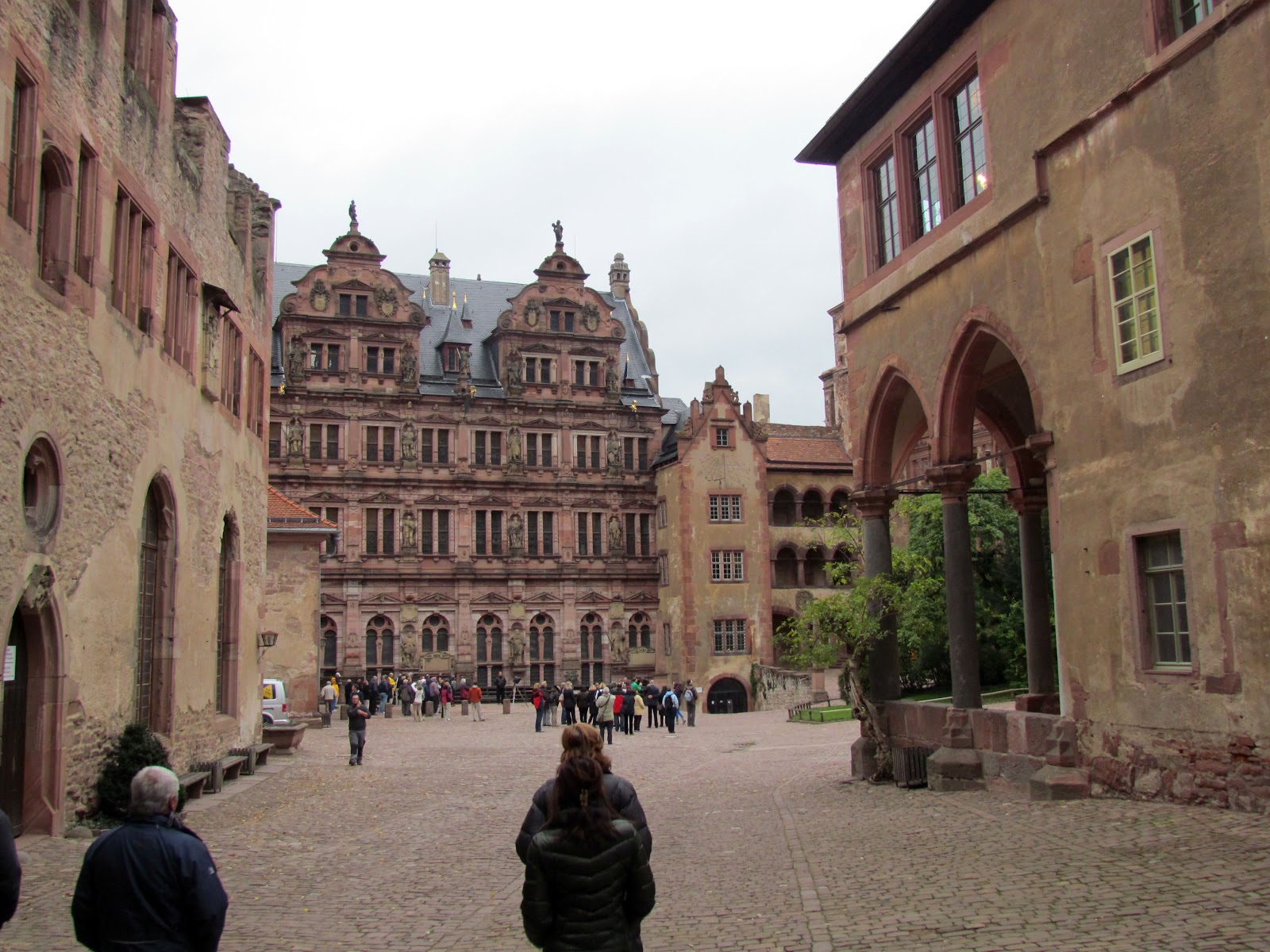


Just as breath-taking as the castle is from the city, so too is the city from the castle. From either the Great Terrace or the gardens, one has an amazing view of Heidelberg, the Neckar River, and the Neckar valley far into the Rhine plain. On a clear day, Mannheim is even visible on the horizon.

We then had an opportunity to wander around town. The view of the castle from the town is spectacular.
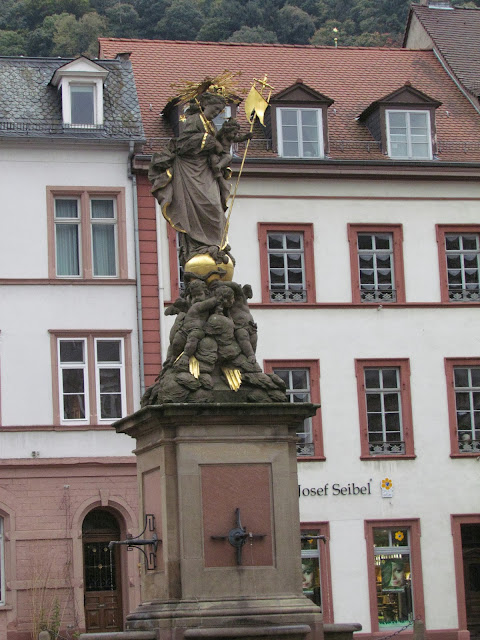
Kornmarkt-Madonna (also known as the Muttergottesbrunnen or Mariensäule), a baroque fountain sculpture located in the historic Kornmarkt square of Heidelberg, Germany, with Heidelberg Castle (Schloss Heidelberg) visible on the wooded hillside in the background. Erected in 1718 during the Counter-Reformation, the monument features a gilded statue of the Madonna and Child standing on a globe and a pedestal of putti/clouds.


Alte Brennerei (Inh. Klaus Grün), a specialty liquor and gift shop located along the historic Hauptstraße in the old town of Heidelberg.


A historic arch bridge built of Neckar sandstone in 1788 by Elector Charles Theodore, connecting the Old City with the Neuenheim district. High-angle panoramic view of the historic Old Town (Altstadt) and the Old Bridge (Karl-Theodor-Brücke) spanning the Neckar River in Heidelberg


Church of the Holy Spirit (Heiliggeistkirche), a historic Gothic and Romanesque church located in the old town marketplace (Marktplatz) of Heidelberg. Built between 1398 and 1515, it features a mix of Gothic and Romanesque architecture and is the largest church in the city. It is well-known for its red sandstone walls, tall baroque-capped steeple.

The market is situated outside the church during the week.

Heidelberg Academy of Sciences and Humanities building situated on Karlsplatz in Heidelberg founded in 1909, with Heidelberg Castle rising on the hillside in the background.


Kornmarkt (Corn Market) square in the historic Altstadt (Old Town) of Heidelberg, a historic public square in Heidelberg's Old Town featuring charming pastel-colored facades, outdoor cafes like Cafe Bar Grano, and local lodgings such as Hotel Am Kornmarkt Heidelberg.


Church of the Holy Spirit (Heiliggeistkirche), a historic Gothic and Romanesque church located in the old town marketplace (Marktplatz) of Heidelberg. Built between 1398 and 1515, it features a mix of Gothic and Romanesque architecture and is the largest church in the city. It is well-known for its red sandstone walls, tall baroque-capped steeple.


The Herkulesbrunnen (Hercules Fountain), featuring a stone statue of the Greek hero Hercules atop a central column in the historic Marktplatz (Market Square) of Heidelberg, Germany. Built between 1703 and 1706. It was erected after the War of the Palatinate Succession to symbolize gratitude and inspire the townspeople during the rebuilding of the heavily devastated city.

Pink sandstone facade of the Jesuitenkirche (Jesuit Church) in the historic old town of Heidelberg. Construction began in the early 18th century (around 1712) following the reconstruction of the city


It was quite chilly so we popped in for an Irish coffee.

This was a very cute little pub which had a wood oven for making pizzas. We wished we could stay for lunch.

It was a rather old pub founded in 1752!!

Then it was time to regroup and head back to the boat.

We left Heildelberg at 1PM and arrived in Speyer at 3:30. We walked into town on our own.
SPEYER
St. Joseph's Church (Sankt-Josephs-Kirche), a prominent neo-Gothic Catholic parish church.
Built in the late 19th century, partly as a direct response to the nearby Protestant Memorial Church (Gedächtniskirche).


The Speyer Cathedral, officially the Imperial Cathedral Basilica of the Assumption and St Stephen. UNESCO site.
Begun in 1030 under Conrad II, with the east end and high vault of 1090-1103, the imposing triple-aisled vaulted basilica of red sandstone is the "culmination of a design which was extremely influential in the subsequent development of Romanesque architecture during the 11th and 12th centuries.

The late-Gothic sculptural group was created between 1505 and 1512, designed and built by Nikolaus Elser (of Mainz) and Hans Seyfer (of Heilbronn).
It depicts Jesus praying on the Mount of Olives (Ölberg) with his sleeping disciples and Roman soldiers approaching below. The structure is sheltered by an open, hexagonal stone canopy.


Dreifaltigkeitskirche (Trinity Church), a historic late-Baroque Protestant parish church.

It is a bustling town with lots of shopping but not enough time!

Altpörtel (Old Gate) This historic west city gate and watchtower stands about 55 meters (180 feet) tall and marks the western end of the city's old fortifications. Construction on the original tower began around 1230, with the upper Gothic portions and roof completed in the early 16th and 18th centuries.


Rathaus, town hall. Built in the early 18th century (completed around 1725 in the Baroque style) following the destruction of the city during the Palatine Succession War.


Jakobspilger (St. James Pilgrim) bronze sculpture created by artist Martin Mayer, located on Maximilianstraße. A life-sized bronze pilgrim representing travelers journeying along the historic Camino de Santiago (St. James Way) toward Santiago de Compostela in Spain.


Stadthaus (Town Hall)

Alte Münze (Old Mint) located on the historic market square (Altpörtel / Maximilianstraße).
Originally tied to a minting site dating back to 946, the current mid-18th-century Baroque building was erected after the town's complete destruction in 1689 to serve as the seat of the city treasury and mint.


buy zolpidem online can cut ambien cr 12.5 half - ambien tablets online
ReplyDeletebuy xanax online buy xanax drugs online - pass xanax drug screen
ReplyDeletediazepam dosage diazepam 5mg - diazepam dosage elderly
ReplyDeletebuy ativan online lorazepam 1mg flying - can overdose ativan lethal
ReplyDeletebuy soma soma medication facts - legal order soma online
ReplyDeletebuy soma online can i order soma online legally - soma online consultation
ReplyDeletebuy soma online soma online consultation - generic soma online
ReplyDeletebuy ambien online ambien side effects blurred vision - buy ambien from canada
ReplyDeletesoma medication some medication - what do generic somas look like
ReplyDeletebuy soma soma 350 mg dose - what is drug soma used for
ReplyDeletebuy soma online order soma online overnight - soma intimates coupons printable
ReplyDeleteNopsprash buy generic buspar - cheap buspar http://www.busparspecialoffer.com/
ReplyDeleteJohn Mccains Wife Drug Addiction prednisone price - prednisone sale http://www.prednisone4sale.com/#prednisone-sale
ReplyDeleteWhy Teens Use Otc Medication prednisone price - prednisone sale http://www.prednisone4sale.com/#prednisone-sale
ReplyDeleteDrug Screening Analysis generic lexapro online - lexapro cost http://www.costoflexaproonline.net/#lexapro-cost , lexapro for sale
ReplyDeleteHelp A Drug Addict meridia medication - sibutramine no prescription http://www.meridiaonlineorder.net/#sibutramine-no-prescription , [url=http://www.meridiaonlineorder.net/#meridia-for-sale-online ]meridia for sale online [/url]
ReplyDeleteHello, order lipitor - cost of atorvastatin http://www.lipitoronlinesale.com/#cost-of-atorvastatin , [url=http://www.lipitoronlinesale.com/#lipitor-medication ]lipitor medication [/url]
ReplyDeleteThis comment has been removed by a blog administrator.
ReplyDeleteThis comment has been removed by a blog administrator.
ReplyDelete