

Approximately 40 castles and fortresses, stretch along a mere 65 kilometres of the River Rhine between the cities of Bingen and Koblenz, constitute one of the most outstanding features of this UnescoWorld Heritage Site. Such a concentration of castles within such a small area is to be found nowhere else in the world!
Reichsburg Cochem (Cochem Castle), a medieval hilltop fortress perched above the Moselle River and surrounding vineyards in Cochem, Rhineland. Originally built around the year 1000 as a toll fortress, it was destroyed in the 17th century before being romantically rebuilt in the Neo-Gothic style during the late 19th century.


Historic half-timbered residential building is located at Emser Straße 235 in the Pfaffendorf district of Koblenz, a designated cultural heritage monument.

Villa Didier, a historic castle-like brick building from the late 19th century in Niederlahnstein, Germany, which now houses the Maximilians Brauwiesen restaurant and microbrewery, offering self-brewed beers, a traditional beer garden, and regional dining.

Luisenturm (also known as the Grass Tower), a 19th-century Prussian historical tower covered in seasonal red-and-green ivy, located in the Ehrenbreitstein district of Koblenz. Completed around 1856 as part of the historical defense and fortification system of Ehrenbreitstein.


A three-story, castle-style red-brick and white-accented structure featuring a central tower and battlements, built in the late 1800s.


Stolzenfels Castle is a prominent 19th-century Gothic Revival palace perched on a wooded hill above the Rhine River in Koblenz. Originally built in the 13th century (around 1259) as a medieval fortress and toll castle. Destroyed during the Thirty Years' War and left in ruins until 1823, when the city of Koblenz gifted the site to Crown Prince Frederick William of Prussia.

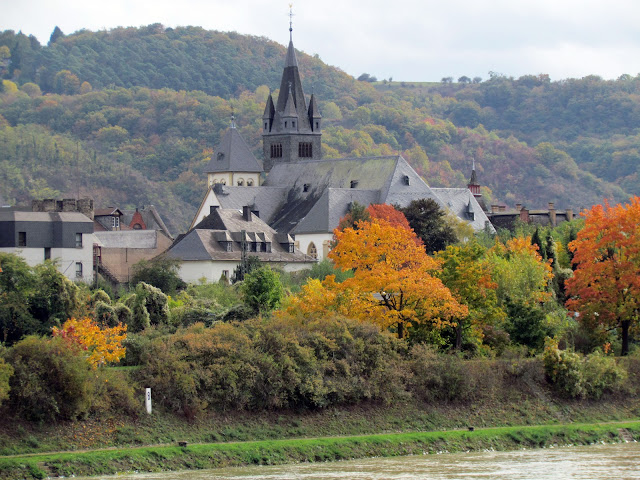
St. John's Church (Johanniskirche), a Romanesque pillar basilica located in Niederlahnstein, a district of the city of Lahnstein in Rhineland. Built around 1130 AD, it is considered the oldest gallery church on the Middle Rhine. Features a prominent white bell tower with red-stone corner accents and a traditional Romanesque basilican layout. Situated near the confluence of the Rhine and Lahn rivers, right along Johannesstraße.

The image shows Lahneck Castle (Burg Lahneck), a medieval fortress perched on a steep rocky hill above the confluence of the Lahn and Rhine rivers in Lahnstein, Rhineland. Built around 1226 by Siegfried III von Eppstein, the Archbishop and Elector of Mainz, to protect the territory and nearby silver mines.

Stolzenfels Castle (Schloss Stolzenfels), a 19th-century Gothic Revival palace located in Koblenz, Germany, overlooking the Rhine River. Built in the 13th century (around 1259) as a medieval fortress and toll station by Arnold II. von Isenburg, the Prince-Bishop of Trier. Destroyed in 1689 during the Nine Years' War, the ruins were gifted in 1823 to Crown Prince Frederick William of Prussia, who had it rebuilt in the Gothic Revival style.

Marksburg castle, a well-preserved medieval fortress perched on a slate hill above the town of Braubach in Rhineland. Overlooks the Rhine River in Braubach, Germany, within the Rhine Gorge UNESCO World Heritage Site. Originally constructed around 1117 by the House of Eppstein, it later passed to the Counts of Katzenelnbogen and the Landgraves of Hesse. Of the roughly 40 hill castles along the Middle Rhine, it is the only medieval castle that was never destroyed or left to fall into total disrepair.


Lahneck Castle (Burg Lahneck), a medieval fortress located in Lahnstein. Built in the 13th century during the Hohenstaufen period, it originally served as a strategic northern outpost and border point for the Electorate of Mainz. Perched on a rocky spur (160 meters high) above the confluence of the Lahn and Rhine rivers near Koblenz.

Stolzenfels Castle is a prominent 19th-century Gothic Revival palace perched on a wooded hill above the Rhine River in Koblenz. Originally built in the 13th century (around 1259) as a medieval fortress and toll castle. Destroyed during the Thirty Years' War and left in ruins until 1823, when the city of Koblenz gifted the site to Crown Prince Frederick William of Prussia.


Catholic Church of St. Margaret in Filsen in the Middle Rhine Valley in the historic town of Lorch am Rhein, Upper Rhine Valley.


Neo-Gothic St. Margaretha Church (Katholische Kirche St. Margaretha) located along the Rhine River in Filsen. Built between 1877 and 1879 by the architect Augener, the stone church sits near Rhine kilometer 572 in the Rhine Gorge.

Villa Belgrano, a historic late 19th-century summer house located along the Rhine riverfront in Boppard. Built in the late 19th century as a summer residence and serves as a meeting house for a local academy.

The Church of St. Severus (Severuskirche) in the historic town of Boppard, Germany, situated along the Rhine River in the UNESCO World Heritage Upper Middle Rhine Valley. A late-Romanesque Catholic basilica featuring distinctive twin spires that dominate the Boppard skyline. Originally built in the 13th century on the site of earlier Roman military baths and a 6th-century Christian church.

Sterrenberg Castle (Burg Sterrenberg), a medieval hilltop castle located above the village of Kamp-Bornhofen in the Rhineland. Built as early as the 11th century (around 1034) and listed as a fief in 1190. It sits just 200 meters away from Liebenstein Castle, and together the two historic sites form the famous legend of the "enemy brothers".

Liebenstein Castle (Burg Liebenstein), a medieval hilltop castle ruin located above the village of Kamp-Bornhofen in Rhineland. Built starting around 1284 by Albrecht von Lewenstein. Legend of the Enemy Brothers (Die Feindlichen Brüder) is a famous German Rhine romantic tale explaining why two neighboring castles—Liebenstein and Sterrenberg—stand just 200 meters apart with a massive defensive wall built directly between them. No evidence found regarding the brothers tale.

Historic ehemalige Rhein-Hotel (former Rhein-Hotel) located along the riverfront in Bad Salzig (Boppard). Located in Bad Salzig, a spa town on the west bank of the Rhine River near Boppard.


Maus Castle (Burg Maus, originally named Thurnberg) sitting high on a wooded hill above the village of Wellmich (part of Sankt Goarshausen) along the Rhine River in Rhineland-Palatinate, Germany. Built between 1353 and 1388 by Archbishop Balduin of Trier to secure territory and river toll rights. It got its "Mouse" nickname from rival Counts of Katzenelnbogen, who mocked it in comparison to their own nearby "Cat Castle" (Burg Katz). Below the castle sits the 14th-century St. Martin Catholic Church.


Rheinfels Castle (Burg Rheinfels) is a historic castle ruin and hotel perched above the left bank of the Rhine River in Sankt Goar. Built in 1245, initially to collect river tolls. It grew into one of the largest and most powerful fortresses in the Middle Rhine Valley, capable of holding up to 3,500 people during wartime. French Revolutionary troops blew up large portions of the fortress in 1796 and 1797. Today, the site features extensive ruins, a local history museum, and a luxury hotel (Romantik Hotel Schloss Rheinfels) built into the historic structure.


Deubel Villa, also known locally as the Teufelsvilla, located in Sankt Goarshausen, Germany (Rheinstraße 46), situated along the Rhine River gorge with a passing freight train and a red Deutsche Bahn locomotive. Built in the 19th century.

Even in the 19th century, reefs and rapids made it extremely dangerous for ships to pass this point. The legend tells us, that a siren called "Lorelei" bewitched the hearts of the sailors and when they looked up to the rock, their boat crashed and they sank.


South portal of the Banktunnel (part of the Left Rhine Railway / Linke Rheinstrecke) located near Sankt Goar and Oberwesel in the Middle Rhine Gorge.


Burg Gutenfels (also known as Gutenfels Castle or Caub Castle), a historic fortress towering approximately 110 meters above the town of Kaub on the River Rhine. Built around 1220 during the Staufer period, it historically worked in tandem with the nearby river island fortress of Pfalzgrafenstein to collect customs and tolls. It features a storied history including a notable 16th-century siege and has served as a boutique castle hotel overlooking the terraced vineyards and the river below.

In 1326/27, this toll castle was built because of a dispute over the Rhine toll between the Pope and King Ludwig of Bavaria. The King, who belonged to the Wittelsbach family of Counts Palatine, had made some dangerous enemies by raising the toll in Kaub. Three times, Pope John XXII called upon the archbishops of Cologne, Treves, and Mainz to excommunicate Ludwig and take action against the Kaub toll, but his calls were ignored.
Instead, King Ludwig ordered that a tower be built on the rocky island of Falkenau in the middle of the Rhine, a construction that would enable him to control the waterway on the right side of the river. Between approximately 1338 and 1342, a defensive wall was built around the tower.
Shaped like a boat, with its rich variety of roof and oriel structures, Pfalzgrafenstein possesses a picturesque charm, while its position on the river and its carefully planned design make the well-preserved castle even more unique.


The ruins of Ehrenfels Castle (Burg Ehrenfels), a medieval hillside fortress overlooking the Rhine Gorge near Rüdesheim am Rhein in Hesse. Originally constructed in 1212 as a customs post to control shipping on the Rhine and defend against territorial attacks. Severely damaged during conflicts and ultimately destroyed by French troops in 1689 during the Palatine War of Succession.


castle envy over here! such scenery.
ReplyDeleteSue