
July 2018 - Toronto ON
It's funny that I worked in this area for a few years and yet never came out at this subway exit.
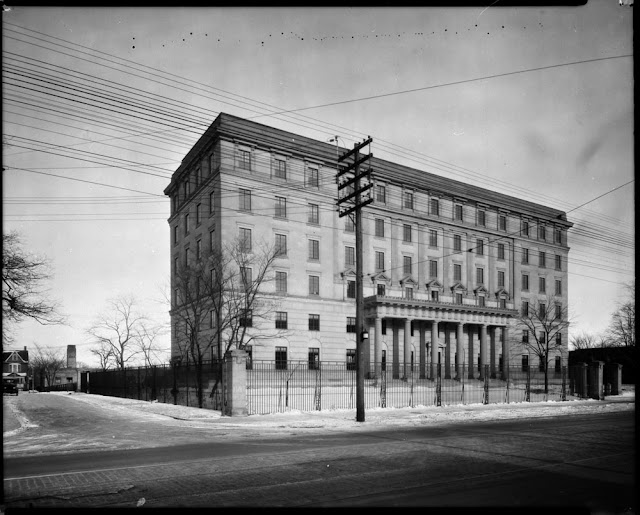
I stepped into this office building to get my orientation and saw these old photos of the area.


Turns out I was in the Crown Life Insurance Company of Canada which was founded in 1900 and was based in Toronto. It was acquired by Canada Life in 1998.
Formerly the Canadian headquarters of Crown Life Insurance this building was vacated in the early 1990’s by the tenant and sat mostly empty until 1998. Built in two eras, the 50s and then added onto in the 70s, 120 Bloor Street East resulted in two diverse architectural styles. In 1998, contemporary design merged with classical detailing to restore the long lost grandeur to a well-respected 350,000 square foot commercial space.


I divert from my plan when I see this sign across the street.
St. Andrew's United current church building dates from 1983 having a flexible worship space, fully air-conditioned multi-use facilities, underground parking, an elevator and commercial-grade kitchen facilities. Backlit stained glass windows shine out every evening for all to see.

Click here to learn more about Joseph Bloor and see more photos of Bloor St.


You can't see it in the photo but there is a lot of stained glass inside. The door was locked.

For many years we would drive past this church and even admired the building of the addition but had never been inside. I will feature it in an upcoming inSPIREd Sunday. It turned out to be one of the most interesting interiors I have seen in Toronto. St. Paul's Anglican Church.
The flag is at half mast due to the Danforth shootings on Sunday.

I've shown this sculpture before but any photos were taken from a car.
I took the photo of the church from this building, while this one was taken from the church steps.
Manulife Financial Headquarters.
The firm was founded as The Manufacturers Life Insurance Company in 1887. Its first president was Sir John A. Macdonald, the first Prime Minister of Canada. The company sold its first policy outside of Canada in Bermuda in 1893. In 1894, policies were sold in Grenada, Jamaica and Barbados; Trinidad and Tobago, and Haiti in 1895; and British Honduras, British Guiana, China and Hong Kong in 1897.
One of its founding fathers was George Gooderham who was a renowned international businessman in the distillery business. His distillery is now the Distillery District, a vibrant neighbourhood of shops, theatre and restaurants.

Constructed in 1925 with eight stories, then in 1953 an additional twelve stories were added.
Community by Kirk Newman.


The grounds of Manulife are a green sanctuary in the middle of a lot of greyness.


If you follow this path you will come to the ravine.

The Rogers Building is part of the corporate campus of Canadian media conglomerate Rogers Communications, as well as the home of most, but not all, of the company's Toronto operations.

Constructed in 1925 with eight stories, then in 1953 an additional twelve stories were added.

Community by Kirk Newman.


The grounds of Manulife are a green sanctuary in the middle of a lot of greyness.


If you follow this path you will come to the ravine.

The Rogers Building is part of the corporate campus of Canadian media conglomerate Rogers Communications, as well as the home of most, but not all, of the company's Toronto operations.

Located at 1 Mount Pleasant Road / 1 Ted Rogers Way (formerly 777 Jarvis Street), the complex occupies almost all of the block bounded by Jarvis, Bloor, Huntley and Isabella Streets. Mount Pleasant Road divides the northwest corner of the block from the remainder of the site, but Rogers occupies separate buildings on both sides of Mount Pleasant which are connected by a bridge and an underground tunnel. Collectively all of the interconnected buildings (in addition to nearby buildings at 333 and 350 Bloor Street) are referred to as the Rogers Campus.
The company's cable television and magazine publishing operations, as well as its local radio stations, including CFTR (680 News) and 98.1 FM operate from 333 Bloor Street East.
Corner of Bloor East and Ted Rogers Way. These people just keep walking by.


When Rogers subsequently bought the building on that corner, they insisted on moving the sculpture to its present location. The building in the background of these photos is the Rogers building at Bloor and Jarvis (although that stretch of Jarvis has been renamed Ted Rogers Way).
The giant tree is ‘Red, Orange and Green’ by Michael Snow. This 14 metre high, stainless steel sculpture stands in a small park on Huntley Street.

A two-sided piece by Ian Leventhal in the Mt Pleasant underpass at Bloor.


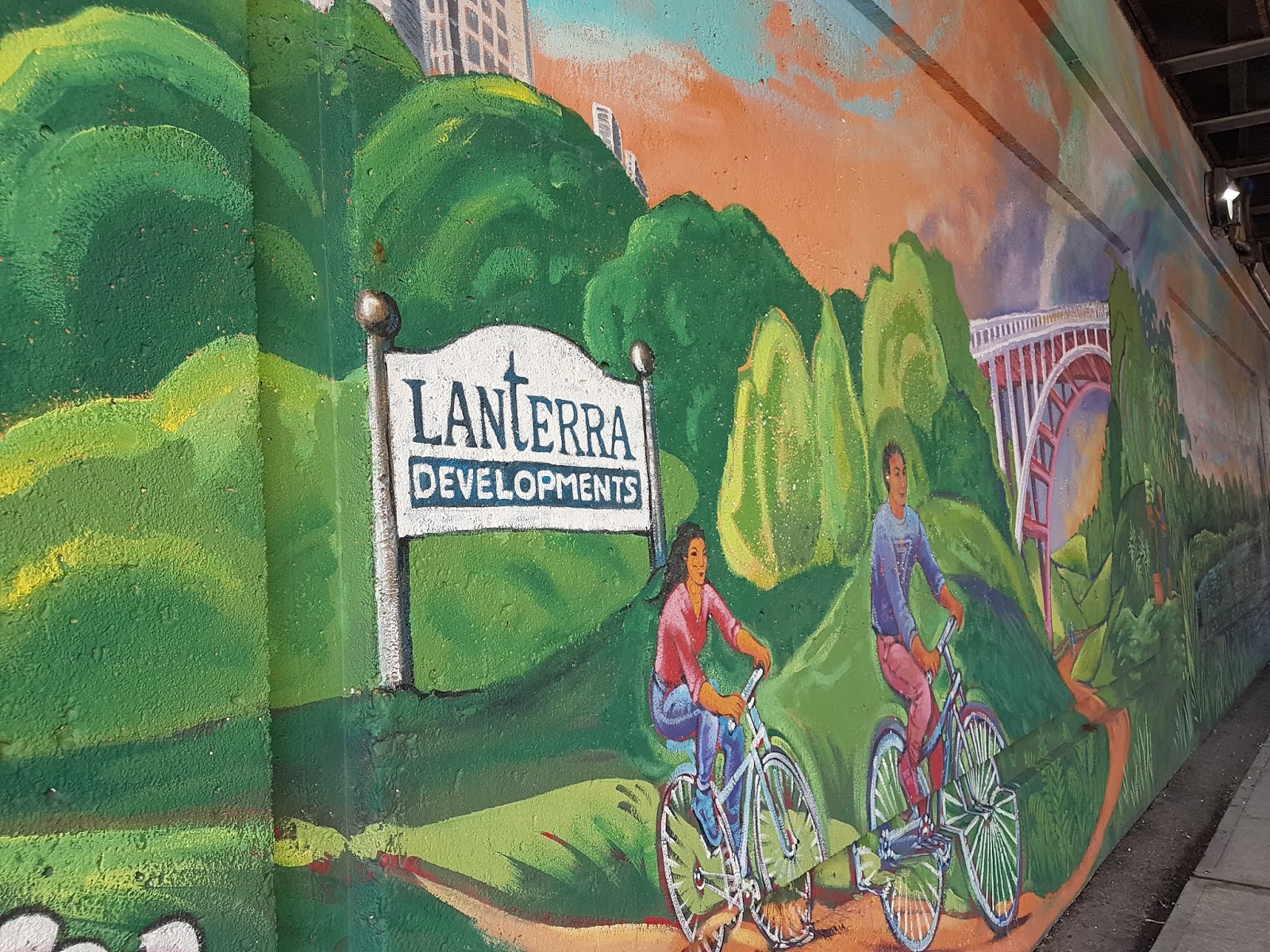


Blue waves in front of Rooster Coffee.

Onto Charles St. can't find any background on this house, will work on it.

Onto Church, the heart of the Gay Village, a mixture of architecture.


Would love one of these!


Gloucester is such a pretty quiet street right off Yonge St.
.


Back on Yonge, walking south.
Yonge is such a diversified street, and the longest street in Toronto. Click on Yonge St. in the tags below this post for lots more Yonge!


Paul Kane purchased this property and built a stucco cottage in 1853. Enlarged in the late 1850's, and again in 1873 with the addition of buff brick and a porch, the house was owned by the Kane family until 1903. From 1925 to 1973 it was used as a church hall by the Evangelical Church of the Deaf. In 1978 the City of Toronto purchased the property, assisted by Province of Ontario WINTARIO funding. In 1979 it was designated under the Ontario Heritage Act and a city park was established. The Church-Isabella Residents Co-operative Inc. leased the land in 1985 and Paul Reuber, Architect, incorporated the original house into the residential development opened in 1986. The preservation of this house in the park is a tribute to the persistent efforts of local citizens and heritage organizations.

Paul Kane purchased this property and built a stucco cottage in 1853. Enlarged in the late 1850's, and again in 1873 with the addition of buff brick and a porch, the house was owned by the Kane family until 1903. From 1925 to 1973 it was used as a church hall by the Evangelical Church of the Deaf. In 1978 the City of Toronto purchased the property, assisted by Province of Ontario WINTARIO funding. In 1979 it was designated under the Ontario Heritage Act and a city park was established. The Church-Isabella Residents Co-operative Inc. leased the land in 1985 and Paul Reuber, Architect, incorporated the original house into the residential development opened in 1986. The preservation of this house in the park is a tribute to the persistent efforts of local citizens and heritage organizations.


These murals are on Maitland between Yonge and Church and are sponsored by the Bank of Montreal BMO in support World Pride.


Royal Bank branch on Church St.

Church Mouse


I stopped to admire this house and a woman asked if I was looking for something, no, I said, just wondering if this house had a historical designation.
We chatted and she told me that it didn't but should have. She did tell me that her lawyer, in this building, was the grandson of the Galbraith that built the house.
UPDATE - Flour merchant Galbraith built himself one of the most radiant houses in Toronto in 1868.

Looking across from there.

The Laundry Lounge, corner Yonge and Wellesley.


Back at Yonge again. I featured this fire tower a few weeks ago, look at it now.
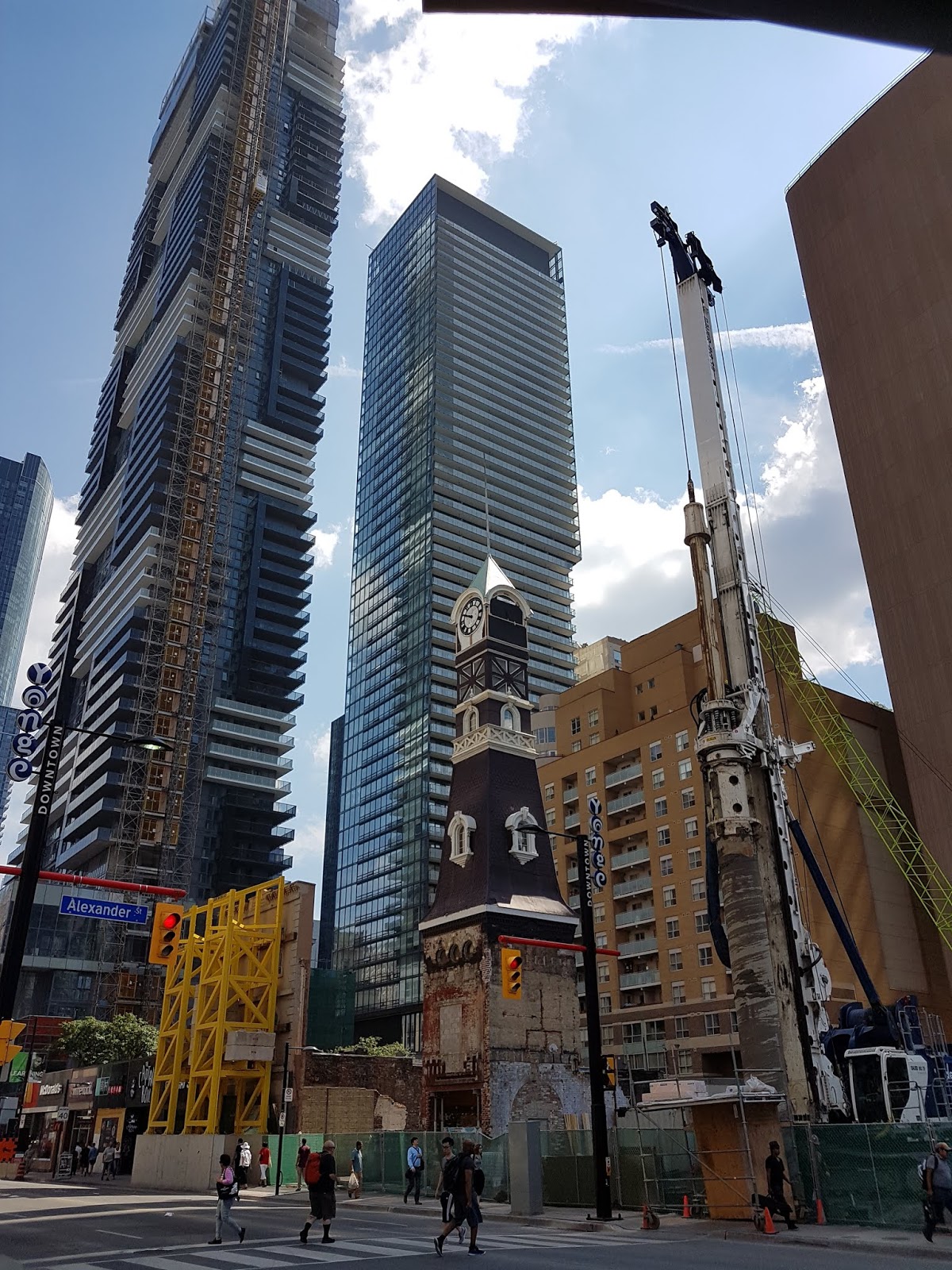

Turned down Alexander St. passed the never-ending construction to the Buddies in Bad Times Theatre.

Up the lane to find the mural, as I went to take a photo of the Sky Gilbert street sign, the woman I had met earlier, came barreling towards me on her electric scooter. I didn't get the photo, because we chatted about Toronto, favourite neighbourhoods, and where we live. Her name was June.

As I took this photo, a man said "it's not a Banksy, but it is a shame they put that door in". So we chatted about Banksy and his remaining murals in Toronto. We exchanged some locations.

One of the major figures in Toronto’s theatre history is George Luscombe, who created Toronto Workshop Productions in 1959, when it was originally called Workshop Theatre. The group has been heralded as one of the great early alternative performance troupes, and one of Canada’s first professional alternative theatre companies.
Luscombe first got involved in the arts when he assembled a song-and-dance troupe with the Canadian Commonwealth Federation Youth Club to perform for striking workers on the picket line. In the 1950s, Luscombe moved to London, England, and worked with the Theatre Workshop under Joan Littlewood, where the company put on classic and modern plays and lived in a commune. Inspired by his time across the pond, Luscombe returned to Toronto and founded his own workshop.

Working on finding out what this building is as well.

Across the street from the Courtyard Marriot on Wood St. at Yonge. This fence outlines Toronto Hydro's history.
Here is an excellent article on the history of Toronto Hydro.
You can find a statue of Adam Beck, the founder of Toronto Hydro, over on University Ave.


Just noticed that these two streets off Yonge are named Alexander and Wood. I did a post about Alexander Wood in June for World Pride kickoff.
There were a few more goodies on this excursion that deserve their own post and a few things I need to revisit.


