Showing posts with label Jewish. Show all posts

23 September 2025

Tuesday Treasures

 Tom the backroads traveller hosts this weekly meme.


August 2025 - Toronto ON

346 Spadina Avenue was the location of the Labor Lyceum, the building has been many things over the years.
It was demolished and a new building housing The Scott Mission sits there now.


It sat on the corner across from this Chinese restaurant.


The garment industry was the main employer of Jewish immigrants in the early 1900s. The Labor Lyceum was home to unions that supported the interests of workers. Learn about the industry and two key events that the Jewish community and workers actively participated in.


The plaque reads:
Established in 1913 by Henry Dworkin and Sam Easser, the Labor Lyceum Association sought to advance the interests of the city's Jewish trade union movement. Through the sale of $5.00 stock certificates, the Association purchased the houses at 344 and 346 Spadina Avenue in 1924, adding meeting rooms in 1929.
The Labor Lyceum operated as the headquarters for the non-Communist trade unions of the primarily Jewish garment district. The seasonal nature of the textile industry meant that workers could socialize and strategize here during slow work periods. The Labor Lyceum also served as an important cultural centre for various Jewish societies and fraternal organizations. It hosted a range of activities from lectures and rallies to dances, plays, and concerts. In the 1940s, the provincial Co-operative Commonwealth Federation held political conventions here.
Beginning in the 1950s, the Jewish community moved out of the Spadina Avenue area. The Labor Lyceum, however, remained significant to new immigrant groups and their labour activism. In 1971 the building was sold and the Labor Lyceum moved to Cecil Street.


In 1924, the Labor Lyceum, a union hall for Jewish workers in the garment industry, stood at the corner of Spadina and St. Andrew, in the Jewish Market, now Kensington Market. Their strike action led to better conditions for all garment workers in Toronto. So when trailblazing anarchist and feminist Emma Goldman, who J. Edgar Hoover called “the most dangerous woman in America” was exiled from the U.S. for agitating on topics as radical as birth control and women’s rights, she fittingly chose Kensington Market as her adopted home. When her funeral was held at the Labor Lyceum, the crowds caused havoc with traffic in downtown Toronto.


Emma Goldman, the renowned anarchist, lived in Toronto during various periods of her life, most notably from 1926 to 1928, 1933 to 1935, and 1939 until her death in 1940. Deported from the United States in 1919, she chose Toronto as a base for her activism in Canada. She resided on Spadina Avenue and was a central figure in a vibrant anarchist and activist community in the city.

It took me two trips to find this plaque, it was hidden in plain sight! I found the building 233 Spadina, but it looked like a non-descript cafe???

It made me laugh as I looked at this photo, you can see the plaque, but that man was blocking my view as I peered in the door, looking around for a plaque, assuming it was attached to the building itself.
I ventured in and found an assembly line of Asian women with a huge line of customers buying delicious looking sandwiches.


It's funny, and kind of amazing, to think of the history of this building. What did it look like when Emma Goldman lived here in the 1920s? What else has the building been? What was it back then?


05 September 2022

Tuesday Treasures

  Tom the backroads traveller hosts this weekly meme.

August 2022 - Toronto ON

Click here for more Jewish Toronto history.


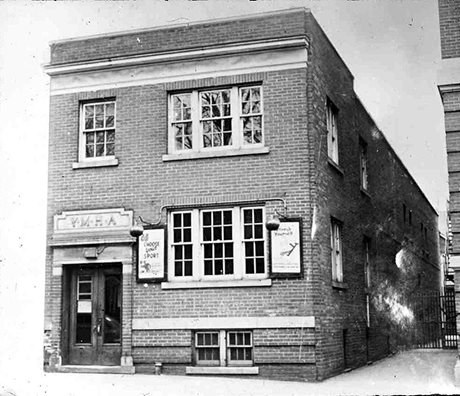
YMHA/YWHA
Credit: YMHA/YWHA building at 15 Brunswick Avenue in Toronto, c. 1960. Photo courtesy of the Ontario Jewish Archives.

Statistics:
Year club formed: 1919
Community: Toronto, Ontario
Milestones:1937 – New facility opened on Brunswick Avenue
1953 – Jewish Community Centre opened at Bloor Street at Spadina Avenue
1961 – Bathurst Jewish Community Centre opened as new facility

The Young Men’s and Women’s Hebrew Associations (YMHA/YWHA) were formed at the beginning of the 20th century to provide a place for Toronto’s Jewish youth to participate in recreational activities and to socialize. Due to discrimination in the first half of the 20th century, many Jewish immigrants were barred from participation in amateur sport leagues or clubs. 
In 1919, to meet growing needs, 21 smaller clubs in Toronto amalgamated as the YMHA/YWHA. The primary focus of the club was athletics, but they also offered educational and cultural programs. 
As enrolment increased, new facilities were built on Brunswick Avenue in 1937. This new club offered a wide range of sports, including the use of a gym and pool. In the 1940s, regulation-size courts were added to the building, the only ones in the city at the time. 
In 1953, a new facility was built at Bloor Street at Spadina Avenue, which is today the Miles Nadal Jewish Community Centre. Since 1953, other Jewish community centres have opened in the province and follow the original mandate of the YMHA/YWHA.


In 1972 it looked like this at Bloor W and Spadina.


Today it looks like this.


Here is an update to a 2018 Tuesday Treasures featuring an old theatre that is now a Shoppers Drug Mart. It seems effective now (forever?) photography is forbidden!!!


19 April 2016

Spadina St.

UPDATED August 2022 - video added.
April 2016 - Toronto ON


After we had lunch in Chinatown we went for a stroll, we had just skipped spring and it was summer 25 C!!! Click here for our lunch.


Chinatown is on Spadina at Dundas and surrounding streets. I did a walk last year featuring Chinatown so I'll try not to repeat photos.


This section of Spadina is called the Fashion District.

Click here for a video of the area's history.


The origins of Toronto's Fashion District start in the 1920s and used to be situated around King Street and Spadina Ave. Called 'The Garment District', it was the centre for fashion and textiles and many of the original building, plus their store signs, still stand today. In fact, they built a giant thimble in honour of the old Toronto Fashion area.


In the 1950s when the Jewish community that used to inhabit Spadina Ave and Kensington Market moved to Bathurst Street. Many of the immigrants were seamstresses or tailors and opened up their own businesses in the location now known as the Fashion District.

A ghost sign for M.Wintrob and Sons, purveyors of combs, curlers, sunglasses and housewares. Sounds like a department store.


This now hangs on our kitchen wall as a poster.


Discovered this "new" art gallery and cafe called the 401.


At the turn of the 20th century, the 401 Richmond building was occupied by the Macdonald Manufacturing Company, which operated a factory producing the finest lithography on tinware in Canada. The original building, which began construction in 1899, was followed by four four-storey expansions between 1903 and 1923 to the west, north, and northeast. From the sky, 401 Richmond looks like a capital "A" with a crosswalk or bridge (what we now call the skywalk) connecting the north and south buildings.

The Macdonald Manufacturing Company was purchased in 1944 by Continental Can of Canada who then occupied the premises until 1967. Over the next twenty-five years the building fell into the hands of several owners, and by 1994, was bankrupt and ready for the wrecker's ball. That same year the building was purchased by the Zeidler Family and Margaret Zeidler took over as President.


A first ever exhibition featuring Benjamin Brown, one of Toronto's most significant architects of the early 20th century.

The Ontario Jewish Archives, Blankenstein Family Heritage Centre (OJA) presents the work of Architect, Benjamin Brown (1890-1974), whose career made a significant and lasting impact on Toronto’s built heritage. Brown’s buildings—the Balfour and Tower Buildings, the Hermant Building, the Primrose Club, Beth Jacob Synagogue—are exquisite examples of Brown’s mastery of the au courant Art Deco styles while also incorporating the more traditional architectural tropes of the period. Brown’s iconic loft-style buildings on lower Spadina express his signature style that characterized the garment district for much of the 20th century.


The ten-storey Art Deco-style Tower Building at 106-110 Spadina Avenue, on the northwest corner of Adelaide and Spadina Avenue, is today a landmark structure in the Fashion District. Erected in 1927 by the Oxford Clothing Company, it was owned by the Poslun Brothers and C. James. They specialized in ladies clothing –cloaks, suits, and dresses. The Tower Building was designed by Benjamin Brown, who also designed the Balfour Building on the opposite side of the street.


I took this photo of the Tower Building when we were back on Spadina.


Across the street from the Tower Building is his Balfour Building.


A road map of his buildings around the city.


South to Queen St. W and Spadina.


This streetcar is heading south towards Harbourfront.


Dropped into this lamp shop.


We took a short detour along Queen St. W lots of fabric stores in this area.


Funky outfits.


Back on Spadina, on the west side walking north.

They didn't have a menu posted for us to check out.


We take a turn down an unfamiliar street. A very cool bench outside a men's salon.

Window display.


Odd, another men's salon, right next door.


Spotting some murals we head down another street.

Strange looking house.


I checked and this business is still operating.


Seriously they didn't have anywhere else to put their sign???


Another "remnant" in the Fashion District, it's up for lease.


Down a laneway and we realize we are in Graffiti Alley behind Queen St. W.


Back onto Spadina. School of Burlesque and cabaret Arts.


Back in Chinatown.


For over forty years, the Labor Lyceum was the epicentre of political activism for Toronto’s textile workers. Located at the southwest corner of Spadina Avenue and St. Andrew Street, it was an important cultural centre through which the collective identity of Jewish Torontonians was forged. J.B. Salsberg, a lifelong labour activist, wrote that “no single institution and no single building on Spadina – the main street of Jewish Toronto – was more important in the refashioning of the Jewish immigrant into an actively involved Canadian Jew” than was the Labor Lyceum.


Between 1901 and 1931, the Jewish population of Toronto grew from 3,000 to 45,000, a rate of growth that was four times that of the rest of the city. During this time, Toronto’s economy was growing. However, garment workers were faced with increasingly dire conditions on the factory floors. In 1913, united by hardship, they formed a co-operative led by businessman Henry Dworkin and machinist Sam Easser.

Dworkin and Easser encouraged garment union workers to purchase shares for the Labor Lyceum Association at five dollars each.

Despite their early efforts, conditions on the shop floor remained dreadful into the 1930s. Lighting was poor and there was no heating and no ventilation. Furthermore, so-called “task-masters” were charged with managing the workload, discriminating in the distribution of work and rewarding those who did favours. Armed with stopwatches, they instigated “speed-ups” when the workload increased.
On February 25, 1931, garment workers organized in front of the Labor Lyceum as part of a major strike by dressmakers. At exactly ten o’clock in the morning, members of the International Ladies’ Garment Workers’ Union (ILGWU) put down their work, stopped their machines, and abandoned their posts, walking out of garment shops along Spadina Avenue.


One final look down Spadina before we get back into the car.