Sep 20 Eastport to Trinity
We woke to this view at the Happy Adventure Inn.
We drove to Salvage Bay before heading out.
Salvage is a town on the Eastport Peninsula, population 108.
The name ‘Salvage’ is thought to have originated from the Spanish term ‘Salvaje’ meaning untamed, wild, or savage. This term was potentially used either as a dated reference to the continued presence of Beothuk people in the area throughout the early contact period. An alternative theory on the origins of the name Salvage is that it made reference to its geographic location on the edge of rough waters, comparing it to the selvage, the end of cloth materials, but this theory is not as well grounded.
An unusual Christmas tree at the church hall.
On our way to Trinity. We took the Trans Canada Highway through the Terra Nova National Park.
Many visitors pronounce Malady as if they were talking about an ailment but that’s not how locals say it. The locals say ‘ma-la-dee.’ There are stories suggesting the name came from European settlers referring to the large bluff as ‘my lady.’
A "bight" is the bend in a coast forming an open bay. In Newfoundland English the twelve communities of "Trinity Bight" define a magical place of history and heritage, of music and merriment, of character and charm.
Trinity Bight, from the north shore, contains the communities of English Harbour, Champney's East, Champney's Arm, Champney's West, Trinity East, Port Rexton, Trinity, Goose Cove, Dunfield, Trouty, Old Bonaventure and New Bonaventure.

There is no documentation showing the origin of the name, it may be from a reference by Sir Richard Whitbourne to the three arms within the harbour or may have been named by the Portuguese explorer and navigator Gasper Corte Real, who sailed into the harbour on Trinity Sunday, 1501.
The first settlers are believed to be ten families from the English Brig Hawk who settled here in 1583. In the 1700's Trinity became an important fishing and mercantile centre. Many prominent merchants from the south of England, especially Poole, established businesses that continued to operate well into the 1800's. The English considered it so valuable, that in the mid 1700's they went to the expense of building a fort here to protect the harbour from the French. Some of the cannons are still there. This was a prosperous and progressive town.
We check in at Rosewood Suites. It is a registered heritage structure. It has historic value due to its association with the Reid Newfoundland Company, the firm responsible for construction of much of Newfoundland and Labrador’s railway infrastructure. The structure was built as a railway hotel in 1910, but did not assume this use and was sold shortly after construction when the rail line was not extended into Trinity as planned. It was owned for many years by Captain George Barbour, part of the rescue effort during the 1914 sealing disaster, who converted the structure into a duplex home. The structure went through a series of owners and uses since construction, but was used as a hotel or inn for much of its history.

On Taverner's Path.
We go sightseeing and in search of lunch.
Trinity can also lay claim to a number of important first events. Sir Richard Whitbourne held the first Court of Admiralty in the New World in Trinity in 1615 and it was here that Rev. John Clinch, surgeon and missionary, administered the first smallpox vaccine in North America in 1800.
This medical and missionary pioneer came to Newfoundland from England in 1775 and later settled in Trinity (1783) where he died.
He is buried at St. Paul's Anglican Church.

St. Paul's Anglican Church in Trinity is the third Anglican church in the community since 1730. It is built on the site of the first church, which was erected in 1730, and is adjacent to the second structure, which was constructed in 1820. The bell in the third church was donated by a local merchant Robert Slade in 1833 and was initially installed in the second Trinity church.
The interior of St. Paul's is impressive as it was never painted and the original wood work is still in full view. Over the years the congregation has attempted to conceal the modernization which had to be made to the original structure. The duct work for the oil furnace, which replaced the initial two wood stoves, is concealed. Similarly three ceiling fans and a public address system were installed in such a way as to make them hardly noticeable. The most noticeable change was the transformation from oil to electric lighting.


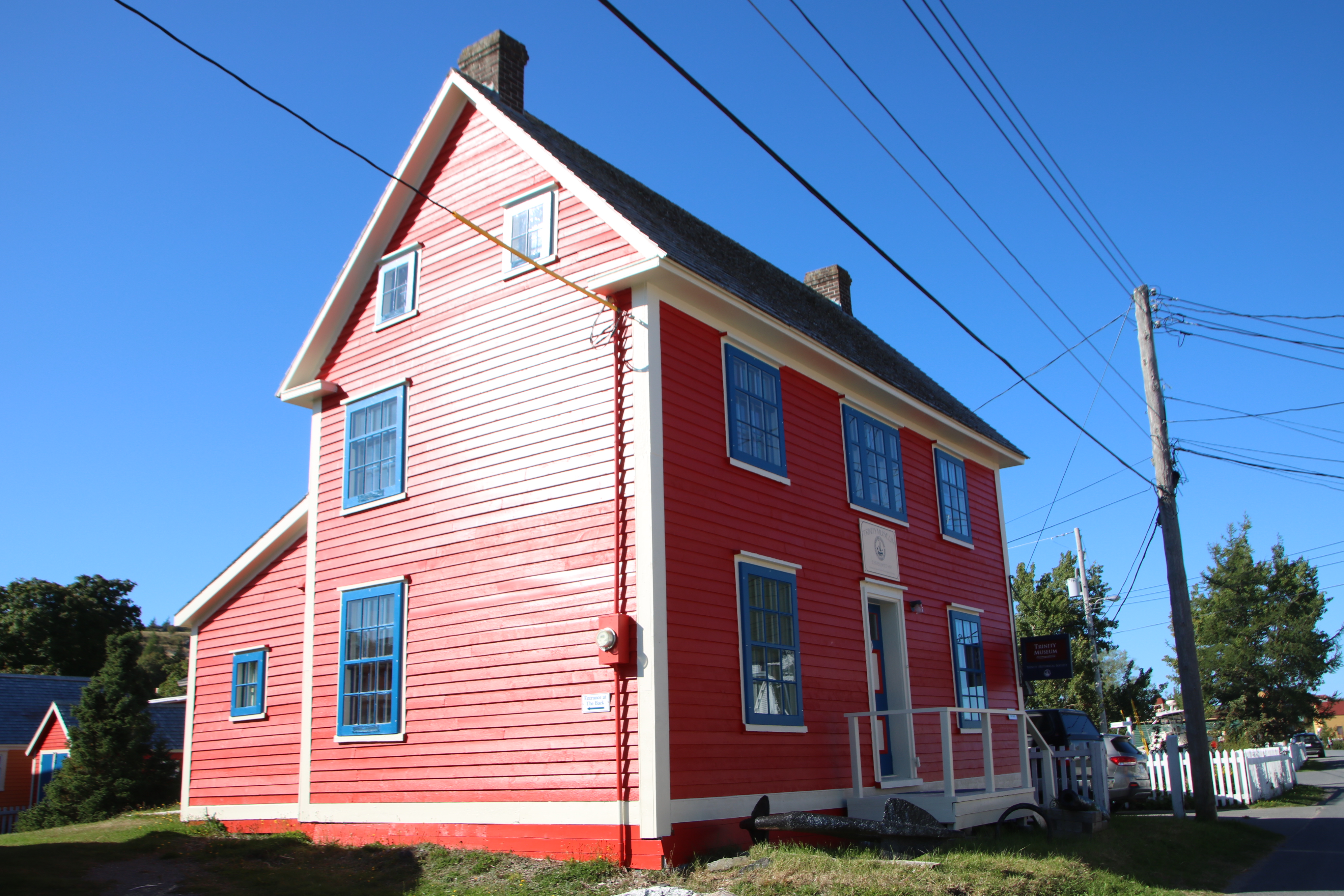
The Hiscock House is historically valuable because it is a good surviving example of a typical merchant’s family home. Constructed in 1881, this house was built in anticipation of the marriage of Richard Hiscock and his future wife, Emma. This property remained in the Hiscock family until 1978 when the Province of Newfoundland and Labrador purchased it. Most of the artifacts within the property are original and these buildings are well suited to telling the story of a nineteenth and twentieth century merchant family. The house and shop have been restored as a community museum to highlight the story of the self sufficiency of Emma Hiscock, who became widowed not long after her marriage. Emma was able to support herself and her family, and keep them together, educate them and maintain a position in the community in spite of her circumstances. The Hiscock House has undergone many changes and renovations in its history, as Emma Hiscock used her resourcefulness to operate a post office and a bank from the property. The Hiscock House stands as a reminder of the resilience of an outport woman who was faced with the difficulties of early twentieth century life, and succeeded.
Built by William Lockyer, its style influenced by Second Empire design, the Parish Hall is a two-storey hip-roofed building with attached tower. Constructed between 1898 and 1905, it is one of the best preserved examples of a rural parish hall utilizing ornate design elements. The building's most remarkable feature is the tower on the front façade. It stands two full storeys and is topped by a decorative cupola. The hipped roof and symmetrical lines on the exterior façade give a sense of orderliness to the structure.
Constructed in 1903, the structure is similar to other government buildings of the day in Greenspond, Bonavista and Placentia. In addition to the court and jail, the building housed the police constable and his family, the Customs House, the Magistrate’s Office and the Post & Telegraph Office.
Church of the Most Holy Trinity Roman Catholic Church is a timber framed church built in the Gothic Revival style of architecture.
The Church of the Most Holy Trinity is the oldest surviving wooden church on the island and is one of the oldest wooden churches still in use in Canada. This church, built in 1833, was likely the first Catholic church built on the island after the passing of the 1829 Roman Catholic Relief Act in Britain, a law which granted emancipation and freedom of religion to Catholics under British rule. Although this emancipation did not reach Newfoundland until the mid-1840s, the construction of this church reflects the increasing status and strength of Roman Catholicism in Newfoundland during this era.
The church was built in response to the need of Trinity’s Catholic congregation who, though established in Trinity since 1825, had no church of their own and no choice but to use the local Anglican church for weddings and funerals. The land for the Church of the Most Holy Trinity was donated by local Anglican merchant and magistrate George Garland, one of a family of Dorset merchants prominent in Trinity at the time. As such, this church represents not only the religious history of the community, but also the ways in which the influential West Country fishing merchants shaped the cultural and built landscapes of Trinity.


.jpg)
.jpg)




.jpg)


