We took a tour that included Changi. No photos were allowed inside the museum.I have to admit that I didn't know anything about Singapore and World War II.
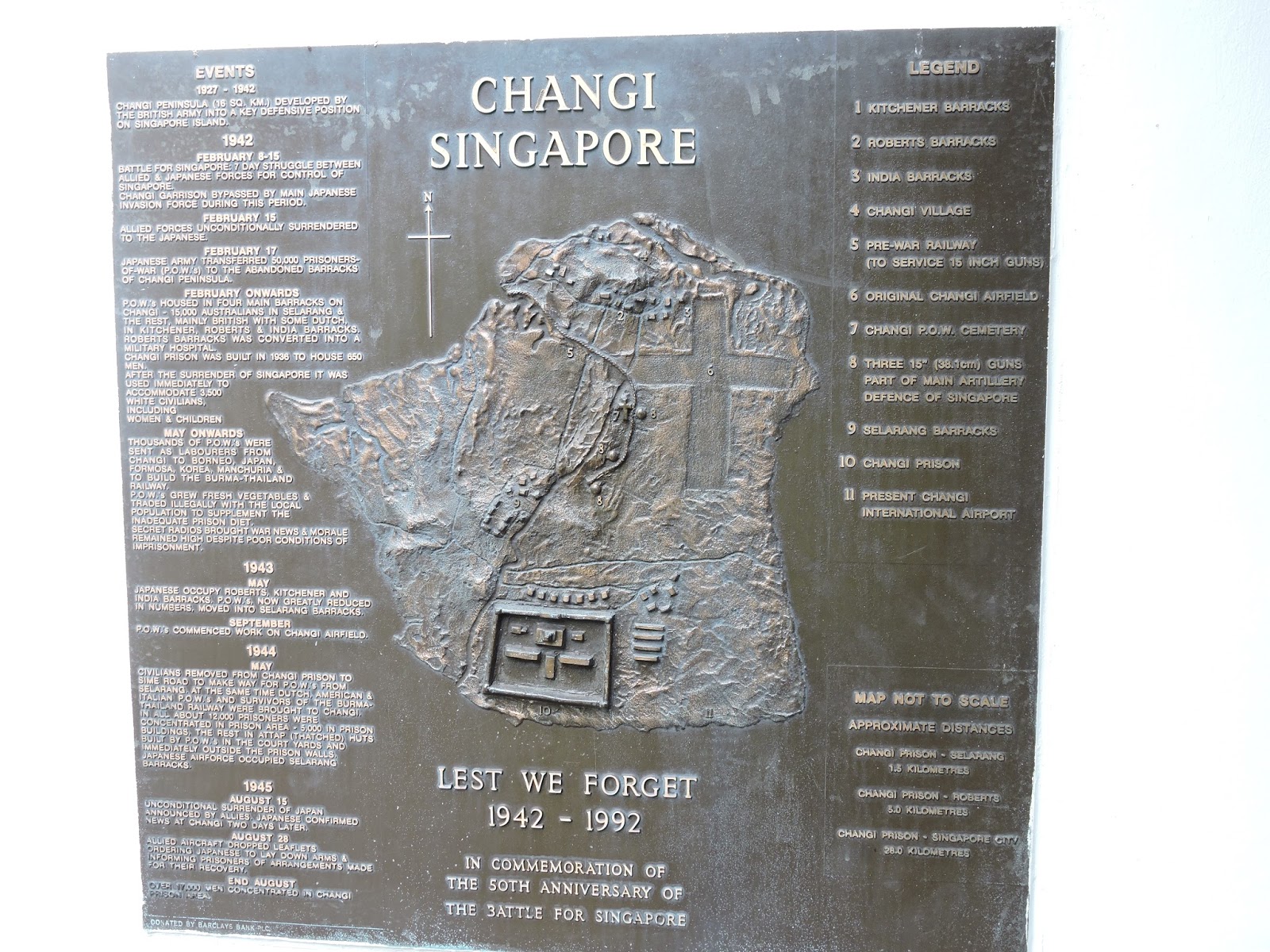
Changi Prison was constructed by the British administration of the Straits Settlements as a civilian prison, in 1936.
During World War II, following the Fall of Singapore in February 1942, the Japanese military detained about 3,000 civilians in Changi Prison, which was built to house only 600 prisoners. The Japanese used the British Army's Selarang Barracks, near the prison, as a prisoner of war camp, holding some 50,000 Allied—predominantly British and Australian—soldiers and, from 1943, Dutch civilians brought over by the Japanese from the islands in the Dutch East Indies (now Indonesia). Although POWs were rarely, if ever, held in the civilian prison, the name Changi became synonymous with the POW camp in the UK, Australia, The Netherlands, and elsewhere.
About 850 POWs died during their internment in Changi during the Japanese Occupation of Singapore, a relatively low rate compared to the overall death rate of 27% for POWs in Japanese camps. However, many more prisoners died after being transferred from Changi to various labour camps outside Singapore, including the Burma Railway and the Sandakan airfield.
After the war, the prison was briefly used to hold Japanese and other soldiers who were held on suspicion of having committed war crimes.
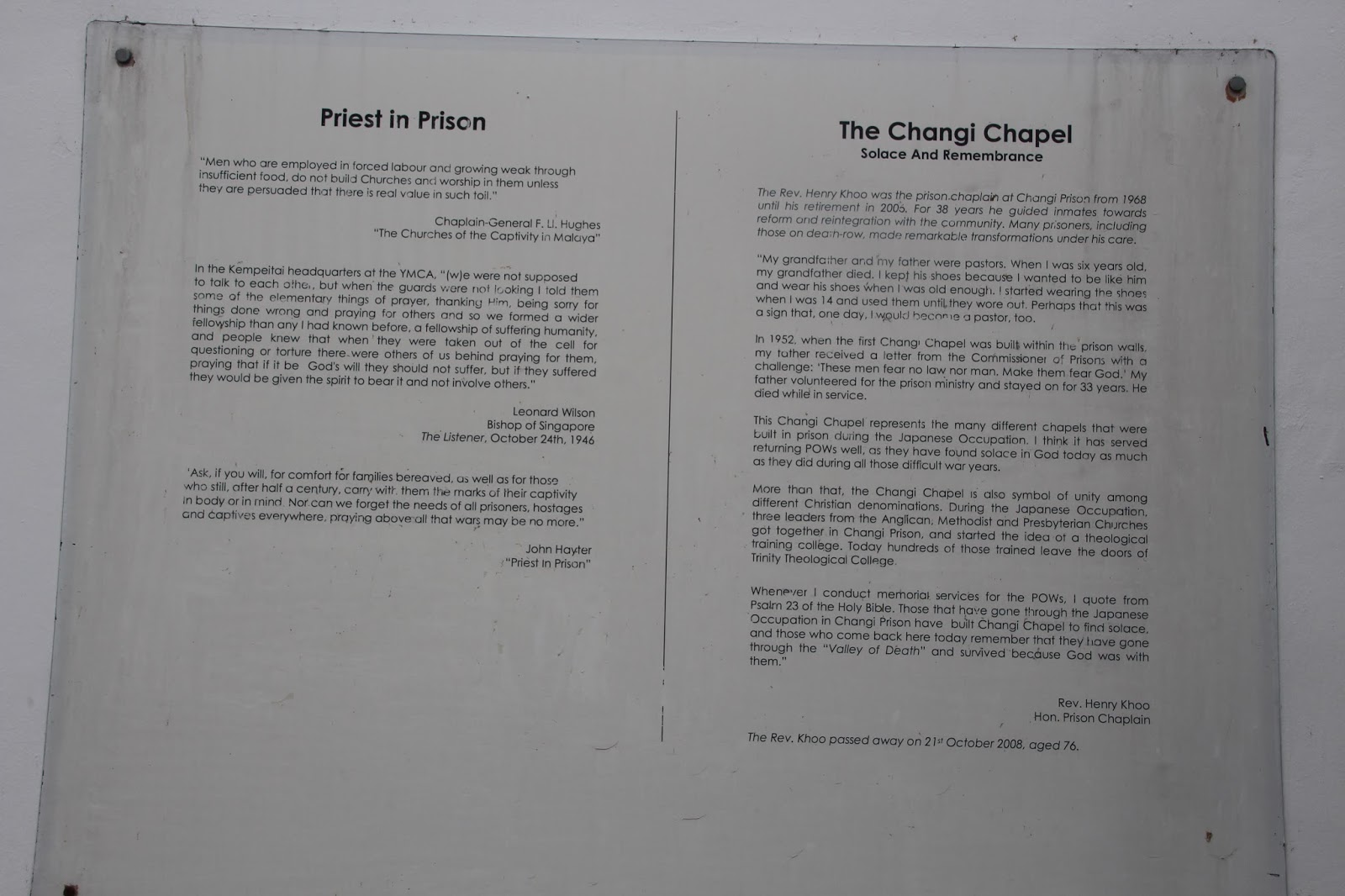
British soldiers were stationed there as prison guards.Allied POWs, mainly Australians, built a chapel at the prison in 1944 using simple tools and found materials.Stanley Warren of the 15th Regiment, Royal Regiment of Artillery painted a series of murals at the chapel. Another British POW, Sgt. Harry Stodgen built a Christian cross out of a used artillery shell. After the war, the chapel was dismantled and shipped to Australia, while the cross was sent to the UK. The chapel was reconstructed in 1988, and is now located at the Royal Military College Duntroon, Canberra.
Click here to see the murals.
In 1988, Singapore built a replica chapel (which was built by the POWs) and museum next to the Changi Prison. When Changi Prison was expanded in 2001, the chapel and museum were relocated to a new site 1 km away and the Changi chapel and museum were officially established 15 February 2001


Thousand Origami Cranes is a group of one thousand origami paper cranes held together by strings. An ancient Japanese legend promises that anyone who folds a thousand origami cranes will be granted a wish by a crane. Some stories believe you are granted eternal good luck, instead of just one wish, such as long life or recovery from illness or injury. This makes them popular gifts for special friends and family. The crane in Japan is one of the mystical or holy creatures (others include the dragon and the tortoise) and is said to live for a thousand years: That is why 1000 cranes are made, one for each year. In some stories it is believed that the 1000 cranes must be completed within one year and they must all be made by the person who is to make the wish at the end. Cranes that are made by that person and given away to another aren't included: All cranes must be kept by the person wishing at the end.
These paper cranes were created by Japanese school children as an act of remembrance and as a wish for peace.
Notes left by Australians.
.


.jpg)
.jpg)
.jpg)
.jpg)
.jpg)
.jpg)
.jpg)