Showing posts with label throwback. Show all posts

25 April 2024

ANZAC DAY

April 25 is ANZAC Day 

Anzac Day is a national day of remembrance in Australia and New Zealand that broadly commemorates all Australians and New Zealanders "who served and died in all wars, conflicts, and peacekeeping operations" and "the contribution and suffering of all those who have served". Wikipedia


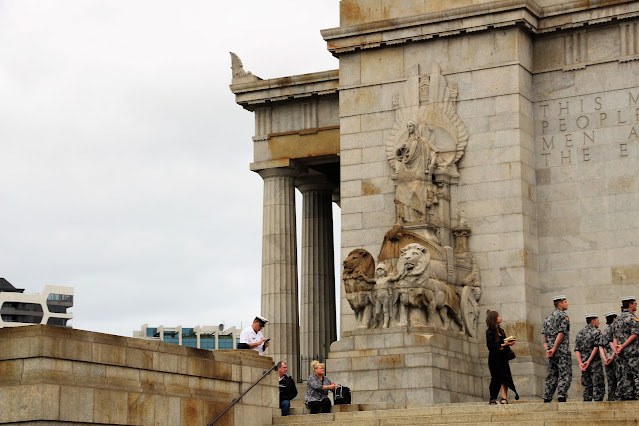
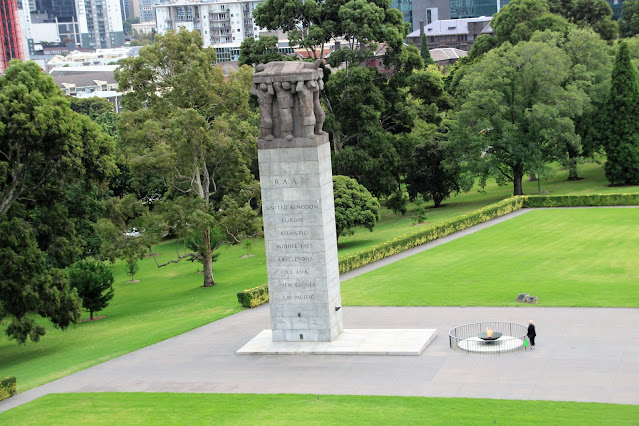
March 2015 - Melbourne Australia


We were lucky to have met some Aussies on a Mekong River cruise and they graciously showed us around their home city of Melbourne in March. The Shrine of Remembrance was a highlight and I would love to spend more time there.

ANZAC Day, originally a commemoration of the landing of Australian and New Zealand forces at Gallipoli on the 25th April 1915, has grown to become perhaps the most important national day in Australia.


ANZAC is an acronym and stands for Australian New Zealand Army Corps, the name given to the body of troops raised by the two countries to aid the British Empire in the Great War. Throughout the war Australian and New Zealand troops, or 'Diggers' and 'Kiwis', would live, fight and die alongside each other creating a bond that still exists today between the two nations.


 ANZAC Day is also inextricably linked with the landings at Gallipoli in the Dardanelles Strait on the 25th April 1915. On this day ANZAC troops were committed to their first major action of the war, and though the campaign would ultimately prove a bloody failure and leave more than 8,000 Australians dead, it marked the beginning of the Anzac legend.


This legend was poignantly put into words by Sir William Deane, Governor-General of Australia on ANZAC Day 1999:

"Anzac is not merely about loss. It is about courage, and endurance, and duty, and love of country, and mateship, and good humour and the survival of a sense of self-worth and decency in the face of dreadful odds."


.


28 March 2024

Loretto Chapel, NM


April 2006 - Santa Fe New Mexico


The history of the Loretto Chapel began when Bishop Jean Baptisite Lamy was appointed by the Church to the New Mexico Territory in1850. Bishop Lamy, seeking to spread the faith and bring an educational system to this new territory, began a letter writing plea for priests, brothers and nuns to preach and teach. In one of his letters he is said to have written, “I have 6000 Catholics and 300 Americans.” The first acceptance of his general plea was from the Sisters of Loretto.

In 1852 the Sisters of Loretto responded to Lamy’s pleas by sending seven sisters who agreed to make this arduous journey to Santa Fe. Their trek was through St. Louis, then up the river to Independence, Mo. This small group was beset by a cholera epidemic, the Mother Superior died, and another nun was too ill to continue the journey and returned to Kentucky. An additional story continues that they traveled by wagon through bad weather, and Indian country.

The Sisters arrived in Santa Fe in 1852 and opened the Academy of Our Lady of Light (Loretto) in1853. The school was started and grew from very small beginnings to a school of around 300 students, despite the challenges of the territory (smallpox, tuberculosis, leaky mud roofs and even a brush with the rowdy Confederate Texans during the Civil War).


Two mysteries surround the spiral staircase in the Loretto Chapel: the identity of its builder and the physics of its construction.

When the Loretto Chapel was completed in 1878, there was no way to access the choir loft twenty-two feet above. Carpenters were called in to address the problem, but they all concluded access to the loft would have to be via ladder as a staircase would interfere with the interior space of the small Chapel.

Legend says that to find a solution to the seating problem, the Sisters of the Chapel made a novena to St. Joseph, the patron saint of carpenters. On the ninth and final day of prayer, a man appeared at the Chapel with a donkey and a toolbox looking for work. Months later, the elegant circular staircase was completed, and the carpenter disappeared without pay or thanks. After searching for the man (an ad even ran in the local newspaper) and finding no trace of him, some concluded that he was St. Joseph himself, having come in answer to the sisters' prayers.

The stairway's carpenter, whoever he was, built a magnificent structure. The design was innovative for the time and some of the design considerations still perplex experts today.

The staircase has two 360 degree turns and no visible means of support. Also, it is said that the staircase was built without nails—only wooden pegs. Questions also surround the number of stair risers relative to the height of the choir loft and about the types of wood and other materials used in the stairway's construction.


14 March 2024

Throwback Thursday - Glasnevin


September 2015 - Dublin Ireland

We stopped in to Glasnevin on the Hop On Hop Off but knew we had to come back and really visit it.


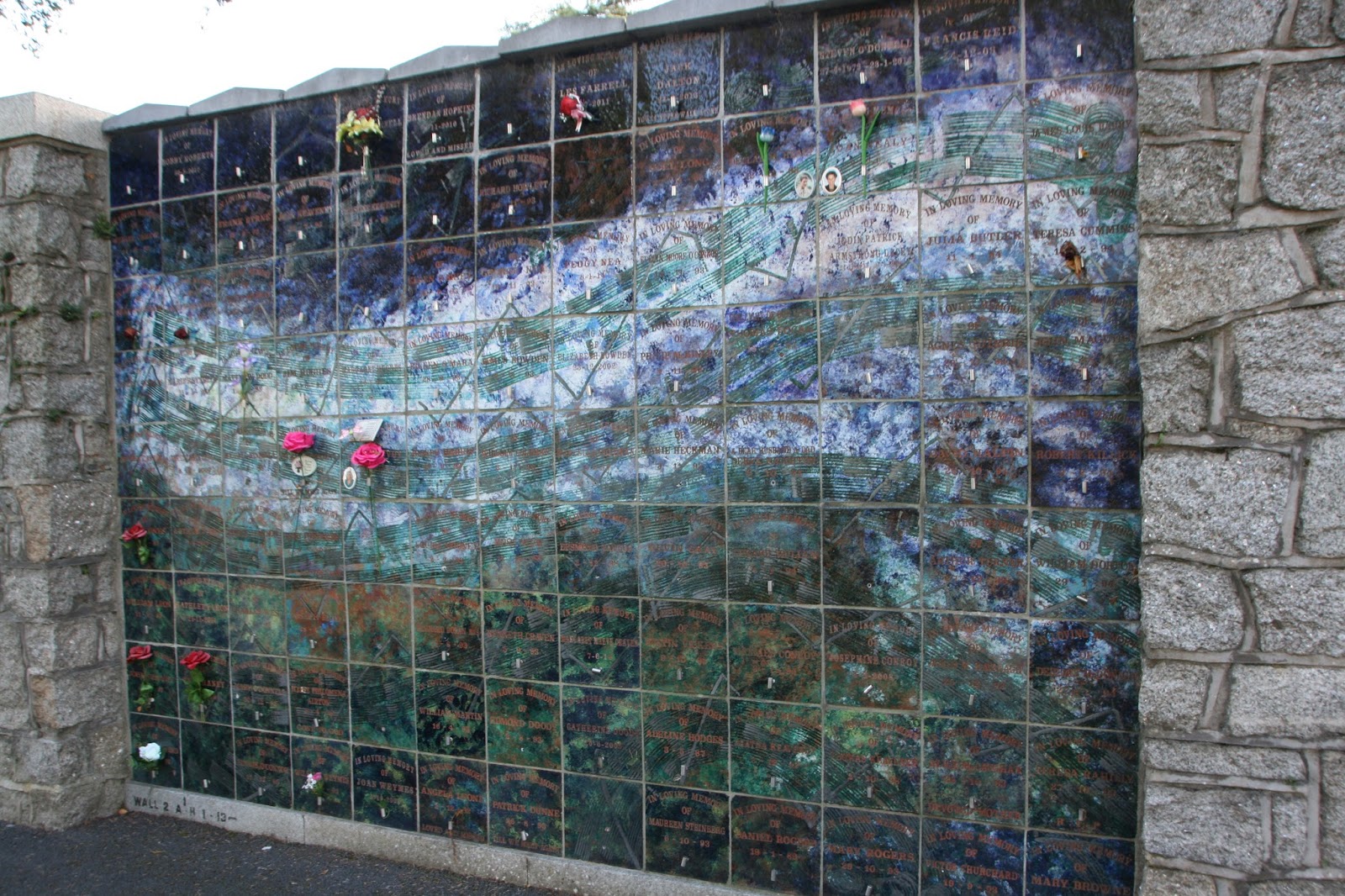
Glasnevin Cemetery, also known as Prospect Cemetery, is the main Catholic cemetery in Dublin, the capital of Ireland. It first opened in 1832.


Before the establishment of the Glasnevin Cemetery, Irish Catholics in Dublin had no cemeteries of their own. This was due to the repressive Penal Laws imposed on the Irish by the British who had placed restrictions on the public performance of Catholic services.

The round tower was built between 1855 and 1869 to commemorate the death of Daniel O’Connell, who had established the cemetery in 1832.  Click here to see a church dedicated to him in his home town.


Glasnevin Cemetery contains many historically interesting monuments as well as the graves of many of Ireland's most prominent national figures — Charles Stewart Parnell and Daniel O'Connell as well as Michael Collins, Éamon de Valera, Arthur Griffith, Maude Gonne, Kevin Barry, Sir Roger Casement, Constance Markiewicz, Brendan Behan, SeĂĄn MacBride and Christy Brown.

Michael Collins
Brendan Behan


The cemetery also offers a fascinating view of the changing style of death monuments in Ireland over the last 200 years: from the austere, simple, high stone erections of the period up until the 1860s, to the elaborate Celtic crosses of the nationalistic revival from the 1860s to 1960s, to the plain Italian marble of the late twentieth century. Glasnevin Cemetery has grown from its original nine to over 120 acres.


Sunday Oct 18 Budapest

  Itinerary Oct 12 -13 Toronto - Copenhagen - Vienna Oct 13 - Vienna Oct 14 - Vienna Oct 15 - Vienna Oct 16 - Vienna to Budapest by train Oc...