
Today I'm taking you on an Island walk, Toronto style. We had been to the Island before but always with visitors and small children so we spent our time at the amusement park on Centre Island.
So this was new territory and a treat for us.
The ferries run frequently with several drop off points.

It is an inexpensive ride - under $10 for a return trip that takes about fifteen minutes. They can be crowded especially on the weekends but we went during the week.
It was a perfect summer's day warm and not a cloud in the sky. Temperature 33C or 91F and not too humid.
The view as we head out. Stunning, isn't it?

The view as we approach, quite a contrast.
The Toronto Islands were not always islands but actually a series of continuously moving sand-bars originating from Scarborough Bluffs and carried westward by Lake Ontario currents. Eroded stone of the Scarborough Bluffs was carried westward by Lake Ontario currents to create the islands. By the early 1800's the longest of these bars extended nearly 9 kilometres south-west from Woodbine Avenue, through Ashbridge's Bay and the marshes of the lower Don River, forming a natural harbour between the lake and the mainland.

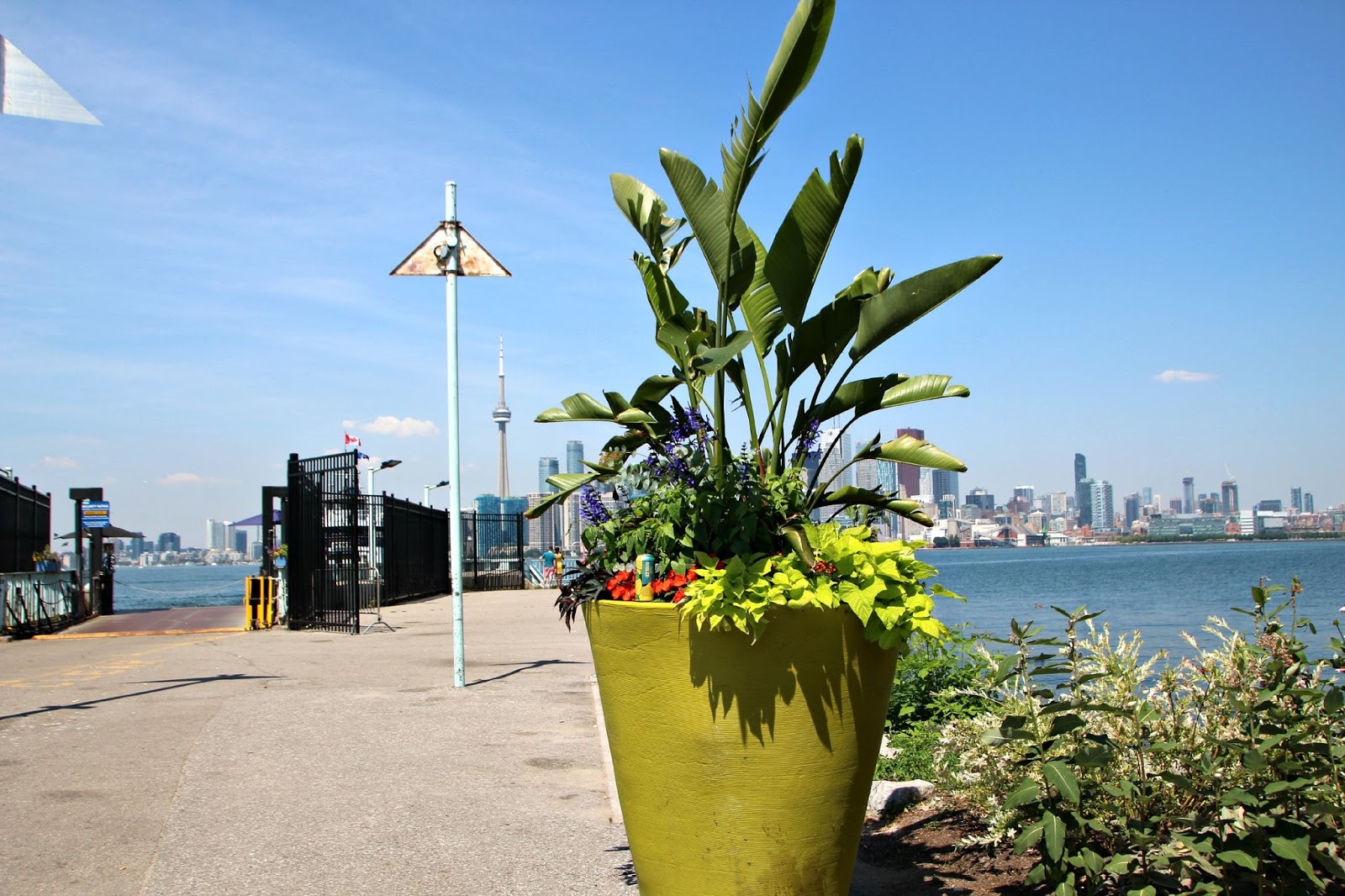
Playing around with my cell phone when we left the ferry.

The sand bars were first surveyed in 1792 by the British Navy, but they were well known by native people, who considered them a place of leisure and relaxation. The main peninsula became known to European settlers as the “Island of Hiawatha”. A carriage path from York which led to Gibraltar Point was very popular during the 1800’s. It later became known as Lake Shore Avenue. Part of the boardwalk on Centre Island traces this same route. A number of severe storms and their strong wave action worked to erode the peninsula, requiring frequent repair to small gaps until finally, in 1858, an island was created when a storm completely separated the peninsula from the mainland and the gap was not repaired.

Back in the late 1880s, David Ward and his seven children built a hotel on the newly-formed Centre Island. A small tent and resort community developed around them, followed by a residential community. Most of the people who live on the Toronto Islands today live on the eastern edge, in the Ward's or Algonquin Island neighbourhoods.

Ward Island is a world onto itself. Imagine living in cottage country a 15 minute ferry ride from your office! We'll be back to tour around the community on another day.
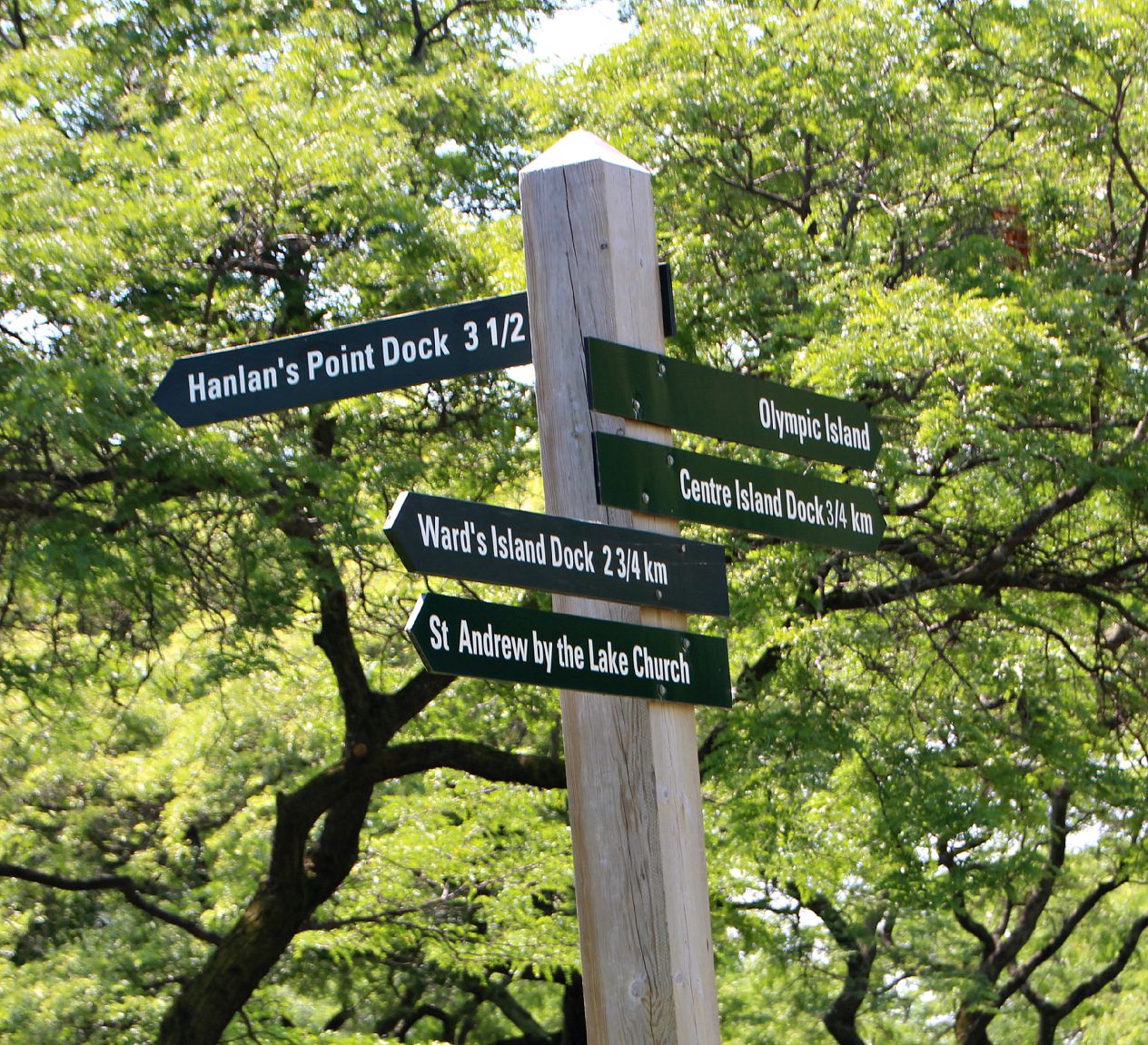
A church! Click here for more photos.

The CN Tower is ever-present!


From the late 1880s on, many Torontonians built summer homes on Toronto Island to escape the summer heat in the city. Wealthy families like the Masseys and the Gooderhams, who were among the founding members of the Royal Canadian Yacht Club, built grand, summer homes along Lakeshore Avenue (on the Boardwalk) from Ward's west to Centre Island on 50 by 200 foot lots from the lakefront to Cibola Avenue and the lagoon.


Before the Second World War, 750 summer homes and more modest cottages existed on the Island extending from Hanlan's Point to Ward's. In response to Toronto's post-war housing shortage after the war, many Island houses became occupied year-round.
Soon after the creation of the Metropolitan Toronto government in 1953, the new Metro Parks department decided to demolish all the houses on the Island to eliminate problems caused by periodic flooding (in 1947 and 1952, for example) and to create a vast, empty public park, even though at the time more than half the Island was public space.
Time for lunch at The Rectory Cafe. The Rectory is a two-story, stucco residence built in 1948 by the engineer who rebuilt the seawall along the boardwalk. Presumably, he used the same construction techniques in the house as on the seawall - poured reinforced concrete. Thus, Metro couldn't demolish his house with their bulldozers as they did the other, wood-frame houses at Hanlan's, Centre and along the Boardwalk. For many years after the demolitions, the Rectory housed the priest in charge of the Church of St. Andrew-by-the-Lake at Centre hence, its name.


Sautéed black tiger shrimp with kale, Vidalia onion & oyster mushrooms in a N'Duja cream sauce. I need some help from my readers as I have researched N'Duja and it seems to be a spicy salami so I am puzzled why it is listed as the sauce.

Tandoori Pulled Chicken - caramelized onions, baby kale, dill pickle mayo on a Swiss bun.

Time to wander. Lake Ontario is a big place! It is bounded on the north, west, and southwest by the province of Ontario, and on the south and east by the American state of New York.
In the Wyandot (Huron) language, ontarío means “Lake of Shining Waters”. It is the last in the Great Lakes chain and serves as the outlet to the Atlantic Ocean via the St. Lawrence River. Lake Ontario is also the only one of the five Great Lakes not to share a shoreline with the American state of Michigan.

The cement sea wall mentioned above.






Time to head back to the big city.


Back on land.


Monday's Walks

Our World Tuesday

Beth hosts Weekend Cooking where you can post anything food related.

