Showing posts with label Mickalene Thomas. Show all posts

26 March 2019

AGO - Femmes Noires


March 2019 - Toronto ON


This exhibit was very different from the one we had just seen, Impressionism.

I quite liked these works because of the colour and vibrancy. I also liked the collage effect.


Mickalene Thomas: Femmes Noires upends and overturns familiar representations and monolithic notions of Black women today.

This exhibition, developed in a creative partnership between the AGO and the Contemporary Arts Center of New Orleans, presents a bold new collection of Thomas’s vibrant, colourful and provocative paintings, silkscreens, photographs, time-based media and site-specific installations exploring how Black women are represented in art and popular culture.

The exhibition also highlights Thomas’s collage work and the inspiration she takes from popular art histories and movements, including Impressionism, Cubism, Dada and the Harlem Renaissance.

Mickalene Thomas: Femmes Noires is the first large-scale solo exhibition by this African-American contemporary artist to be staged in Canada. It will spark timely and urgent conversations about race, representational politics, Black celebrity culture and sexuality as seen through a Black queer feminist perspective.

.
I first saw a piece of her work in Boca Raton FL a couple of years ago and was immediately impressed.


This impressive canvas is the first thing you see!


Mickalene Thomas was born on January 28, 1971 in Camden, New Jersey. She was raised by her mother Sandra "Mama Bush" Bush, who, at 6'1" tall, modeled in the 1970s. She exposed Mickalene and her brother to art by enrolling them in after-school programs at the Newark Museum, and the Henry Street Settlement in New York. Thomas' mother raised her and her brother Buddhists. As a teenager, Mickalene and her mother had a very intimate and strenuous relationship due to her parents' addiction to drugs and Thomas dealing with her sexuality, which she documented in the short film Happy Birthday to a Beautiful Woman: A Portrait of My Mother.


During her early career she found herself immersed in the growing culture of DIY artists and musicians, leading her to start her own body of work. Mickalene noted that when she became an artist, fashion was always "in the back of my mind" as a source of inspiration. Most influential to her was the work of Carrie Mae Weems, especially her Kitchen Table and Ain’t Jokin series, which were part of a retrospective held at the Portland Art Museum in 1994. Thomas describes the encounter in this way: "It was the first time I saw work by an African-American female artist that reflected myself and called upon a familiarity of family dynamics and sex and gender." Weems’ work not only played a role in Mickalene Thomas’ decision to switch studies and apply to Pratt Institute in New York, but to use her experience and turn it into art.


Thomas’s work is also distinctive in its foregrounding of queer identity and themes: she is a queer woman of color representing women of color in a way that emphasizes their erotic beauty. By emphasizing the women’s striking presence and sensuality along with their assertive gazes, Thomas empowers these subjects, representing them as resilient, stunning women who command the spectator’s attention. The sitters have the control and power of the gaze, and when this exchange is between women, it subverts the traditional dominance of the male gaze in art and visual culture. Thomas’s queer identity is foregrounded, for example, in her painting and print edition entitled Sleep: Deux femmes noires (2012 and 2013), in which we see two female bodies intertwined in an embrace, on a sofa, thus highlighting for her audience the femininity, beauty, and sexuality of women lovers.


24 November 2017

Boca Raton Museum of Art

November 2017 - Boca Raton FL


We had gone to the Boca Raton Museum of Art on impulse when we were in town for lunch.


Count and Countess Adolph and Henrietta de Hoernle received their titles from Prince Alexis d'Anjou in 1981 for their years of charity work. Regardless of the authenticity of the title, their generosity and philanthropy is definite and real. More than 40 buildings in and around Boca Raton were associated with the De Hoernle's donations. Count Adolph de Hoernle was born in Pforzheim, Black Forest, Germany on May 10, 1903. Countess Henrietta de Hoernle was also born in the Karlsruhe, Black Forest, Germany as well. However, they met in the US after they had both immigrated in 1926 and were married in 1950. Count de Hoernle made his millions as owner of the Stewart Stamping Corporation in New York state. In 1965 he sold his company and retired. The Count and Countess have been very involved in supporting the arts and health care around Florida, especially around Boca Raton.
The sculptures of Count Adolph and Countess Henrietta de Hoernle are located at the proper right of the stage of the amphitheater, where the edge of the art museum and the amphitheater come together. The statues are bronze with a brown patina. The Count has his hair combed back and has a trimmed moustache. He is wearing a business suit with a bow tie and has a medallion around his neck which hangs below his bow tie. The Countess is wearing a full length outfit made of a floor-length skirt and matching jacket, both heavily embellished with brocade. She wears a tiara in her hair, has a sash draped across her proper right shoulder that settles on her proper left hip where a large medallion is attached. Around her neck, she too wears a long ribbon with a smaller form of the medallion her husband wears. She wears bejeweled ear rings and her proper left arm has a jeweled bracelet and a large ring on her finger. The Countess stands with her proper left arm against the Counts proper right side. Both have their arms relaxed by their sides. The face of the bronze base has embossed in bronze the title and names of the figures: Count Adolph and Countess Henrietta de Hoernle. Inscribed on the top edge of the granite plinth is their saying of "Give while you live and know where it goes."


I looked at more of her sculptures online and really like her work.

Vivian Wang - Padded Jacket


Mickalene Thomas (born 1971 in Camden, New Jersey), "As If you Read My Mind", 2005.


Vik Muniz has created editions of his enlargements of the vintage Matchbox cars that speak to childhood memories and popular culture. Produced by British toymaker Lesney Products beginning in the 1950s, these miniature cars and trucks came with their own matchbook size box and are now valued by collectors including Muniz himself. Instead of a brand new toy, his versions show the wear and tear of play, including missing paint and carefully reproduced distressed cardboard.


You can step outside in this link to the Boca Raton Museum of Art Sculpture Garden.


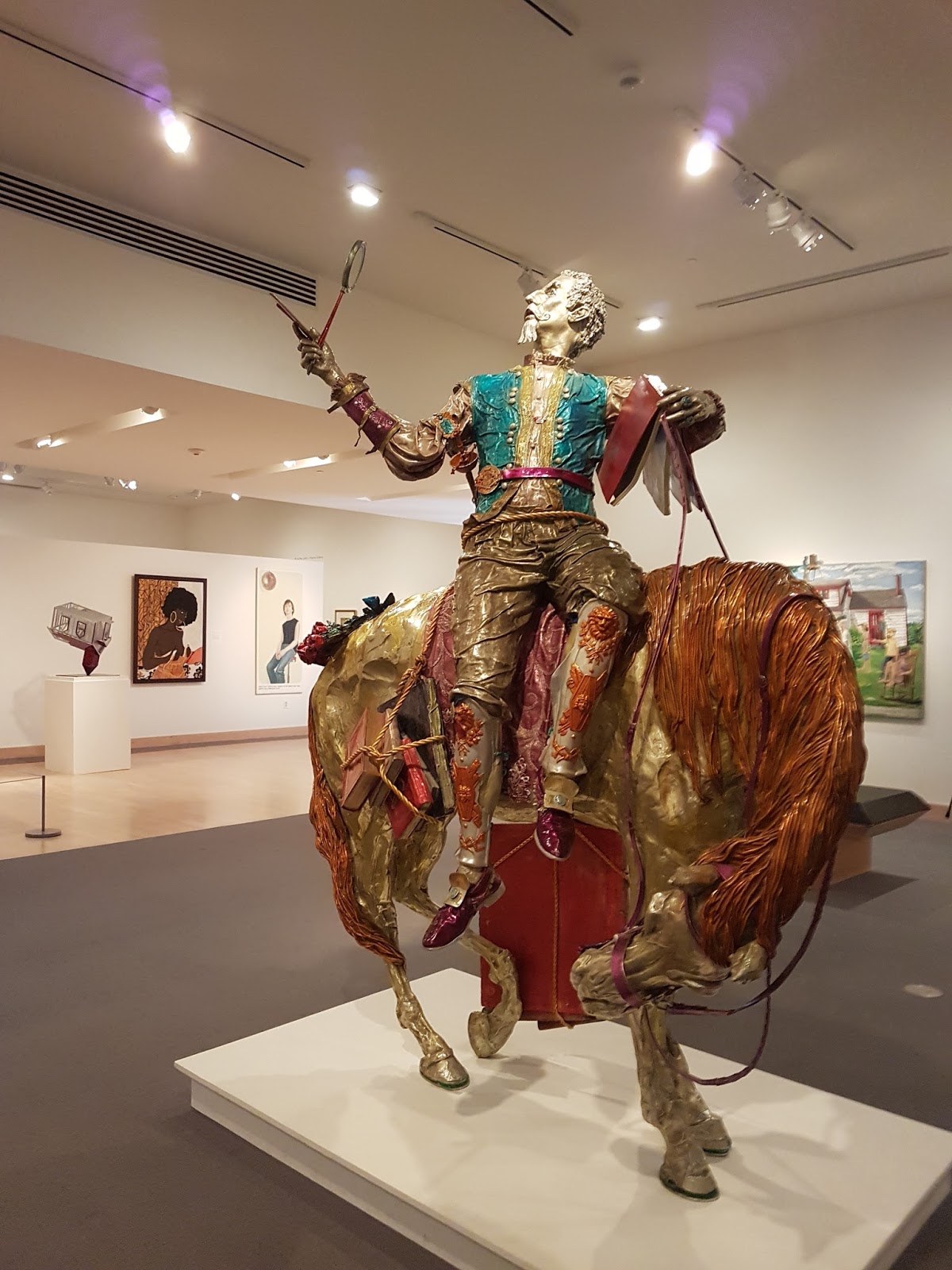
This was my absolute favourite piece.


In 2016 we visited the Don Quixote Museum in Guanajuato Mexico so I am now drawn to any displays of or about him.


Source
The piece is by artist Izhar Patkin. It is a stunning, brightly colored anodized aluminum sculpture of Don Quixote saddled on his horse in a curious position whilst reading a book. Don Quixote is reading the second part of the book series that bears his name. 


Besides a book, he holds a mirror in his hand which is aimed at his face, seemingly as if to allow Quixote to see how he reacts to reading his own life story. He seems to be making a very grotesque or disgusted face. Perhaps he is worried about how he appears to people who have read about him and wants to know how he himself would react to his adventures in order to gauge how others react? Perhaps the piece is a comment upon the viewer of the piece themselves, telling them to observe how they appear to others and to themselves in comparison. 


The exhibit is called “Alex Katz: Small Paintings” because, other than the two huge works, the rest of the show consists of 37 petite canvases Katz, known as the father of American contemporary art, completed between 1990 and 2015.

Alex Katz, Yellow Flags, 2011


Charles McGill (1964–2017)

Sculptor and educator Charles McGill is best known for repurposing vintage golf bags by creating assemblages with their tempered plastic, steel, leather, vinyl, and hardware.
“I find the golf bag to be a very political object due to its historical associations with class . . . and racial injustice . . . It is both an object and subject that lends itself well to found object abstractions and assemblages that address these well-chronicled complexities,” McGill said.


Morning Reflections