Showing posts with label Casavant. Show all posts

16 June 2022

Day 2 London ON

 Monday June 2022 - London ON

Day 2
Day 3
Weekly recap including meals

Monday we had breakfast at the hotel and headed out around 10:30. The plan was to walk along Richmond, according to the tour guide:
Take a stroll on Richmond Row with its upscale shops like David E. White Clothier and Hangar 9, as well as other chic boutiques, salons and cafés. With wide sidewalks and leafy trees, Richmond Row is also home to some of the most diverse restaurants in the city.

It was too early for Spageddy Eddy's to be open, I would love to see the inside.


Standing within the London’s business core the Dominion Public Building is a distinctive example of Modern Classicism. It is a six-storey building with a tall tower emphasizing one end. Built of smooth ashlar limestone, the impression created is of a stepped skyscraper with a long extension to the rear.
 

The building is distinguished by the strong vertical accent of the multi-storey piers and recessed windows, the polished black granite used for the plinth course, around the entry doors and by the decorative masonry carvings.
The Dominion Public Building is a very good example of the theme of the establishment of a federal presence in communities across Canada; also of the theme of major buildings erected under the Public Works Construction Act of 1934. In an effort to alleviate the worst effects of the Great Depression the Federal Government allocated 40 million dollars to public works so as to generate employment and to stimulate the economy. The Dominion Public Building is one of the more prominent of the 26 buildings erected under this Act.


Yes, London Ontario has a St. Paul's too.
St. Paul's Cathedral is the seat of the Diocese of Huron of the Anglican Church of Canada. It was designed in the Gothic revival style by William Thomas and built between 1844 and 1846, replacing the previous church, which was built in 1834 and burned down in 1844. It is the oldest church in the city.


The grounds of the Cathedral once served as a graveyard for the village of London. Most of the interred and their grave markers were transferred to Woodland Cemetery, which is owned and operated by the Cathedral. Twelve marked graves remain on the Cathedral grounds as reminders of London's early pioneer days.


Just a block away is St. Peter's Cathedral Basilica, the seat of the Roman Catholic Diocese. 

It was established in1834 and the first church was constructed of logs at the southwest corner of Dufferin Avenue and Richmond Street. Prior to this, a travelling priest visited the area to celebrate Mass for Catholic residents. The church was dedicated to St. Lawrence and could hold 180 people. It was destroyed along with much of the town in the London fire of 11 April 1845.

A larger frame church was built with donated materials and labour, but this church also burned in August 1850. This was replaced by a new St. Lawrence Church constructed of brick. The new church was located at the northeast corner of Dufferin and Richmond, just in front of the present structure. 


The Diocese of London was created in 1856 and Bishop Pierre-Adolphe Pinsoneault selected St. Lawrence as his cathedral renaming the church St. Peter's.


St. Peter's was raised to the status of a minor basilica 13 December 1961 by Pope John XXIII.
There was a funeral taking place and we were told to come back after to visit. However, it was locked when we returned.


We were curious to notice that along with the Gothic gargoyles there were two modern images. I later learned they were Bishop Walsh and Bishop Cody. Bishop Walsh's face is carved into the Cathedral facade to the right of the main door. Bishop Cody's face is on the other side of the doorway. Why these two Bishops? It was under Walsh that the building itself was constructed, the Diocese grew rapidly, and St. Peter's returned to being a Cathedral Church. Under Cody, the Cathedral was completed and became a Minor Basilica.


Neptune's is a 1950s sci-fi diner.


The pink Marble Slab is an ice cream shop.


Brewery. 


Joe Kool's.


The park was originally the site of the British garrison, as well as the cricket grounds. The garrison was expanded with new buildings during and after the Upper Canada Rebellion in 1837. The British troops withdrew to Europe in 1853 to train for the Crimean War, but their barracks were used to house escaped slaves from the United States, as one of the end stations of the Underground Railway. The troops returned in 1861, fearing that the American Civil War might spread to Canada. In 1874, the park was transferred to the city and renamed Victoria Park, after Queen Victoria.


Santa's House is supposed to move to a permanent location at Covent Garden Market.


The bandshell was built in 1950 (rebuilt in 1990). The area in front of the bandshell now serves as a free, public skatepark, consisting of many metal benches and a stage drop.


Near the bandshell is the Women's Memorial for the victims of the École Polytechnique massacre in Montreal, built in 1994.


Time for some drinks.


John offered to stop here the next day when we had the car.


Perfect spot, by the railway tracks.


Waiting for the train to pass.


Image source as I forget to get a photo of our lunch spot.


Cousin Vinny's pizza and deli.


Alexander Keith is a brewery in Halifax, Nova Scotia.
The clock faces south. It takes the shape of the top of a traditional barrel cask with the burnt branding of Alexander Keith's and "EST. 1820" at the centre. From the centre, the brown hands extend. There are no numerals.

Walking back along York St. after getting wine at the LCBO. You can tell they are going to be building condos in this area. Whenever they open a liquor store and a new bank branch you know new housing is coming.


A black and white photograph of the Tecumseh House Hotel with its portico facing Richmond Street. The hotel was located on the south west corner of Richmond and York Streets. The photograph may have been taken in very early spring as there are no leaves on the trees in front of the hotel yet several of the upper floor windows are open. Traces of snow are seen in the left foreground and the road way appears wet at the intersection. Several people are walking by or standing on the street. In the left foreground is a horse drawn carriage. A low single rung fence with ball topped posts runs along the front of the hotel as well as the York Street side.
The Tecumseh House, west side Richmond St., between York and the C.N.R.(Canadian National Railway) tracks. This hotel was erected in 1856, and for nearly three-quarters of a century was London's biggest hostelry. When the Prince of Wales (Edward VII) visited London in Sept. 1860, he stayed here, and the great ball given on the occasion was held at the rear of the hotel. About 1890. Other famous guests included Sir John A. McDonald, Henry Ford and Louis Riel.


Back to the hotel.

26 August 2018

inSPIREd Sunday - Mary Queen of the World Cathedral


August 2018 - Montreal QC


Mary, Queen of the World Cathedral (French: Cathédrale Marie-Reine-du-Monde) is a minor basilica in Montreal, and the seat of the Roman Catholic archdiocese of Montreal. It is the third largest church in Quebec after Saint Joseph's Oratory (also in Montreal) and the Basilica of Sainte-Anne-de-Beaupré east of Quebec City.

The construction of the cathedral was ordered by Mgr. Ignace Bourget, second bishop of Montreal, to replace the former Saint-Jacques Cathedral which had burned in 1852. His choice to create a scale model of Saint Peter's Basilica in Rome was in response to a rivalry with the Sulpician order who had been the feudal seigneurs of Montreal, and with the Anglican Church, both of which favoured the Neo-Gothic style instead. The site also sparked controversy due to its location in the western part of downtown, in a then predominantly English neighbourhood far from the homes of the French-Canadian church-goers.

Click here for our photos of Saint Peter's Basilica in Rome.

Instead of the statues of the 12 apostles on the façade of St. Peter's, the front of the cathedral is topped by statues of the patron saints of 13 parishes of Montreal who donated them, including St. John the Baptist and St. Patrick. All of the statues were sculpted by Olindo Gratton between 1892 and 1898. These statues represent (from left to right):
Saint Anthony of Padua, patron of the Saint-Anthony-of-Padua parish (at 1950 Saint-Antoine Street West);
Saint Vincent de Paul, patron of the Saint-Vincent-de-Paul parish in Laval;
Saint Hyacinth;
Saint Thomas Aquinas;
Saint Paul;
Saint John;
Saint James the Greater, patron of this very cathedral and its predecessor that was destroyed by fire, the Saint-Jacques Cathedral;
Saint Joseph, patron of the Saint-Joseph parish in Rivière-des-Prairies;
Saint John the Baptist, patron of the parish of the Saint-Jean-Baptiste Church;
Saint Patrick, patron of the parish of the St. Patrick's Church;
Saint Ignatius of Antioch;
Saint Charles Borromeo, patron of the parish of the Saint-Charles Church in Pointe Saint-Charles;
Saint Francis of Assisi.


Next to the church,a monument for Mgr. Ignace Bourget.


Religious art display in the lobby.


A confessional on display.


The aisles of the nave and the arches in the transept contain painting depicting historical events in the early days of Montreal.


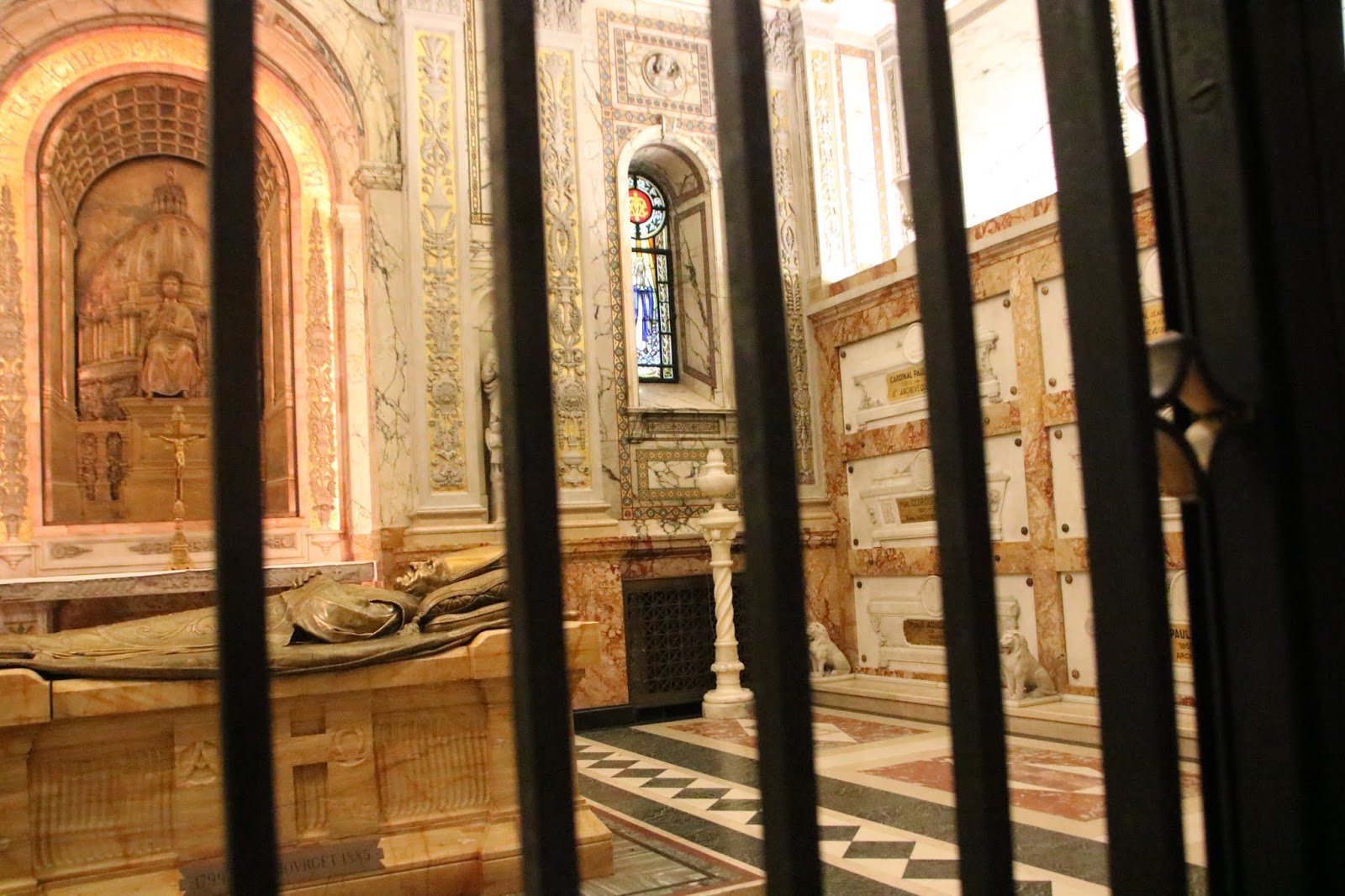
The bishop's mortuary chapel

Burial chapel, completed in 1933, is located on the left of the nave, halfway between the main entrance and the altar in the centre.


The walls and floors are made of marble imported from Italy and feature several mosaics. The bronze plaque above the altar depicts the St. Peter's in Rome.


 The tomb of Mgr. Bourget, an art work which was created in Rome, is located in the centre. The remains of the bishop that lay in a crypt under one of the pillars in the cathedral, were transferred to his tomb on April 27, 1933.


The titular bishops are buried on the right-hand side and the auxiliary bishops on the left-hand side.


The Chapel of the Assumption

This chapel, also known as the Marriage Chapel, is located on the right side of the nave (across from the Bishop's Chapel). This work of art features a wood-carved altarpiece, decorated with gold leaf and framing a painting depicting the Assumption of the Virgin Mary. It was made around 1635 at the Benedictine Abbey in Bellelay, Switzerland by a Spanish monk. When the monks were forced to leave during the religious retaliation, the occupying French troops sold all the precious furniture in the Abbey. At the beginning of the 20th century, the Austrian architect-conservator Rodolphe Messmer, discovered the altarpiece in the church of Suarce, France and acquired it. In 1994, Bruno Messmer donated it to the Roman Catholic Archdiocese of Montreal.

In 1957, Cardinal Paul-Émile Léger put the chapel at the disposal of the Order of Malta. The stained-glass windows are dedicated to this Order.


The sacrament of baptism is celebrated in the small chapel. The marble baptismal font is surmounted by an impressive stucco crucifix sculpted by Philippe Hébert.


Built by Casavant Frères, the organ was inaugurated on September 22, 1893. At that time, it consisted of 56 stops on three manuals and a pedal board. In 1951 the organ required enormous maintenance, after which was decided to rebuild the entire organ. Again, Casavant Frères was chosen for the job and they added 20 stops and a manual.

Covering the altar, which is located under the dome, is a neo-baroque ciborium or baldaquin, with twisting columns. It was created in Rome in 1900 by Joseph-Arthur Vincent and is a reproduction of the famous 'baldacchino' in the St. Peter's, created by Gian Lorenzo Bernini. It is fully hand-made and made with red copper and gold leaf. The angels, garlands and papal insignia were sculpted between 1910 and 1911 by Olindo Gratton. This full work of art was a donation to the cathedral by the Sulpicians.


Monday Mural

I'm linking up at Monday Mural July 2026 - Toronto ON