Sunday was a glorious but chilly sunny day and we decided to go for a drive.
Collingwood is known for skiing and there is still some snow on the Blue Mountains.
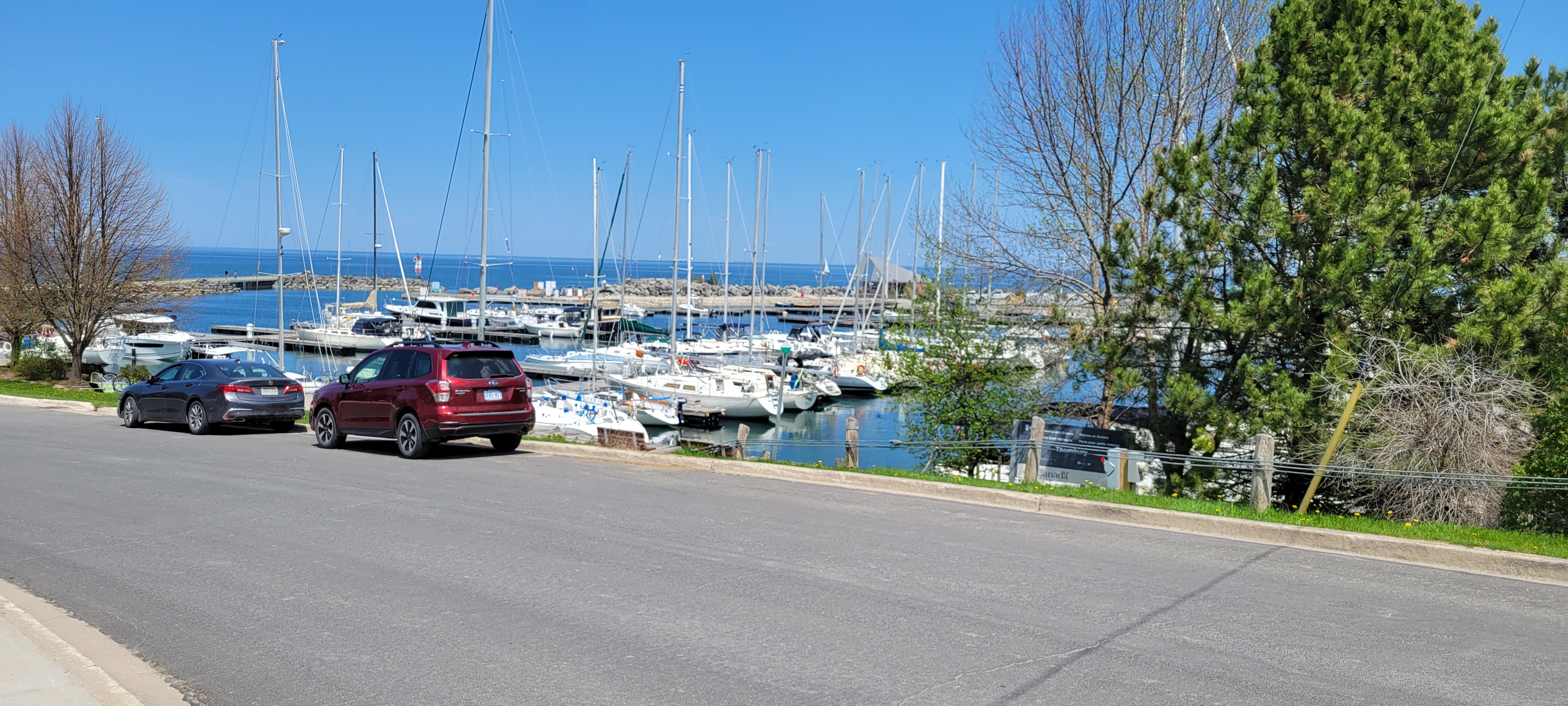
We had planned Thornbury as our destination but it was crowded so we drove on to Meaford.
In the summer of 1835, surveyor Charles Rankin reserved 200 acres on the southern shore of Georgian Bay at the mouth of the Big Head River for a town plot.
It was named Meaford, after Meaford Hall, the residence of the Earl of St. Vincent. The streets were named for naval heroes and later Christian names of the settlers.
The first settler, David Miller, arrived from Ireland and built a log cabin on the south bank. The year 1846 saw the beginning of the land sales, and a blacksmith, Joseph Hamilton, was one of the first settlers on this land.
Among the settlers in the 1840s was C.R. Sing, who operated the first carding machine in Grey County and became a community leader; Hassard Purdy, who built the first sawmill; and storekeeper George Jackson, who later became the first MP for Grey County.
This beautifully-restored post-1883 commercial building with apartments offers a fine, and tastefully nuanced, example of polychromatic brickwork, sometimes known as "streaky bacon". The style became popular in Britain after the publication of Victorian architect George Edmund Street's drawings of gothic architecture in Spain.
Years ago, Stedmans Department Store owner George Potopynk invested in a restoration of the ornate "streaky bacon" brickwork on his building, and today it's a standout on Meaford's main street.
The architecture of the main street is as historic as anything in town.
The old fire station, with it's tall tower for drying hoses after a fire.
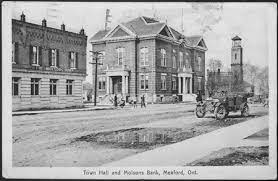
On a cold, early spring day in 1909, a crowd of townspeople gathered at the muddy corner of Nelson and Sykes Streets. A glint of brass and a valiant fanfare announced the arrival of the Meaford Cornet Band, and the crowd strained to see as the town's officials mounted the steps of Meaford's new Town Hall and Opera House.
For the past year, the town had watched as Meaford Town Hall rose on the hill above the harbour; its grand Palladian lines and stately Doric columns a stamp of respectability on the booming town. And today, it was to officially open.
When fire had swept through the old Town Hall in the wee hours of October 5, 1907, no one was unduly upset. The building, built in 1864, had become dilapidated, and there'd long been talk of something grander. Now the way was paved.
Local contractor James Sparling won the construction bid for $20,240, and thrifty businessman that he was, recycled as much of the original town hall's brick as possible in the construction of the new building.
Like many public buildings across small-town Ontario, Meaford Hall was meant to be more than a Town Hall. Presiding over Market Square, with its bandstand and athletic field, the building housed the council chambers and town offices. The chambers also served as a courtroom, and in the basement miscreants apprehended by the local constabulary would find a cold berth in one of three tiny jail cells. Down at the other end of the building, the Meaford Public Library welcomed generations of schoolchildren and their parents. Farmers used the basement on market day, and in time this space served as ballroom, meeting area, and Boy Scout hall. Later divided into smaller rooms, it housed the Women's Institute, the Friendship Circle Quilters, a Senior Citizens club, and the Senior Men's Euchre Club.

But up the high staircases to either side of the Sykes Street entrance is where the magic truly happened. The second-floor Opera House – with its broad stage beneath a proscenium arch, its rows of wooden seats (each fitted with a wire rack for a gentleman's hat), its balcony embellished with raised plasterwork acanthus leaves, and its high ceiling and tall windows – was the cultural heart of the community. Local plays, high school graduations, concerts and famous speakers have all filled the theatre’s seats with eager audiences. In the early years of the 20th century, train-traveling musical shows would whistle into town, cast and costumes in tow, mustering amateur performers from the Meaford citizenry. (This ensured that a young hopeful’s friends and family would all buy tickets to see their darling onstage.) The Meaford Citizens Band took to the stage on Sunday nights for years. Theatre groups and festivals staged comedy, drama and musical theatre. And it has never stopped. For more than a century, the Opera House has rung with music, drama and debate, and the exceptional acoustics of the room remained famous in theatrical circles.
In 1967, the library moved to a bigger space in the old Post Office on Trowbridge St.

Despite its now dilapidated condition, the Town Hall had remained an icon of stoic and stately demeanour in the downtown core. The townspeople vowed it would be saved.
In 2003, Meaford secured a grant to restore and renovate the building and to add an elevator for accessibility. Three years and thousands of volunteer hours later, Meaford celebrated the completion of the $6 million project, and the Meaford Hall Arts & Cultural Centre opened for business in the spring of 2006.
In 2017, the balcony seating in the theatre was renovated as the final completion of the entire building make-over. This was done through fundraising by the Meaford Hall & Culture Foundation, a Heritage Canada Grant and support through the taxpayers of Meaford. The building’s transformation was now complete.
Cenotaph outside honouring the veterans of the Great War, World War I.
Meaford Independent newspaper still operates.
Giant red Muskoka chairs have been introduced at scenic places around Meaford.
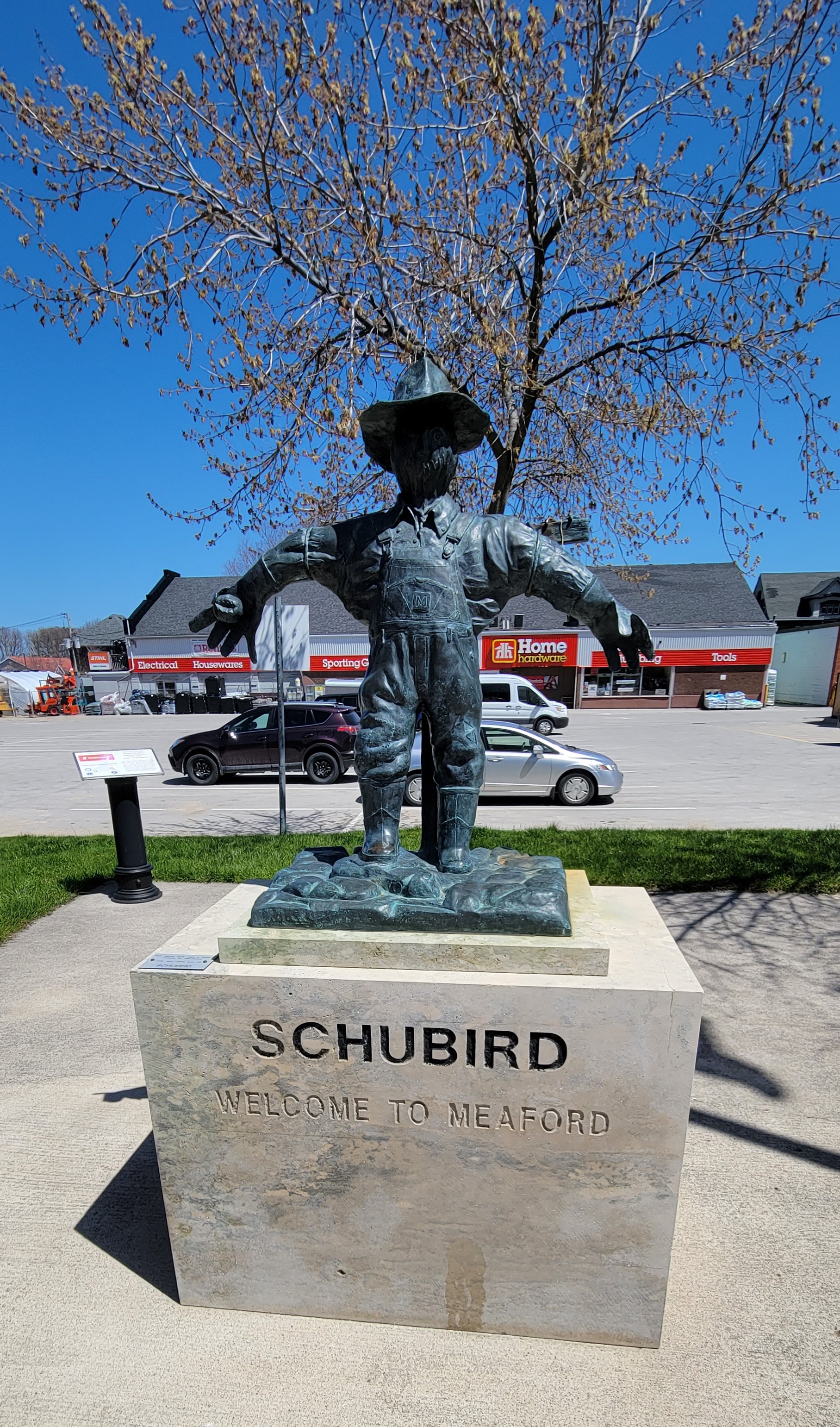
Meaford bills itself as the Scarecrow Capital of Ontario because of the abundance of farmland surrounding the city. Every October a Scarecrow Invasion and Family Festival is celebrated for two days. The bronze scarecrow statue was unveiled during the 2009 festival. Named Schubird ("Shoo, bird") the three-foot-tall scarecrow was designed by local artist Gunter Neumann. Below Schubird is a plaque telling visitors to rub his right foot for good luck.
The Meaford Apple, also known as the Big Apple, has been an iconic local tourist spot for decades, welcoming thousands of out-of-towners annually for tourism information and souvenir photos. The Big Apple was built in 1974, after the Town of Meaford received generous funding from Globe Mills Limited.
Construction of the Big Apple was no easy feat. Back then, before the days where volunteers were turned away due to liability concerns, the Kinsmen and the Chamber were able to get quite creative. The lumber used to build the structure had to be bent to make the curved shape, and they had an ingenious solution for this: soaking it in a pool!
Mr. Crawford, owner of the Hilltop Hotel, donated the use of his swimming pool to soak and bend the wood. It had to be soaked overnight, with pool temperatures reaching as high as possible. That swimming pool is still in use today, and the motel is now operated by his son Randy Crawford.
On the way into town I had seen a sign for
Beautiful Joe Park, which meant nothing to us until we were reading some historical billboards around the Big Apple.
Then we obviously had to go to the park.
The Park is named after a dog “Beautiful Joe”, the hero in Margaret Marshall Saunders best-selling novel of the same name. He is laid to rest in the Park grounds. The park was Joe's backyard after his rescue by the local Moore family, and today it reminds us of kindness to animals and the impact they have on our lives.
With what would be her second novel — written from the perspective of a mistreated but beloved, heroic dog — Saunders won an American publishing contest. The book, Beautiful Joe, came out in 1894. It was a story filled with animal rights and humanitarian messages that charmed readers everywhere. Beautiful Joe is said to be the first book written by a Canadian to sell over a million copies. By the late 1930s it was in fifteen languages and had sold over seven million copies worldwide.
The story Saunders told in her best-seller was true. It was about a mongrel dog she had come to know in Ontario. The loving family she wrote about was based on her own and the locations where the action unfolds were inspired by Halifax and the Annapolis Valley. However, the contest she had won — and the publishing reality — insisted that fictitious American place names be used instead of the Nova Scotia ones.
Beautiful Joe and later books made Margaret Marshall Saunders a well-known author and public speaker, honoured by both Great Britain and France. She was a champion of children's and animal rights, but ended her days needing charity to help her get by.
You can see this heritage sign that recognizes the efforts of the woman who made Joe famous at his burial site, and his friends at The Society added a footstone in 2017.
Margaret Marshall Saunders was laid to rest in Mt. Pleasant Cemetery in Toronto in an unmarked grave, the Society felt this tribute to her was very deserving to a woman ahead of her time - who loved all animals. It was unveiled in 2013.
At the entrance to the Park, you will find a bronze sculpture of Beautiful Joe that was created by local Meaford resident, Gunter Neumann. You must pat him on the head and say hi!
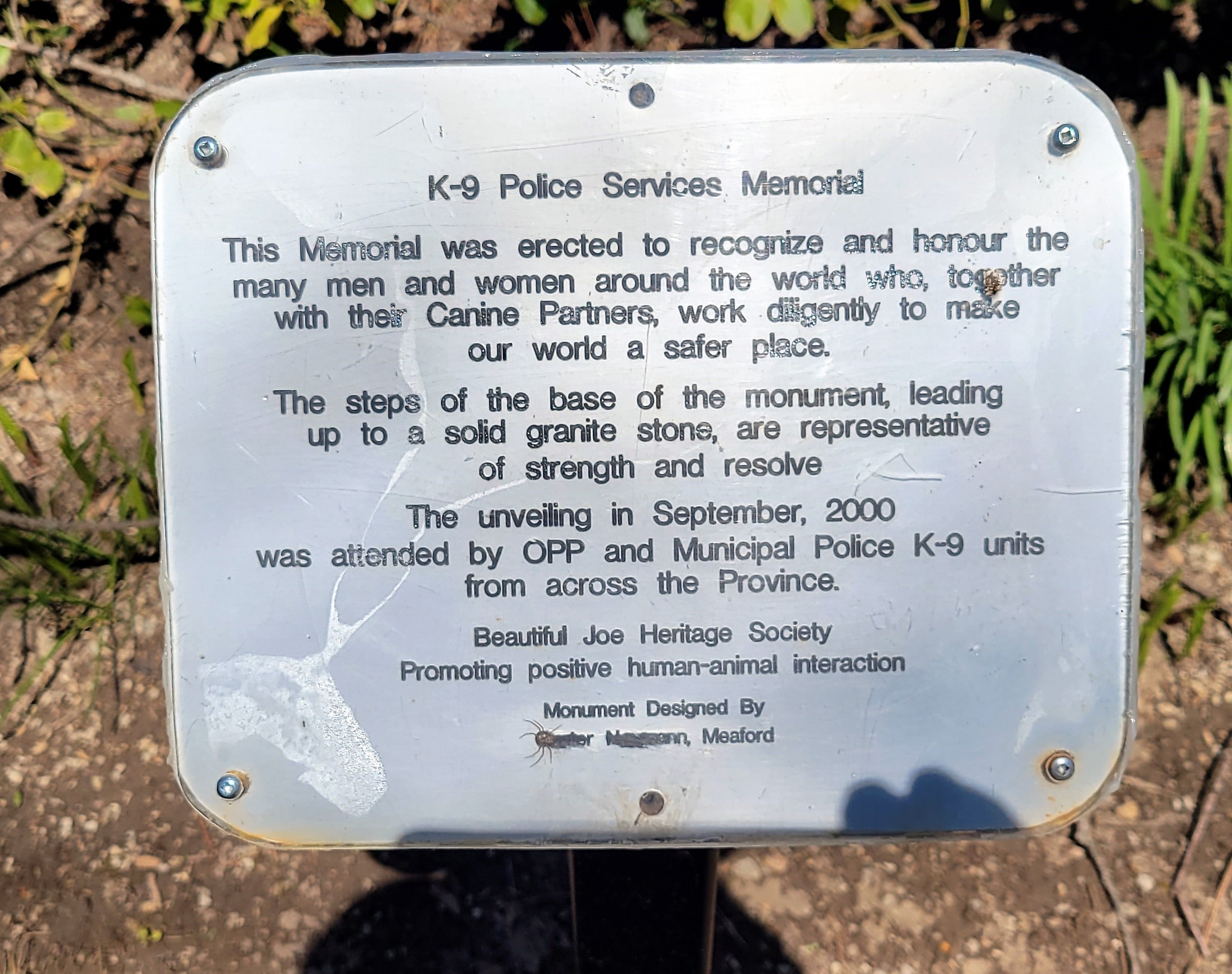
Service Dogs Monument.
Joe’s Park is also home to a 9/11 Monument honouring a brave dog named Sirius, who was K-9 partner to Officer David Lim.
The Park is also home to Paradise Islands, a place where people can have a plaque respectfully placed honoring their beloved companions.
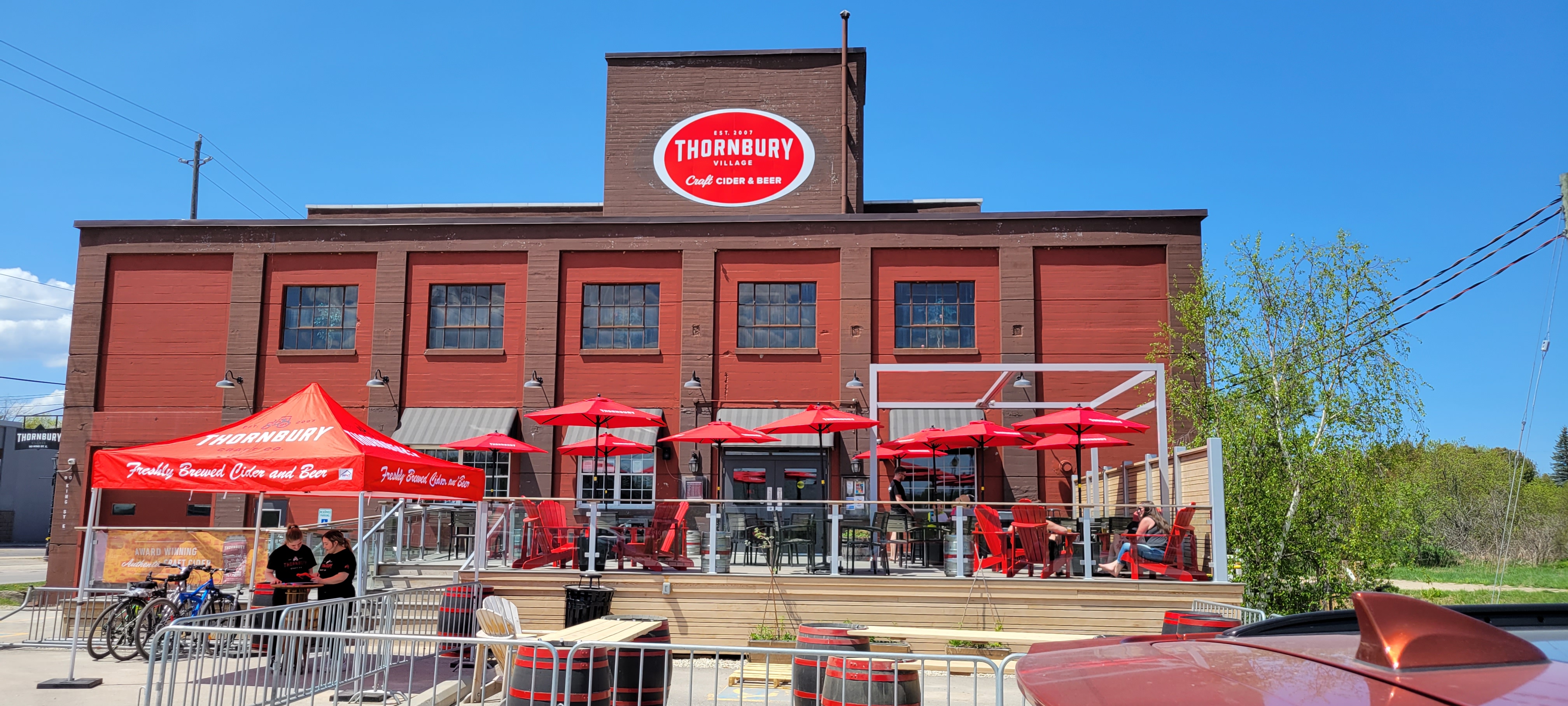
On our way back to Collingwood I have John pull into Penny's Motel in Thornbury. He thinks I'm weird but then he learns the story.
The next thing I know he is ordering drinks and we sit on the patio!


%20jackie.jpg)








.jpg)