In honour of CANADA DAY I plan to post a daily image of Canada and a link to a random Canadian location we have visited.
Canada's 10 provinces and 3 territories span from the Atlantic to the Pacific and up to the Arctic. The main difference is that provinces derive their powers directly from the Constitution, while territories have powers delegated to them by the federal government.
The 10 Provinces
Province
Capital
Explanation
Ontario
Toronto
Canada's most populous province. It is the economic and industrial powerhouse of the country and home to the nation's capital, Ottawa.
Quebec
Québec City
The largest province by land area. It is the heart of French-Canadian culture and the only province where French is the sole official language.
British Columbia
Victoria
Located on the Pacific coast, known for its majestic mountains, ancient rainforests, and mild climate. Its largest city, Vancouver, is a major global hub for trade and multiculturalism.
Alberta
Edmonton
Known for the majestic Rocky Mountains, vast oil sands, and vibrant agricultural industries. Cities like Calgary and Edmonton are major economic drivers.
Manitoba
Winnipeg
The easternmost Prairie province, characterized by thousands of lakes, boreal forests, and a strong agricultural and cultural heritage.
Saskatchewan
Regina
Famous for its sweeping open plains, it is widely known as the "breadbasket" of Canada due to its massive wheat production and rich natural resources.
Nova Scotia
Halifax
One of the four Atlantic provinces. Surrounded by the sea, it has a rich maritime history, deeply rooted in fishing, shipbuilding, and scenic coastal lighthouses.
New Brunswick
Fredericton
Located in the Maritimes, it is Canada's only officially bilingual province and is famous for the Bay of Fundy, which has the highest tides in the world.
Newfoundland and Labrador
St. John's
The easternmost province. It is renowned for its distinct dialects, colorful historic capital, unique geography, and deep seafaring traditions.
Prince Edward Island
Charlottetown
Canada's smallest province. Famous for its red sandstone cliffs, sandy beaches, potato farming, and for being the setting of the classic novel Anne of Green Gables.
The 3 Territories
Territory
Capital
Explanation
Yukon
Whitehorse
The smallest of the three territories, famous worldwide for the Klondike Gold Rush, breathtaking wilderness, and viewing the aurora borealis.
Northwest Territories
Yellowknife
A vast expanse of boreal forests and tundra, rich in natural resources like diamonds, and home to the massive Great Slave Lake.
Nunavut
Iqaluit
Canada's newest and northernmost territory. It consists primarily of Arctic tundra, and its population is predominantly Inuit, who maintain strong traditional lifestyles.
In honour of CANADA DAY I plan to post a daily image of Canada and a link to a random Canadian location we have visited.
Georgian Bay, Ontario, often called the "sixth Great Lake," is a world-class travel destination famous for its crystal-clear turquoise waters, windswept pines, and rugged granite shorelines. Spanning over 30,000 islands and 2,000 kilometres of shoreline, it offers the perfect mix of outdoor adventure, beach relaxation, and rich cultural heritage.
I'm not going to mention how HOT it was on Thursday when we explored here. I already mentioned in the the Shrine post and my weekly recap which includes some photos of our drive and the area.
Thanks to the Sainte-Marie website for the information.
After paying an entrance fee we watched an informative video on the history of the village.
The story of Sainte-Marie among the Hurons dates back almost four hundred years. Wendake (“the land apart”) was the ancestral homeland of the Huron Wendat nation, a branch of the Iroquoian family. The Wendat were a matrilineal society of skilled traders and farmers.
You then exit the Visitors' Centre and enter the village.
It is popular legend that the IHS stands for the Latin phrase Iesus Hominum Salvator, “Jesus the Savior of (all) Men”.
Following the trail of French explorer Samuel de Champlain, French Jesuit priests arrived in Wendake early in the 17th century. An international order, the Jesuits operated like an army, dedicated to spreading Catholicism throughout the world. They believed that the first step in converting a person to Christianity was to educate him.
The Jesuits established themselves in Wendake. They travelled from village to village, learning the Wendat language and customs, and preaching to the Native people. Their Superior, Father Jérome Lalemant, dreamed of "building a house apart, remote from the vicinity of the villages, that would serve among other things for the retreat and meditation of our evangelistic labourers."
After the arrival of carpenter Charles Boivin, further construction resulted in a chapel, a residence for the Jesuits, a cookhouse, a smithy and other buildings. Sainte-Marie became the Jesuit headquarters in Huronia, from which the Jesuits travelled among the Iroqouian-speaking Huron and Petun, and the Algonquian-speaking Nipissing, Ottawa and Ojibwa peoples, whose languages were distinct but related to each other.
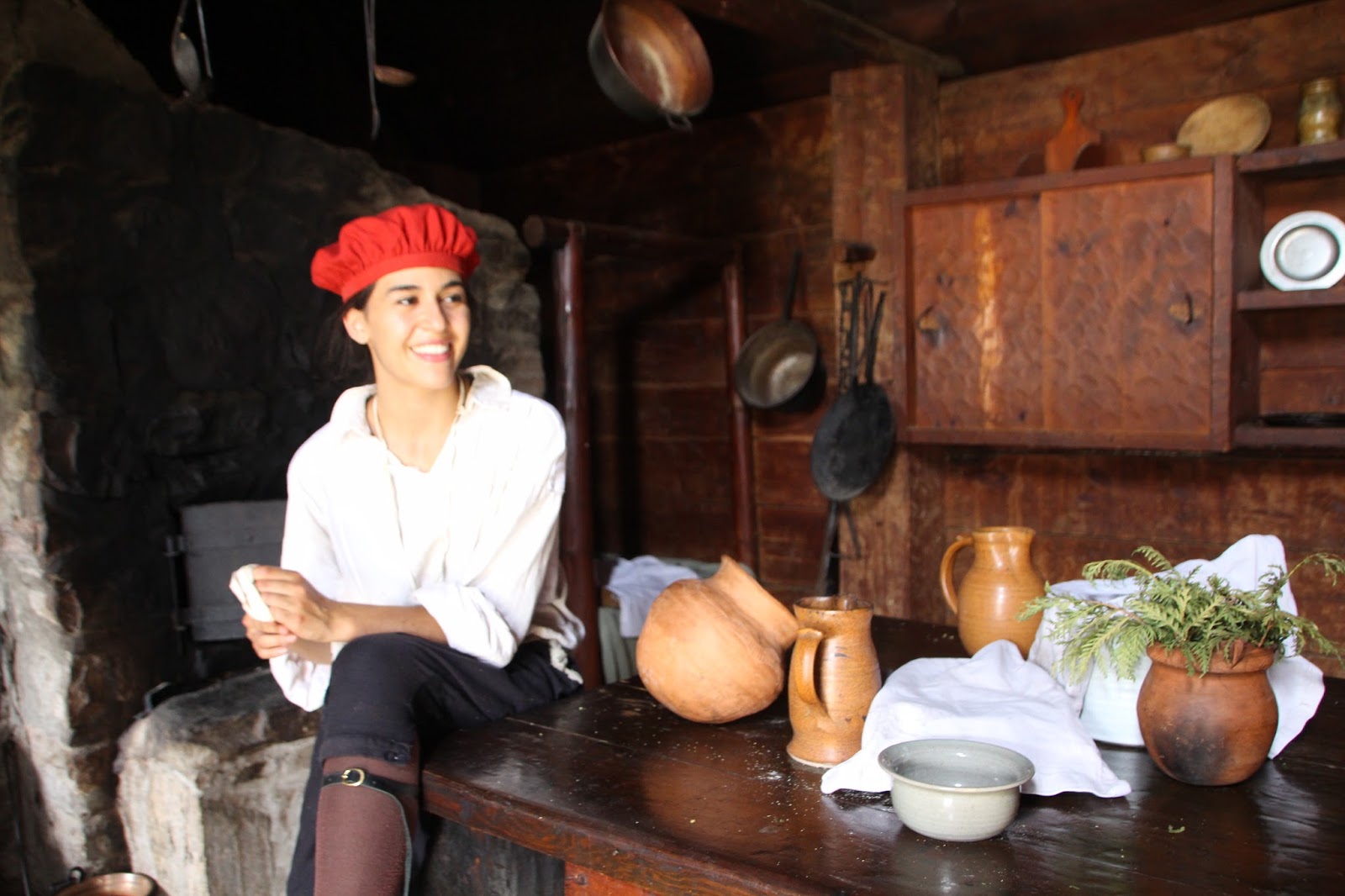
This is the cookhouse. These young guides were excellent, engaging and fun. It was a really hot day to be making soup!
Corn was a main staple of their diet. The heat from the fire would dry the corn for many uses.
A small group of religiously devoted men, also known as donnés (offered, given or gifts), worked at the mission in return for food, clothing, and shelter. The Jesuits hired engagés, laborers, and non-clerical Jesuits known as "lay brothers". The Jesuits preached the Christian Gospel to the Huron, often adapting the story to local customs and symbols. One of the most famous examples of this was the "Huron Carol", a Christmas hymn written by Jean de Brébeuf. A translated version of this song remains popular in Canadian churches to this day.
You could try your hand at writing with a quill.
Carpentry shop
Blacksmith's, this young man was very well informed. Normally the fire would be going but it was just too hot out.
Courageous laymen travelled from France to build a mission on the banks of the Isaraqui (Wye) River in 1639. It was named Sainte-Marie among the Hurons. Huron is the French name for Wendat.
Hard work and dedication soon brought Sainte-Marie to virtual self-sufficiency, an impressive achievement for a community 1,200 kilometres from Quebec. It was to last only 10 years.
In the 17th century, the land we know as Canada was New France. The population numbered in the low hundreds, and most of the people lived along the Saint Lawrence River, their livelihood based on fish, furs and fledgling agriculture. We know the story of Sainte-Marie among the Hurons from the annual reports written by the Superior at Sainte-Marie. The reports, known as the Jesuit Relations, were sent to France via Quebec.
Apothecary garden.
Apothecary / hospital
Wendat villages were places of residence, food storage and interaction. The main buildings within the village were longhouses. The longhouse represented the physical expression of their basic family, social, religious and economic life. The longhouse was a windowless structure, six to nine metres wide and about the same height. Archaeological evidence indicates that the average longhouse was between twenty-five to thirty metres long. Longhouses generally faced northwestward into the prevailing wind. This could have been done to prevent the longhouses from blowing down in a strong wine or to prevent the spread of fire from one dwelling to another. Longhouses were usually built parallel to each other at about three to four paces apart. From archaeological evidence, it appears that longhouses were made of cedar bark and covered by large pieces of elm bark. Doors were left at the ends and sometimes along the sides, and they were usually low to the ground. To enter, a person would need to bend over. Holes were left in the roof to allow smoke to escape and to allow some light in. Large hearths were about 6 metres apart with usually two families per fireplace.
The most common family descent pattern within the longhouse had everyone related through the mother matrilineally. The Wendat did have a strong tradition of hospitality. Visitors were usually permitted to reside for short or long periods of time within the longhouse.
The report written by Father Paul Ragueneau tells us the story of heartbreak and despair that led to the abandonment of Sainte-Marie among the Hurons.
In the spring of 1649, attacks by the Iroquois increased. Under growing pressure, the Jesuit missionaries, their helpers and Wendat followers burned the settlement and abandoned it. They fled to St. Joseph Island (now Christian Island), where they endeavoured to establish a new Sainte-Marie. After a terrible winter of starvation and constant attack, the Frenchmen and the Christian Wendat returned to Quebec.
The Huron were settled on l'île d'Orléans in Quebec, where the Iroquois attacked the community. The surviving Wendat stayed in Quebec, and eventually gathered at Jeune Lorette in 1697, where they established their Huron culture and a nation known as Loretteville or Wendake. Today, it remains one of the largest Huron Wendat communities in Canada. At Sainte-Marie among the Hurons in Ontario, the grave of the martyred priests Brébeuf and Lalemant is a sacred place of Christian pilgrimage.
The ruins of Sainte-Marie lay undisturbed for almost three centuries. Archaeological excavations and historical research provided the information to accurately reconstruct many of the original mission buildings seen here today.
There is a lovely restaurant on site.
And a museum.
A beaver hat is made from felted beaver fur. They were fashionable across much of Europe during the period 1550–1850 because the soft yet resilient material could be easily combed to make a variety of hat shapes (including the familiar top hat).