Tom hosts Tuesday's Treasures Travel Tuesday
Our World Tuesday Image-in-ing
My Corner of the World
June- September 2019 - Toronto ON
This post falls into this category! Not unusual for me.
And then one thing led to more Toronto connections.
And that led to Yorkville, photos I had already in my files.
So I visited the AGO Art Gallery of Ontario to find some pieces in September. Others I found online.
A new City of Toronto Market Gallery exhibit, Toronto Through the Eyes of Women Artists, highlights how Canadian women artists have depicted and engaged with Toronto over the past 170 years.
The 56 exhibited works range from more traditional cityscapes to contemporary views of the city. The exhibit presents 37 nationally-acclaimed artists including: Rebecca Baird, Paraskeva Clark, Marion Long, Kelly Mark, Doris McCarthy, Christiane Pflug, Margaret Priest, Helga Roht Poznanski and Kim Ondaatje, among others.
Archival photos, exhibit catalogues, announcement cards and newspaper articles help curate the historical, social and creative context of women artists living and working in Toronto during three time periods, from 1850 to the present.
All of the 56 exhibited works are part of the City of Toronto's Art Collection. This is the first time the gallery has presented a group exhibit featuring women artists from the collection. The collection contains nearly 3,000 works from almost 900 artists, more than a quarter of them women.
Many works by women artists in the collection depict unique views of the city and often focus on the relationship between interior spaces and the urban outdoor landscape beyond.

Sadly, not much seems to be known about
Mary Hastings Meyer (née Fitzgerald). She married fellow artist, Hoppner Francis Meyer, who specialized in miniature portraits. They lived on Adelaide Street West in 1853, the same year Mrs. Meyer exhibited as an “amateur” at the Upper Canada Provincial Exhibition and won prizes for her depictions of animals and other unspecified subjects. Then she clearly followed her husband when he returned to England around 1862, because she is known to have exhibited flower paintings in London between 1868 and 1885. Flowers and animals – genre subjects regarded as suitable for Victorian female painters.

In Mary Hastings Meyer’s remarkable, three-by-five foot painting of Toronto, a bright
blue-green Don River meanders through the lower Don Valley, past grazing cows,
toward Gooderham and Worts’ (now the Distillery District) windmill tower in the distance (far left). By 1855, the
windmill no longer had its sails and distilling had replaced milling as its industrial
purpose in life. Seen from the Lake and waterfront town site, the windmill tower was
still a major landmark; but seen from the north, it was reduced in size and
importance.
Perhaps that’s why Alderman William Gooderham voted against purchasing this
particular painting in April 1855, despite Aldermen Romain and Smith’s desire to
secure such “a beautiful painting and accurate view of our city executed in a
masterly manner by one of our Townswomen” for the City. Or, perhaps more likely,
the conservative Victorian businessman had little use for spending taxpayers’ money
on fripperies like art. Fortunately, two years later, when Gooderham was no longer
on Council, the City voted to purchase the painting for £50 and to hang it in the
cupolaed City Hall at Front and Jarvis Street so beautifully depicted in the painting.
My photo doesn't do it justice.
Image found online @MasterGalleryTO.
 Clara Sophia Hagarty
 (1871–1958) Born in Toronto, Hagarty worked with paints and pastels. She is best known for her paintings of flowers. She was elected to the Ontario Society of Artists in 1903 Royal Canadian Academy of Arts in 1904. She studied in New Jersey, Paris, and the Netherlands. She spent World War I working for the Red Cross in London, and after the war worked at the Art Gallery of Toronto until 1928.

Born an American citizen,
Mary Hiester studied with Thomas Eakins, a controversial teacher at the Pennsylvania Academy of Art during the early 1880s. It was here that she met her future husband, a Canadian, George Agnew Reid. The couple settled in Toronto in 1885, becoming central figures in the local art community. Mary was one of the first women accepted into the Ontario Society of Artists and the Royal Canadian Academy of Arts.
When I was at the AGO I found more of her work. A little too dark for me.
Mary Ella Dignam was born in 1857 in Port Burwell, Ontario, to Byron and Margaret Ellinor (Ferguson) Williams.
Mary's interest in art proved to be enduring, and she brought to it ambition, willpower and talent. She also benefited from the support of her family. When she was a teenager, her parents were able to send her to art classes in London, Ontario, where Paul Peel was a fellow student. In 1880, she married London businessman John Sifton Dignam. Their marriage was utterly atypical for Victorian Canada, in that Mary was able to leave her husband and children for extended periods to pursue her artistic and professional goals. Mary Dignam studied at the New York Art Students' League in Manhattan, and visited Italy, the Netherlands and Paris.
Soon after her return to Canada in 1886, Dignam came to the view that "women had no recognition or place" in Canadian art societies. Thus, she turned her energies and ambitions to other areas. She became a teacher, and later the head, of a ladies' art school in Toronto, and she organized the Art Studios of Moulton Ladies' College at McMaster University.
I happened on the Moulton plaque this week after I had already written the draft for this post.
Funny, I've never seen this Ontario Heritage Trust plaque located on a west facing wall just inside the left set of doors here at 2 Bloor Street East. It says:
Near this site in Senator William McMaster's former residence, Moulton Ladies' College was opened in 1888. A year earlier the bequest of McMaster's fortune to Baptist higher education had led to the founding of McMaster University. His widow, Susan Moulton McMaster, then conveyed the residence to the University for use as a preparatory school for girls. The Ladies' Department of Woodstock College, an older Baptist institution, was transferred to the Toronto college, named Moulton in honour of Mrs. McMaster. For 66 years Moulton College served with distinction both day and resident students from junior grades to university entrance. The buildings were sold in 1954 and demolished in 1958. The name is preserved in Moulton Hall, a women's residence at McMaster University, Hamilton.
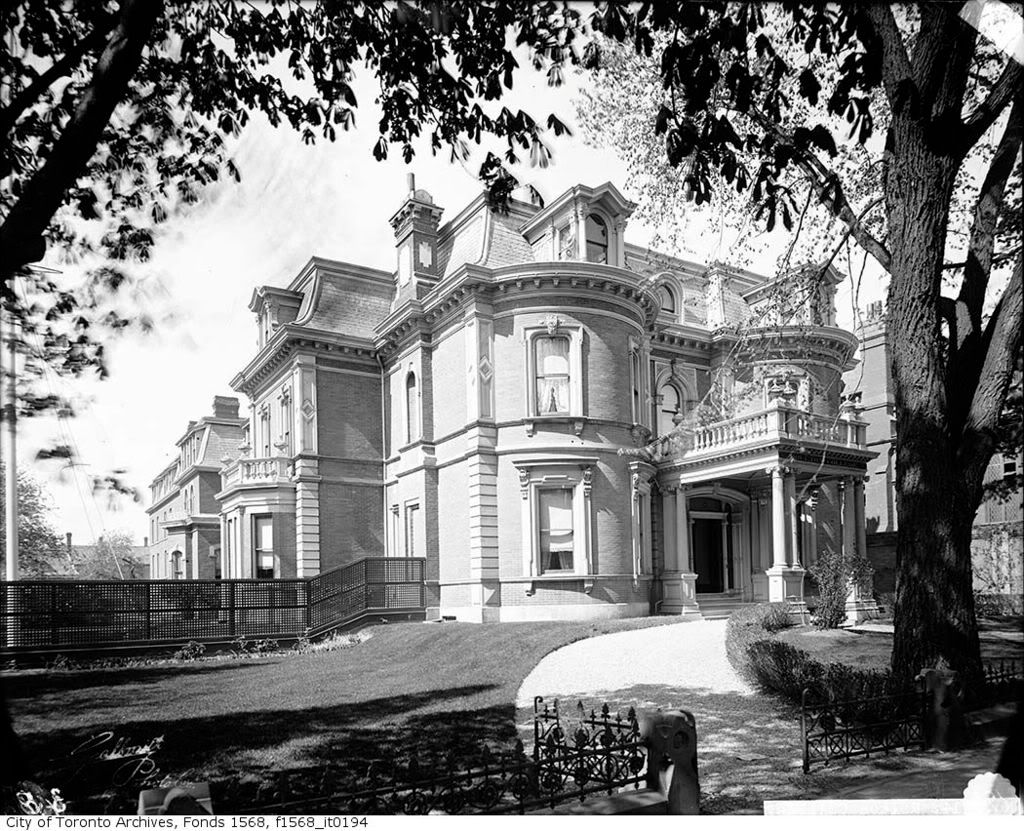
Moulton College, Bloor St. about 300 yards east of Yonge, N side. Now The Bay
In 1886, Mary Dignam organized an informal group of women artists called the Women's Art Club, which later incorporated itself as the Women's Art Association of Canada (WAAC). By 1898, the WAAC boasted nearly 1,000 members and had branches in various Canadian cities. Dignam was president of the WAAC until 1913, after which she continued on as advisory president for many years. Mary Dignam returned as president in 1936 to mark the association's 50th anniversary.
I need to add the Spadina Museum to my list. I went to Spadina Museum in August. During the introductory video on the Austin family, it was mentioned that Mary Dignam was a friend of Mary Austin, and replaced her as president.
Mary Austin (1860-1942)
Mary Austin was the lady of Spadina during the 1920's and 1930's. Born in Perth, Ontario, she was educated in the United States and Canada. Accomplished in music, she was the organist at several Methodist churches here in Toronto. She married Albert Austin in 1882 and had five children. In 1908 she was elected Vice-President of the Women's Art Association of Canada and spent much of her life collecting art and patronizing women artists. She was one of the founders of the Toronto Chamber Music Society in 1896 and became President of the Women’s Musical Club of Toronto in 1910. Mary died in 1942 with an obituary that emphasized her family and distinguished service to art and music.
I asked the guide during the tour of the Spadina House about Mary Dignam and she said there were several paintings by Dignam in this room.
And she pointed out this photo of Dignam (in the middle) on a shelf in Mrs. Austin's sitting room. On the far right is Mrs. Austin.
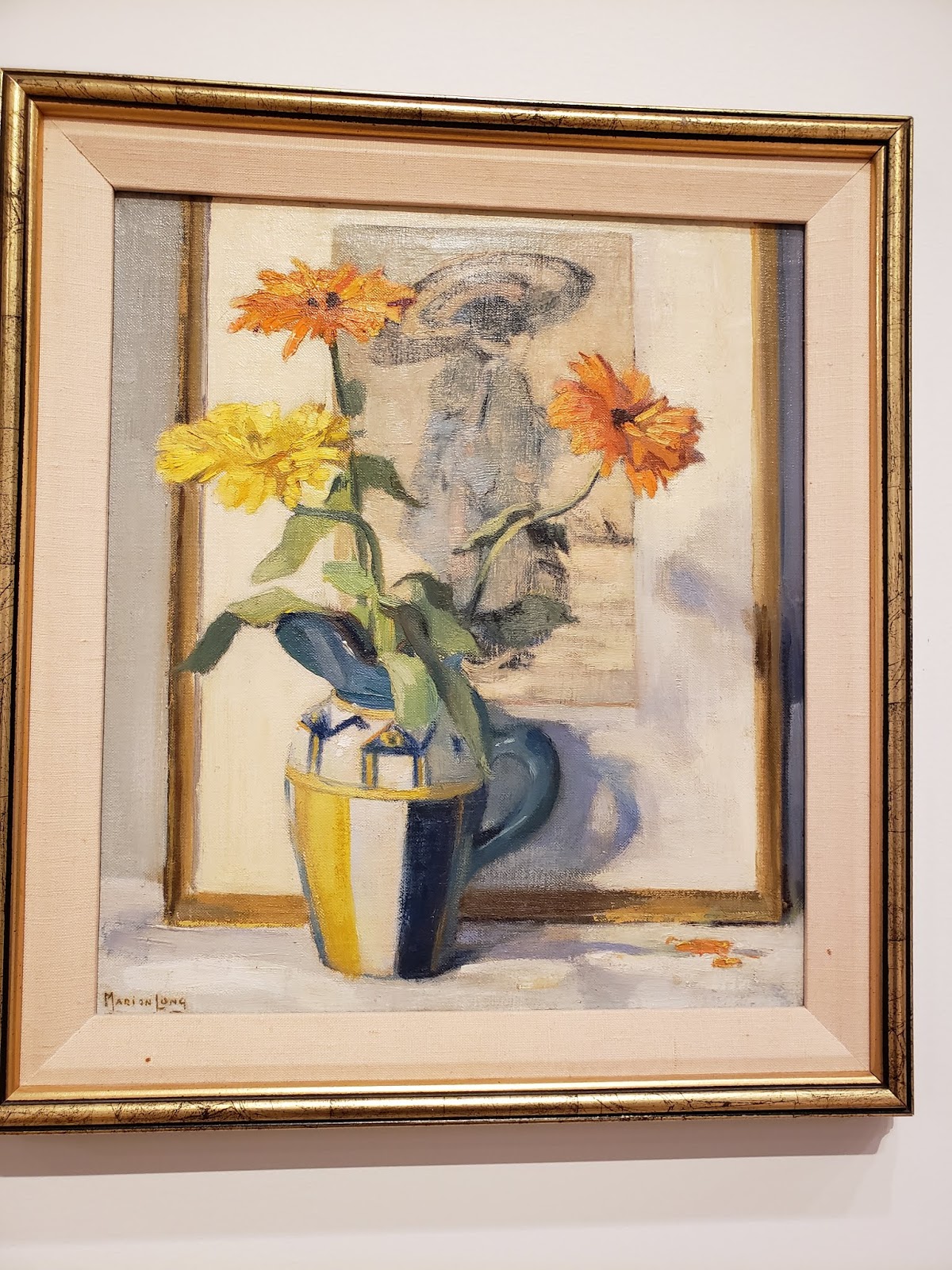
Marion Long RCA, OSA, HC, OIP (1882 – 1970) was a Canadian born artist, elected to the Royal Canadian Academy in 1922. She was a highly commissioned artist and often painted military portraits.
Long studied at OCAD University (then known as Ontario College of Art and Design), privately with Laura Muntz Lyall and Charles Hawthorne.
OCAD is located around the corner from AGO. I actually took this photo of OCAD as I walked to the AGO to find more Long paintings.
In New York she studied at the Art Students League from 1907-1908 with Robert Henri, William Merritt Chase, and Kenneth Hayes Miller.
In Yorkville and still thriving today is the Heliconian Club for women artists.
Women were excluded from clubs such as The Arts and Letters Club of Toronto, founded in 1908 as an association of musicians, artists, writers and architects. In response, the Heliconian Club was founded in 1909. At first members were professional female musicians, writers, painters and actors.
Executive members included the professional artists Estelle Kerr, Dorothy Stevens, Mabel Cawthra,
Marion Long, Elizabeth McGillivray Knowles, Rody Kenny Courtice, Isabel McLaughlin and
Kathleen Daly Pepper (below). Lorrie Dunington-Grubb, co-founder with her husband of Sheridan Nurseries, was another active member of the Heliconian Club. She was president of the
Women's Art Association of Canada from 1925 to 1930.
Later it was opened to other occupations related to the humanities such as dance, sculpture and architecture. The name "Heliconian Club" comes from Mount Helicon, the abode of the muses.
The plaque reads:
The Heliconian Club, founded in 1909 to provide a forum for women in the arts, purchased this property in 1923. Opened in 1876 as the Olivet Congregational Church, this small Gothic Revival building became the church hall and Sunday school in 1890 when a large adjacent building was erected. In 1921 it was sold to the Painters' Union and named Hazleton Hall. When acquired by the Heliconian Club it was extensively renovated as its permanent home. Over the years the membership of the Heliconian Club has included many Canadian women distinguished in the arts.
FYI The Arts and Letters Club still exists in Toronto on Elm St. Women have been admitted since 1985.
At the AGO two Marion Long's.
This rare portrait reveals the friendship and mutual respect between Long and McGillivray. Whitby-born artist McGillivray was a landscape painter noted for her unique brushwork. Long was a student of McGillivray’s, and the two remained lifelong friends, playing a vital role in Toronto’s tight-knit community of women artists.
McGillivray (1864–1938) garnered admiration for her modern landscape paintings, as well as for her mentorship of young artists, including Tom Thomson. She has been credited in some instances as an influence for what would later be known as the Group of Seven.
This painting is the last known image of McGillivray and, poignantly, portrays the artist in her studio.
This Marion Long piece I saw at the Market Gallery, it is part of the City of Toronto's collections.

Frances Bannerman (née Jones) (1855 – 1944) was a Canadian painter and poet. She was born in Halifax, Nova Scotia.
Bannerman is one of the first North American artists to be influenced by Impressionism. In 1882, she was the first woman to be elected an Associate of the Royal Canadian Academy, and only the second woman to be a member of that academy (the first being Academician Charlotte Schreiber). In 1883, she participated in the Paris Salon. One of the works she submitted, Le Jardin d'hiver (The Conservatory), "is the first Canadian subject ever to be shown in that venue." She moved to Italy in 1901, and stayed there until the Second World War forced her to leave. She returned to Torquay, England, where she died in 1944.
Born in Calgary, Alberta,
Doris McCarthy attended the Ontario College of Art from 1926 to 1930, where she was awarded various scholarships and prizes. She became a teacher shortly thereafter and taught most frequently at Central Technical School in downtown Toronto from 1932 until she retired in 1972. She spent most of her life living and working in Scarborough (now a Toronto district), Ontario, though she travelled abroad extensively and painted the landscapes of various countries. McCarthy was nonetheless probably best known for her Canadian landscapes and her depictions of Arctic icebergs.
A lifelong resident of North Toronto,
Dorothy Denovan attended art classes at Northern Vocational School in the 1930s. While still a student she had one of her portraits accepted for exhibition by the Ontario Society of Artists and a landscape by the Canadian Society of Painters in Watercolour. She worked for many years in the advertising business and became a full-time artist in the 1970s when she was in her 50s.


Kathleen Daly Pepper was born in Napanee, Ontarioin 1898. As an aspiring artist, she had excellent training, first at Toronto’s Havergal College and then at the University of Toronto, graduating in 1920. She went on to the Ontario College of Art (OCAD) from 1920 to 1924, where she was taught by a number of famous Canadian painters: J.E.H. MacDonald, Arthur Lismer, J.W. Beatty, George Reid and Fred Haines. Summer training at the Académie de la Grand Chaumière and the Parsons School of Design in Paris in 1924 and 1925 rounded this out. After studying the woodblock under René Pottier in Paris in 1925, she returned to Canada and explored the possibilities of etching in her postgraduate work in 1925 to 1926. Daly was well traveled, biking through Europe in 1924 with fellow painters Yvonne McKague (Housser) and Roselyn (Rody) Kenny. She married Canadian painter George Pepper, whom she had met earlier in Paris at the Académie de la Grand Chaumière in 1929. Her work is widely known under her maiden name, with “Kay” or “K. Daly” being the simple signature she applied to her work most often throughout her life. George shared her love of travel, and they took painting trips together from Banff to Nova Scotia, as far north as Ellesmere Island and Povungnituk in Canada’s eastern Arctic, as well as to northern Labrador and south to the Catskill Mountains in New York State. Together they built a studio cabin in Charlevoix County in the Laurentians in 1933. They would also become long-term tenants in the Studio Building in Toronto beginning in 1934, working there for 17 years.
Also a founding member of the Heliconian Club.
Chief Sitting Eagle's Family by Daly belongs to the AGO but is not currently on display.

Born and trained in Russia,
Paraskeva Clark (née Plistik) immigrated to Canada in the summer of 1931 with her second husband, Philip Clark, whom she met in Paris. She had abandoned painting 10 years earlier when she left the Free Studios in Petrograd (now St. Petersburg), where she received instruction after the Revolution of 1917.
It was through her work at a theatre that she fell in love with and married Oreste Allegri Jr., the son of an Italian artist and stage designer. Were it not for Allegri's untimely death in a drowning accident little more than a year after their marriage, and only three months after the birth of their son, we might not be in a position to claim Paraskeva Clark as an important figure in the history of Canadian art. Clark brought her knowledge of European modernism to a fledgling arts community in Toronto, and it was in this milieu that she began to exhibit her work and develop her skills as a practicing artist.
Click here for her biography.
On Labour Day the Art Canada Institute tweeted this:
This work by painter
#ParaskevaClark (1898–1986) pays tribute to the working women of Canada's past who performed home front maintenance on RCAF aircrafts during the Second World War.
Helga Roht Poznanski was born on 26 June 1927 in Tartu.
She and her mother fled to Vienna, where Helga briefly attended medical school at her mother’s behest, but secretly also attended art lessons at the Vienna Academy of Art.
The day before Vienna was taken by the Soviet army, Helga and her mother fled to the Alps, briefly living in Innsbruck and in various displaced persons camps in Austria and Germany, before successfully emigrating to Montreal, Canada through Bremenhaven in 1948.
A and A Records on Yonge St. now long gone.
The Papery in Yorkville