Showing posts with label Danube. Show all posts

04 October 2026

May 6 - Budapest Jewish Interest Tour

May 6 part 1 - Budapest Jewish Interest Tour

May 2012 - Budapest Hungary

I will split today's post into two sections.

 We had not planned on taking the optional Jewish Interest Tour but signed up for it once we arrived in Budapest.
It is a Sunday morning tour before we board our ship the Sound of Music later in the afternoon. We need to have our bags out before we leave on the tour.


I must mention, before I start, that we had to go through security checks before entering the synagogue and the Holocaust museum.

The tour starts at Budapest Great Synagogue (Dohany utcai Zsinagoga). Our guide is very informative. Kate mentions that as a child growing up under communism she had no idea that she was Jewish, there was no history lessons in school about Nazis or World War II. She said she was 20 before she began reading about the atrocities and she learned about her religion when her children went to school.
Jews were banned from the city in the 18th century so they established a Jewish quarter just outside the old city boundary. Remains of the old Pest city walls run on the opposite side of the road.

The Jews built their main synagogue in a residential area. Theodore Herzl, founder of modern Zionism was born in one of the buildings. This stunning temple was constructed between 1844-59 according to Ludwig Förster's plans. The second largest synagogue (the largest stands in New York although some Hungarians would disagree) in the world can hold 3,000 people. Two onion-shaped domes sit on the twin towers at 43 m height. The towers symbolize the two columns of Solomon's Temple.

The spacious interior has equally rich decorations. A single-span cast iron supports the 12-m wide nave. The seats on the ground-floor are for men, while the upper gallery has seats for women. Surprisingly the synagogue has an organ, pulpits and kneeing benches though these features are normally found in Christian churches,not synagogues.
According to our guide, the elders couldn't agree on an architect so they hired a Christian hence some of the Christian elements. It was built between 1854 and 1859 by Ludwig Forster, a German-born Austrian architect. The original was bombed by the pro-Nazi Arrow Cross Party in 1939, also mentioned in my past post..

The organ was played by Franz Liszt during the synagogue's inauguration.
The synagogue avoided serious damage during the war, likely because the Nazis protected it for their own uses: they put radio antennas on the two towers, stabled their horses in the nave, and according to some sources may have had a Gestapo base in the balcony.


During the Communist period, many windows were broken and the Jews boarded up the synagogue. An ambitious restoration was recently completed, funded in large part by famous Americans Tony Curtis and Estée Lauder, who are of Hungarian-Jewish descent. The building's original splendor is now fully apparent.

Its ark contains 25 torah scrolls taken from other synagogues destroyed during the Holocaust. The torahs were saved by Christian priests and ministers who entered the ghetto and rescued the torahs and buried them in Christian graveyards until they were returned after the war.

The second part of the tour, and the most heart wrenching is the memorial garden and the remembrance garden. 

Budapest's great synagogue witnessed many tragic events in WW II.

In March 1944, Adolf Eichmann arrived in Budapest with the occupying Nazi forces to supervise the establishment of the Jewish ghetto and the subsequent deportations. For a time, Eichman had an office behind the rose window in the women's balcony.

Up to 20,000 Jews took refuge inside the synagogue complex during the war, but 7,000 people perished during the bleak winter of 1944-45. These victims are buried in the courtyard, where you can also see a piece of the original brick ghetto wall.


Next to the main building is the Jewish Heroes' Mausoleum and Temple in memory of the thousands of Jews who died during the Second World War. The Memorial Garden contains monuments to Jews who died in the Holocaust and to non-Jews who protected their Jewish neighbors.
Like many of the Nazi occupied territories, the Jews were driven into a ghetto surrounding this synagogue. Sadly, many of these people froze and starved to death, and their bodies were left in piles within the synagogue walls. The Soviets, after liberating Budapest, devised a system of mass graves in which to place all 2,228 bodies that were in the ghetto, at the time. It looks like a peaceful place, but in 1945, this was a very different matter.

There is a huge metal weeping willow tree called The Tree of Life which contains leaves engraved with the names of  Jews who perished under the Nazis. You can also see a piece of brick from the original ghetto wall in the garden.
The inscription reads "is there a bigger pain than mine?". It resembles an upside down menorah.
At the end of each branch is a Roman numeral to assist families in locating their leaf.

This was erected in 1990 soon after the fall of communism made it possible to acknowledge the Holocaust.

 Our guide, Kate, showing us the leaf engraved with her grandmother's name.

The small stones are typical of Jewish cemeteries evoking the age-old tradition of placing pebbles over desert graves to cover the body and prevent animals from disturbing it.

The best known Righteous Gentile honoured by Jews around the world is Raoul Wallenberg, the Swedish diplomat and businessman who rescued around 60000 Hungarian Jews during World War 2. He was considered a rich playboy and got the job because no one else wanted it.
In July 1944 the Swedish Foreign Ministry, at the request of Jewish and refugee organizations in the USA, sent Wallenberg on a rescue mission to Budapest as an attache to the embassy there.
When Wallenberg reached the Swedish legation in Budapest in July 1944, the campaign against the Jews of Hungary had already been underway for several months. Between May and July 1944, Eichmann and his associates had successfully deported over 400,000 Jews by freight train. Of those deported all but 15,000 were sent directly to the Auschwitz-Birkenau concentration camp in southern Poland. By the time of Wallenberg’s arrival there were only 230,000 Jews remaining in Hungary.
Wallenberg immediately began issuing Swedish ‘protective passports’ with the less well-known diplomats Carl-Ivan Danielsson (1880-1963) and Per Anger (1913-2002). He also set up a series of safe houses placing flags of neutral countries on houses where Jews could seek asylum. He even followed deportation trains, distributing food and clothing and actually pulling some people off the cars along the way.
When the Soviet army entered Budapest in January 1945, the authorities arrested Wallenberg for espionage and sent him to Moscow. In the early 1950s the Soviet Union announced that he had in fact died of a heart attack in 1947. Several reports later suggested that Wallenberg was still alive, but none was ever confirmed.
It is commonly believed that Wallenberg was executed by the Soviets, who suspected him of spying for the USA.
The memorial is also etched with the names of other Righteous Gentiles who helped save Jews. According to the Talmud "whoever saves one life, saves the world entire".

This stained glass represents the Holocaust as a wall of fire (removal of hope) and a snake (Fascism) to remind all of the terror that was felt by the Jewish people of Budapest and the rest of Europe.


These alcoves are labeled for victims and contain lights that come on when darkness falls.

And finally to make you smile after reading this gruesome post, there is always a souvenir shop!


The tour continued with a stop at the Holocaust Museum. Unfortunately, we did not have a lot of time and you could easily spend a whole day here. Some people, however, cannot handle it and often come back out immediately. 

The museum was created around a synagogue which is no longer in use as there are not enough Jews left in Budapest to support the number of synagogues they had before the Holocaust. The Holocaust Memorial Center pays tribute to the victims of the Hungarian Holocaust. The complex, inaugurated in 2004, houses a synagogue, a museum and an inner courtyard with a glass memorial wall dedicated to the over 500,000 victims with their names inscribed on the wall. The museum's permanent exhibition tells the history of the Holocaust through the stories of individuals in an interactive way. Original documents and personal belongings are on display.
It was an eerie, disturbing place to visit. It also includes the gypsies, Romas as part of the displays as the Nazis included them in their persecutions as well.When the Soviet Army captured Budapest on January 17-18, 1945, it was too late to save the lives of 564,500 Jews who had been sent to the various death-camps run by the Nazis. The Budapest SS headquarters, however, was over-run by the Soviets before the Nazis were able to destroy a huge number of papers which documented their efforts to annihilate the Hungarian Jews. These documents, together with many of the photographs that are part of this essay, were bundled up by the Soviets and stored in the basement of the Hungarian Ministry of the Interior where they remained unseen for over forty years.
 As you walked around in partial darkness, you could hear footsteps following you.


 One of the priests who saved many Jews.

Glass chairs represent the victims in the unused synagogue.


Outside in the courtyard.


 We make one more stop at a very sad memorial that will send shivers up your spine. It is called Shoes on the Danube and is located in front of the parliament and between the two bridges along the Danube.

The Shoes on the Danube is a memorial to the Budapest Jews who were shot by Arrow Cross militiamen between 1944 and 1945. The victims were lined up and shot into the Danube River. They had to take their shoes off, since shoes were valuable belongings at the time.
The Nazis had installed the fascist Hungarian Red Arrow Party as the country’s national government. Herds of Red Arrow members, mostly teenage boys, would rampage the streets of Budapest firing at will at Jews. The most notorious massacres were when mobs of supporters would round up groups of Jews and march them to the banks of the Danube. Here, after being made to take off their shoes, they would be blasted into the icy waters. Around 10,000 to 15,000 were killed in this way.
The memorial was created by Gyula Pauer, Hungarian sculptor, and his friend Can Togay in 2005. It contains 60 pairs of iron shoes, forming a row along the Danube. Each pair of shoes was modeled after an original 1940's pair.

10 September 2026

Austria - Random Repost

May 2012 - AUSTRIA

May 8 Vienna and Schonbrunn Palace
May 9 Melk and Durnstein
May 10 today Salzburg


As per our itinerary:
Thursday May 10 - Afternoon in Passau Germany
This morning the ship will make a brief technical stop to drop off passengers joining the optional tour to Salzburg. The ship will continue sailing, and arrive to Passau this afternoon where remaining guests will have the opportunity to explore the city independently. Most well known for St. Stephen's Cathedral and its historic Altstatd, or Old City district, the city boasts many fine examples of Baroque and Gothic architecture. In the early evening, all passengers will rejoin the ship and set sail for Regensburg just before dinner.
Optional: Full Day Tour of Salzburg - BOOKED

Full day excursion to Salzburg, the birthplace of Mozart and famous cultural setting for the Sound of Music. Once ashore, enjoy a walking city tour to see some of the most historic sights for which Salzburg is known, including Mirabella Palace, the house where Mozart lived, Nonnberg Abbey, Salzburg Cathedral, and St. Peter's Cemetery. Enjoy lunch at a local restaurant and time at leisure to explore the streets of Salzburg on your own. Overnight: Cruise
Meals: Breakfast, Lunch, Dinner


We woke in Aschach, Austria, a very pretty town. We had our own alarm clock outside our window.
 Yes, it is 6:50AM, our bus leaves at 8AM for Salzburg. It was another glorious sunny day!!


Today's agenda


We're on the optional tour to Salzburg along with Lee and John. It's a two hour drive with a stop along the way. 


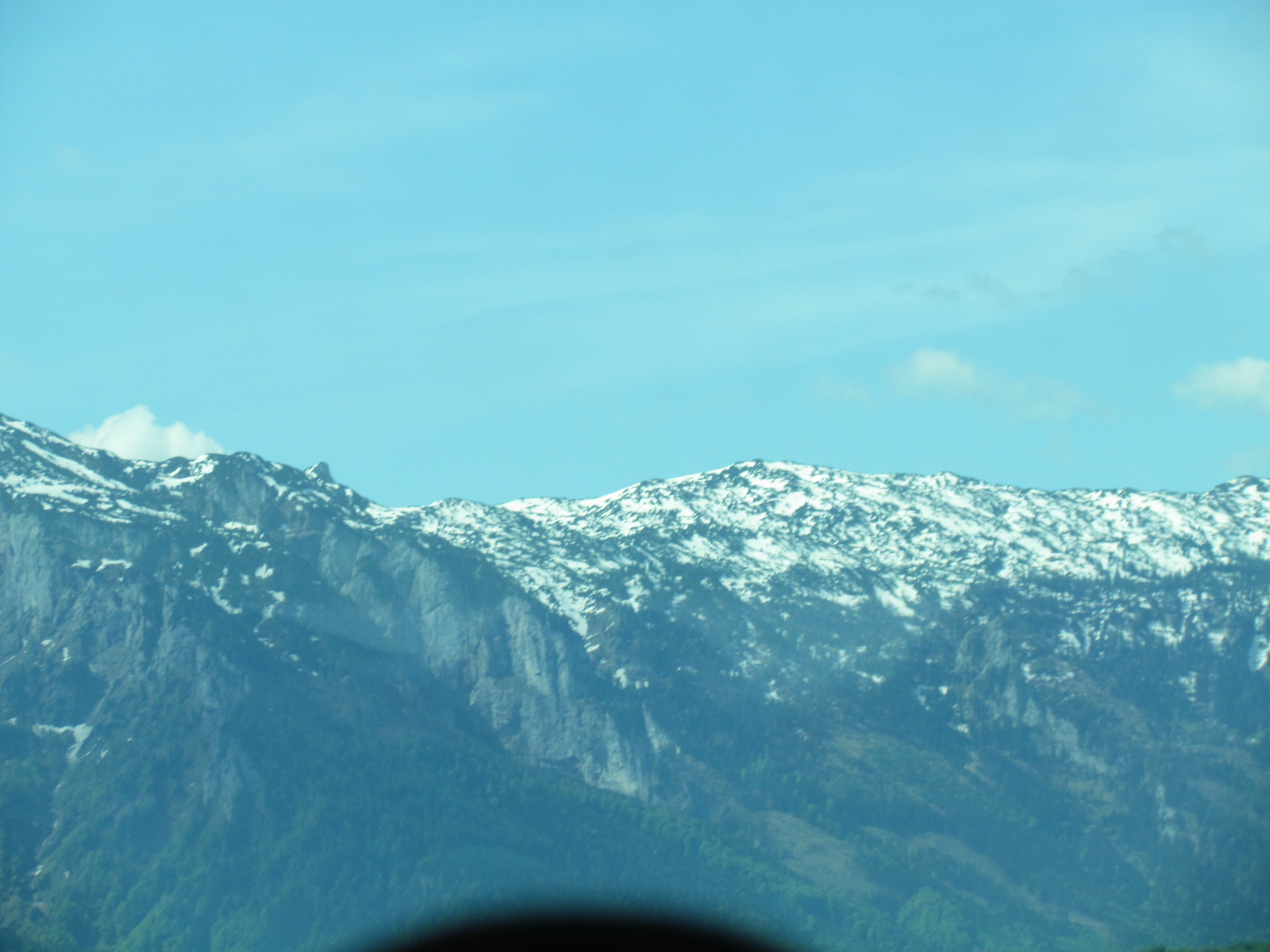
 First glimpse of the snow-capped Alps.


 Coffee break I wish our highway stops were as pretty as this. Landzeit own and operate the restaurants and hotels along the autobahns in Austria.

 
Their restaurant serves "real" food, not the greasy burgers we get here. I wish I had taken a photo of the restaurant, however, I had gotten yelled at when I took the photo of the pastries so I was afraid to.

 
MMMM so so good Kaiser melange coffee and we were given a coffee mug.


From the terrace of the coffee shop - Mondsee lake and mountains from opening scene from Sound of Music!!!!!! Have I mentioned recently how huge a fan I am? "The hills are alive...."


Back on the bus and we get a fleeting glance at the church used for the wedding in Sound of Music.
It's a good thing John is quick with the camera!


Salzburg is the city of Mozart and Maria. It is a very picturesque town of 
It is contemporary and yet old-fashioned. The women love to wear the traditional "trachten" outfits however the young girls wear theirs as minis. Wearing a dirndl or leather trousers in Salzburg is chic, stylish and classy. Traditional costumes are more than just fashion,dressing in the traditional alpine way - for work, for shopping.
Our guide met us as we got off the bus to take us on our walking tour, Salzburg is also a pedestrian friendly city like most of Europe.


We begin with a stroll along the gardens of Mirabell Palace. Modern Salzburg′s city hall is still as attractive as it was when Fräulein Maria and the Trapp children danced between thousands of flowers around it.


In the film, Maria and the children danced around the fountain singing "Do-Re-Mi". The Pegasus fountain next to the 17th century palace can also be spotted in the movie.
The stairs leading up to the rose hill were part of the choreography as well.
That's me in green.


 The children copied the pose of these statues in the movie.


As we left the park we saw a house where Mozart lived.


 Also the house of the scientist who in 1842 discovered the so-called "Doppler effect", the principle for velocity measurements and a number of other applications, including radar technology, distance estimates in astrophysics or automatic doors.


As we crossed the Salzach river there was a tour boat performing a waltz!! 


 Hohensalzburg Fortress up on the hill.


 Me, in green again. Look at all the padlocks along the bridge.


It’s been happening quietly for years, beginning when soldiers going to war would leave locks on the road leading out of their hometown, as a promise to return. But the trend really caught on, and turned romantic in 2006, when a movie based upon the novel, Ho Voglia di Te (“I Want You”), was released in Italy and became wildly popular. There is a scene where the couple writes their names on the top of a padlock and attach it to a lamppost with a chain.


The Getreidegasse is probably one of the loveliest shopping streets in the world: a wide range of shops are found behind the elaborately decorated façades, in the traditional passageways and inside the landmarked buildings. I could have spent the day taking photos of these elegant signs.


 Would you believe this is the McDonald's sign, the town wouldn't allow the garish yellow arches to be mounted.


The house where famous composer Wolfgang Amadeus Mozart was born (Gerburtshaus). 


A mime


The building with the green striped umbrella is Cafe Tomaselli on the 'Alter Markt' the oldest, longest serving cafe in Austria.
Cafe Tomaselli is an institution which has hosted musicians including Mozart and members of high society since 1852.
"Alter Markt" means "old market" and this is exactly what it is: the old market square of Salzburg, just between the Getreidegasse and the Salzburger Dom. It was built in 1280 and unites a number of attractions.Look to the right between the green and white building is number 10A the smallest house in Salzburg.


This 30 foot tall yellow ball with a man on top called Sphaera is an odd sight in front of these medieval churches. Sphaera is a sculpture made in 2007 by artist Stephan Balkenhol and is locally called Mann auf Mozartkugel (the “Original Salzburg Mozartkugeln” are still produced manually by the confectionery Fürst according to the original recipe and using the original technique: First, a ball of green pistachio marzipan covered in a layer of nougat is produced. This ball is then placed on a small wooden stick and dunked in a dark chocolate coating. Next, the stick is placed vertically, with the ball at the top, on a platform to allow the chocolate to cool off and harden. Finally, the stick is removed; the hole that it leaves behind is filled with chocolate coating, and the ball is wrapped in blue-silver tin foil by hand.)

Balkenhol is well known for using this same man in a series of statues throughout Europe


It was then time for lunch which was included as part of the tour. This is a pet peeve of mine, especially since this one wasn't even good and took forever to get served, wasting valuable sightseeing time!

We decided, that in future, we would skip the "reserved" and dreaded group lunch and find somewhere local to eat.

The location St. Peter's Stiftskeller, the oldest restaurant in central Europe was wonderful but the meal was mediocre, weinerschnitzl with boiled potatoes and a meringue for dessert. There was no appetizer, salad or vegetable. We were served a beer each with no chance to order another even though we waited over thirty minutes for our food.
I did check their standard menu and it would probably be much better than what we had thrown at us.


 Have I mentioned lately how I hate being herded around?


We finished lunch and we split up with the other couple to spend some free time wandering the gorgeous streets. We contemplated going up to the fortress but felt we didn't have enough time for everything.
Outside the restaurant is the lovely St. Peter’s Church Cemetery. It is the one that was reproduced in Hollywood for use in The Sound of Music escape scene.


Our next stop was to the lovely Salzburg Cathedral. 


We then went to Residenz Square where the famous fountain with the Stallions is located. Sitting at the former site of an ancient Roman forum, Residenzplatz square still shows off Salzburg's Italian ambitions. The square is bordered by the Old Residenz (Alte Residenz) to the west, the New Residenz (Neue Residenz) to the east, the Salzburg Cathedral (Dom) to the south and historic private houses (Bürgerhäuser) to the north. 


The huge fountain (Residenzbrunnen) in the center of Residenzplatz is complete with Triton which really does match Bernini's famous Triton Fountain in Rome.


Amedaus Mozart made Salzburg his home for the fist 25 years of his life (1756-1777) and his statue dominates the center of this square which bares his name. The highlight of Mozartplatz may actually be the beautiful pink church of St. Michael which overlooks the square and dates back almost 1,000 years before Mozart, to 800 A.D.


  Time for some window shopping.


And then it was time to get back on the bus for our return trip to the river boat.
As we drove we crossed the border into Germany. With the EU it is no longer necessary to have border guards.

The boat is now docked in Passau, Germany. It had sailed down the Danube to meet us.

 
Germany uses a huge amount of solar power, we saw fields like this everywhere. The government subsidizes it.


We arrived in Passau which looks like another pretty town, but we don't have time to visit as we are sailing shortly.


BACK

   One Word Sundays               Cellpic Sunday       Leonard Cohen Exhibit Montreal QC Forthcoming One Word Sundays             8 November...