Showing posts with label 2017. Show all posts

06 October 2026

Tuesday Treasures

Linking up with Tuesday Treasures

September 2017 - Montana


We visited the Little Bighorn Battlefield National Monument, which you might know better as the site of Custer’s Last Stand. Click here - There are more photos in our daily post.

I thought the park service did a great job of honouring the dead from both sides while acknowledging that the Native Americans in the battle were fighting to preserve their way of life against white settler encroachment and broken treaties.

Custer National Cemetery at the Little Bighorn Battlefield National Monument was established on January 29, 1879, to protect the original shallow graves of the 7th Cavalry troopers who fell during the Battle of the Little Bighorn.


Key Historical Milestones
  • June 1876: Soldiers were originally buried in shallow graves where they fell on the battlefield. 
  • 1877–1881: Many officer remains, including Lt. Col. George Armstrong Custer, were exhumed and reinterred in eastern cemeteries. Remaining soldier bones were gathered into a mass grave beneath a granite obelisk on Last Stand Hill. 
  • January 29, 1879: The Secretary of War officially designated the site a U.S. National Cemetery. 
  • December 7, 1886: The site expanded into the National Cemetery of Custer’s Battlefield Reservation to accept burials from other regional military campaigns and wars. 
  • 1890: Over 240 white marble headstones were erected across the field to mark where individual soldiers died. 
  • July 1, 1940: Management transferred from the War Department to the National Park Service. 
  • 1991: The entire area was renamed Little Bighorn Battlefield National Monument to broadly honor all participants, separating the name of the military graveyard as Custer National Cemetery

The Battle of the Little Bighorn, known to the Lakota and other Plains Indians as the Battle of the Greasy Grass and commonly referred to among white Americans as Custer's Last Stand, was an armed engagement between combined forces of the Lakota, Northern Cheyenne, and Arapaho tribes and the 7th Cavalry Regiment of the United States Army. The battle, which resulted in the defeat of US forces, was the most significant action of the Great Sioux War of 1876. It took place on June 25–26, 1876, along the Little Bighorn River in the Crow Indian Reservation in southeastern Montana Territory.


Like many other national cemeteries, Custer National Cemetery was created after those killed in battle were already buried here. Between 1877 and 1881, troops garrisoned at nearby Fort Custer (modern-day town of Hardin, Montana) regularly gathered remains for reburial, recovered graves, and policed the battlefield for exposed bones. The first of these details disinterred and collected all identified officers, except Lieutenant John Crittenden. Lt. John Crittenden was left where he fell at the request of his family until 1932. General Custer was reinterred at West Point while most of the others were shipped to Fort Leavenworth, Kansas and other private cemeteries back east at the request of their families.


Congress passed the first National Cemetery Act in 1867. It provided funds to purchase land, outlined common features, and defined appropriate, acceptable behaviors within the cemetery walls. In National Cemeteries, all rest as equals. This is opposite to the rigid caste system that defined day-to-day military operations. Here in the Custer National Cemetery, for example, Brevet Brigadier General Marcus Reno is buried directly beside Private Dale Hepler, conferring to each soldier an equal honor in death regardless of their military rank or socioeconomic status in life.


 7th Cavalry Memorial located atop Last Stand Hill within the Little Bighorn Battlefield National Monument.
Erected in 1881, this granite obelisk stands directly over the mass grave where the remains of most of the 7th Cavalry soldiers and civilians killed in the battle were reinterred.

The Inscriptions: The face of the monument visible in the photo is divided into distinct sections commemorating those who fell:
Soldiers: Lists the names of the enlisted men and non-commissioned officers.
Arikaree Indian Scouts: Specifically honors scouts like Bloody Knife, Bobtailed Bull, and Little Soldier who fought alongside Custer's forces.
Civilians: Lists attached personnel, including Custer's brother Boston Custer, his nephew Arthur Reed, the newspaper correspondent Mark Kellogg, and guides/interpreters like Mitch Bouyer and Charley Reynolds.


The 7th Cavalry Horse Cemetery honors the roughly 39 cavalry horses that were killed and used as protective breastworks by Lt. Col. George Custer’s men during their final stand on June 25, 1876.

History of the Horse Cemetery
June 1876: Desperate for cover on the exposed and windswept plains of Last Stand Hill, soldiers shot their own mounts to create a makeshift defensive wall.
1879 (The Cordwood Monument): Captain George K. Sanderson gathered the horse bones scattered across the battlefield and placed them inside a temporary 11-foot cordwood monument erected at the summit of the hill.
July 1881: When the temporary wood structure was replaced by the large permanent stone obelisk seen in your previous photo, the horse remains were carefully and respectfully reburied nearby.


Archaeological Finds: Investigations in 1941, 1946, and 2002 uncovered additional equine skeletal remains alongside battle artifacts like boots and pierced hardtack tins, confirming the exact location of the horse burial site.
The Marker Today
Located just down the ridge from the main monument, the site is designated by a dedicated dark granite marker engraved with a saddled cavalry horse. It serves as a somber reminder of the animals that had no choice in the battle but shared the same fate as the men.


Other graves scattered about.


29 September 2026

Tuesday Treasures


2013, 2017 and 2025 - Memphis TN

2017
William Christopher Handy (November 16, 1873 – March 28, 1958) was a composer and musician, known as the Father of the Blues. An African American, Handy was one of the most influential songwriters in the United States. One of many musicians who played the distinctively American blues music, Handy did not create the blues genre and was not the first to publish music in the blues form, but he took the blues from a regional music style (Delta blues) with a limited audience to a new level of popularity.

Handy was an educated musician who used elements of folk music in his compositions. He was scrupulous in documenting the sources of his works, which frequently combined stylistic influences from various performers.


Taken in 2025

W.C. Handy used the cigar counter to write out copies of the Beale Street blues for the band members.

Club Handy and the surrounding Handy Park are named in honor of W.C. Handy (William Christopher Handy).


Taken in 2013


Renamed in 2017


20 August 2026

Day 11 Boca Raton Florida to Daytona Beach Florida

November 2017 - Daytona Beach FL


The plan was to only drive three hours today and enjoy some of the sunshine.

We were going to have a late lunch at Joe's Crab Shack before we checked into the hotel so we parked in the first lot we found, $15.
I stepped out of the car and saw a Hilton to our right and said "we could have saved $15 and parked at our hotel!"

Daytona Beach was founded in 1870 and officially became a city when it was incorporated in 1876. Most sources agree that it received its name from its founder Matthias D. Day, a business tycoon from Mansfield, Ohio. He purchased 3,200 acres in the fall of 1870 for the sum of $1,200.


Made famous for its wide beach and smooth, hard-packed sands, Daytona Beach became widely known in the early 1900s for high-speed automobile testing, and later, racing. This made the beach a mecca for racing enthusiasts.

By the 1920s, it was dubbed the “World’s Most Famous Beach.” As more and more racing took place, the sandy beaches gave way to the development of the famous racetrack known as the Daytona International Speedway, which was built by NASCAR founder William “Bill” France. The speedway has been hosting the Daytona 500 since 1959 and attracts thousands of tourists and race enthusiasts from all over the world in search of thrills.


The glass building on the right is our hotel.


I


The Clock Tower has stood as a symbolic landmark for the "World's Most Famous Beach" since its construction was completed in 1937. Its four, one-of-a-kind, 48 inch diameter clock dials [which were made from vitrolite6 glass with a milk white color] featured the twelve letters of the city (D-A-Y-T-O-N-A-B-E-A-C-H) instead of the traditional one through twelve Arabic or Roman numerals. The original hour and minute hands were made from wood. The structure itself is constructed of reinforced concrete faced with coquina rock and stands 55 feet tall. The base has circular steps and a low masonry railing with arched openings that surround the fountain pool. It is classified as being of a late 19th and 20th century Revival/late Gothic Revival architectural style.


In the 1920s, residents of Daytona Beach considered this area to be run-down and held discussions on ways to improve it.

In 1936, WPA workers began construction on this community-use project that was to cost Daytona Beach $84,000, the federal government $184,000, and be completed in 1938. Originally known as "Broadwalk", common usage gradually changed the name to the boardwalk.

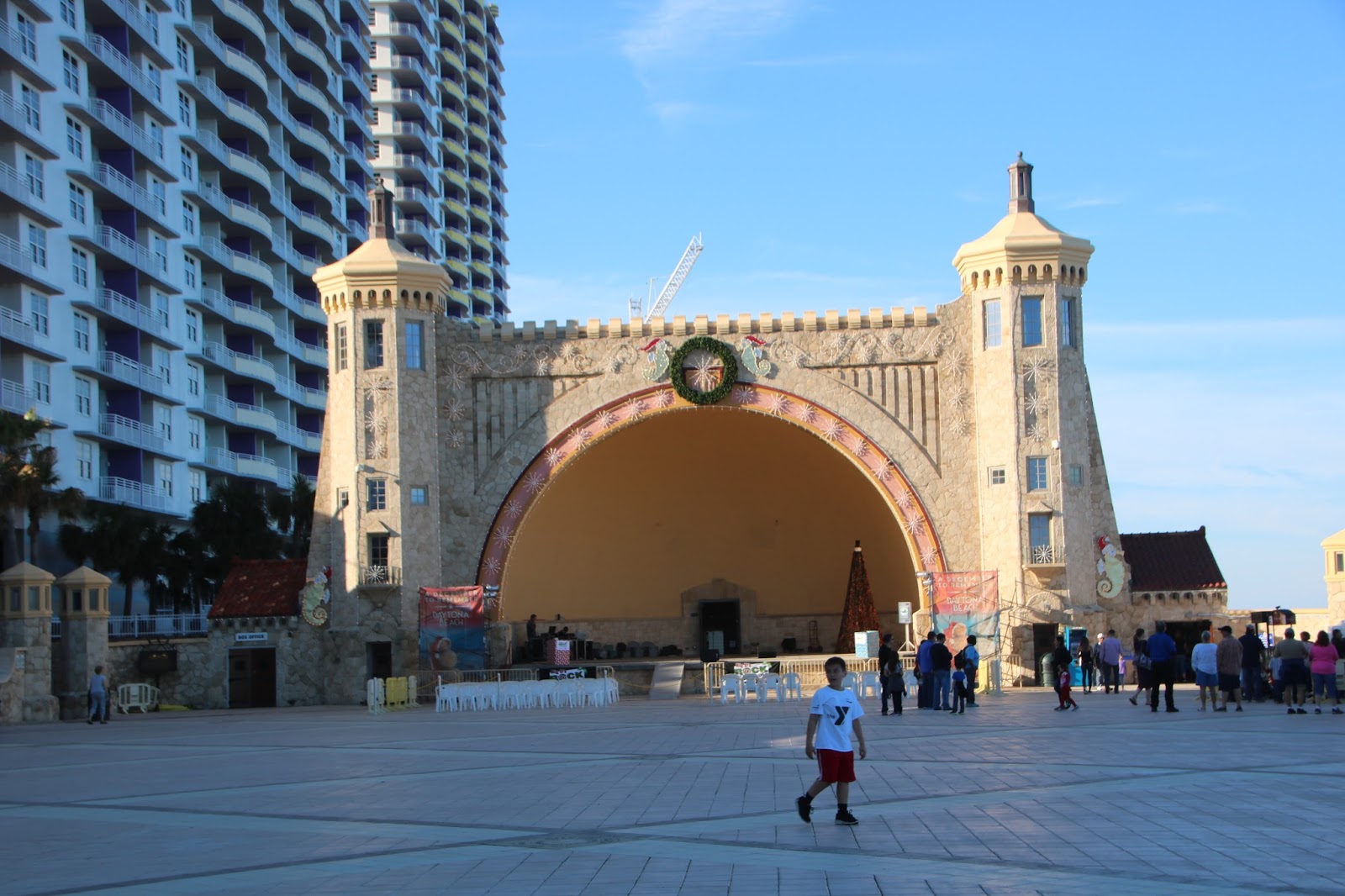
The first facility constructed was the 48 foot by 114 foot natural coquina rock bandshell which seats 4,500. This was begun in September, 1936, and was completed in time for the first program to be presented on July 4, 1937. Open air concerts, as well as other programs, are still presented in the bandshell. The other structures in the boardwalk area are a clock tower, kiosk, concession facilities, restrooms, subway entrances (now closed), and an elevated walk from Earl to Ora Streets.


Daytona Beach is dubbed the “World’s Most Famous Beach” for a variety of reasons, but mainly for its 23 miles of wide, hard-packed sand that welcomed the first automobile and motorcycle races in 1902.


Beach driving is one of the most popular and iconic activities beach goers have come to enjoy as part of their Daytona Beach vacation tradition. Take a scenic ride or put your car in park to enjoy a beach day with everything you need just a stone’s throw from your beach towel.


Frank Stallworth Lockhart (born April 8, 1903 at Dayton, Ohio - April 25, 1928 at Daytona Beach, Florida) was an American automobile racing driver active in the 1920s, considered by many historians to be a legend in the sport on par with 1960s British World Driving Champion Jim Clark. During a "remarkable if all too short" career, Lockhart won numerous races on dirt, board tracks, the 1926 Indianapolis 500, and set a world land speed record for a distance average. In all, he had nine AAA wins and two vice-championships in two years of competition.


The Daytona Beach Boardwalk, also known as the Daytona Beach Broadwalk, was built in 1938. It is open seven days a week and consists of a concrete walkway with various stores and shops including the City Walk shopping and entertainment complex, hotels, gift shops, amusement centers, arcades, restaurants and bars. It also features outdoor and indoor rides like the Ferris wheel, Slingshot, Hurricane, Tilt-O-Whirl, go-carts and rollercoaster.


The Daytona Beach Pier is the most recognizable landmark on Daytona Beach and has been the center of beach life since the beginning of the community.

The original pier, constructed of palm logs, was built before the turn of the 20th century and extended 600 feet into the ocean. It was built by Thomas Keating and was known as the Keating Pier. It was located at the end of Main Street, where the present pier is located.


On January 20, 1920 a tremendous fire destroyed the pavilion and most of the pier. In 1924, Keating sold the remains of the pier to Jeter McMillan who tore it down and began construction of a new pier. The new Pier Casino opened on June 11, 1925. The pier was 1,000 feet in length and featured a Victorian style building. Its ornate ballroom could accommodate 2,000 dancers and hosted some of the top bands of the day. In addition to dances, the Pier Casino was the scene of charity balls, weddings, beauty contest, social events as well as civic meetings. 


During the years of beach racing, some of the pilings were removed to allow race cars to pass under the pier. The Pier Casino was also a popular location for photos of the famous racers who came to Daytona Beach. Those photos were seen worldwide and helped Daytona Beach to become known as “The World’s Most Famous Beach.”

In 2012 Joe's Crab Shack moved in.


The clock Tower from our hotel room.


The next morning as we are leaving town.


Beach racing in Ormond was an idea of J.F. Hathaway, a guest of the Hotel Ormond. Hathaway noted the heavily packed sand was perfect for driving his auto. In 1902, he observed a bicycle race on the beach and became eager to stage an automobile race there also. He shared his idea with Price, Anderson, and W.J. Morgan, a sponsor of bicycle races and a New York sports writer. The first race was held on Ormond’s beach in 1903. In 1904, Flagler built the Ormond Garage just east of the hotel to house the cars brought to participate in the annual races. Some of the early racers and enthusiasts were Ransom E. Olds, Alexander Winton, William K. Vanderbilt II, Barney Oldfield, Henry Ford, Louis Chevrolet, Glenn Curtiss, and Sir Malcolm Campbell. Unfortunately, the Ormond Garage burned down in 1976.


Birthplace of Speed Park, commemorating the world’s first time trials, is located where Granada Boulevard S.R. 40) meets the beach. The Motor Racing Heritage Association raised funds to build a small replica of the Ormond Garage in the park.

The park was dedicated March 28, 2013, exactly 110 years after the first race. The garage houses replicas of Bullet #1 and the Pirate automobiles.


FORWARD

 29 November: Forward Stratford ON 6 December: Water