Showing posts sorted by relevance for query ago pop art. Sort by date Show all posts

02 May 2016

Song-ography

April 2016 - Toronto ON
I was at the Art Gallery of Ontario recently and saw this Roy Lichtenstein painting.


Roy Fox Lichtenstein October 27, 1923 – September 29, 1997) was an American pop artist. During the 1960s, along with Andy Warhol, Jasper Johns, and James Rosenquist among others, he became a leading figure in the new art movement. His work defined the basic premise of pop art through parody.Favoring the comic strip as his main inspiration,


The words intrigued me and I discovered it referred to the 1927 song "Stardust" by Hoagy Carmichael (Lichtenstein loved jazz). The painting is housed in Housatonic Museum of Art and another copy signed by Lichtenstein is kept in Neuberger Museum of Art.

The woman on the image, holding a microphone, was likened to modern character of Betty Draper from Mad Men. The painting was described as being among those that "don't lower art to the level of the comic strip but raise the comic strip to the level of high art". A version of The Melody Haunts My Reverie from 11 Pop Artists, Volume II was sold at Christie's for $17,250.


While googling this I came upon a blog with this painting as its header and titled "The Dark Melody Haunts My Reverie".

I found a version of the song by Nat King Cole.


"Stardust"


And now the purple dusk of twilight time
Steals across the meadows of my heart
High up in the sky the little stars climb
Always reminding me that we're apart

You wander down the lane and far away
Leaving me a song that will not die
Love is now the stardust of yesterday
The music of the years gone by

Sometimes I wonder why I spend
The lonely night dreaming of a song
The melody haunts my reverie
And I am once again with you
When our love was new
And each kiss an inspiration
But that was long ago
Now my consolation
Is in the stardust of a song

Beside a garden wall
When stars are bright
You are in my arms
The nightingale tells his fairy tale
A paradise where roses bloom
Though I dream in vain
In my heart it will remain
My stardust melody
The memory of love's refrain


Song-ography is hosted by You'll Shoot Your Eye Out, a fantastic photographer and funny lady.

25 July 2019

Hanging Out at the AGO

July 2019 - Toronto ON

The Art Gallery of Ontario is a favourite place of mine to hang out. There is always something new and interesting.

VIJA CELMINS: TO FIX THE IMAGE IN MEMORY was next as it closes August 5.
Vija Celmins: To Fix the Image in Memory is the first major North American retrospective of the celebrated artist’s work in over two decades. One of the few women to be recognized as a significant artist in 1960s Los Angeles, Celmins relocated to New York City in 1981, where she continues to live and work. Her subject matter ranges from early studio still life paintings and sculpture, to small scale drawings of ocean surfaces, spider webs and celestial skies, all meticulously rendered in extraordinary detail. This exhibition will also feature several large scale paintings, drawn from the artist’s newest body of work.   

Vija Celmins is an American-Latvian contemporary artist known for her photo-based drawings and paintings of the ocean, rocks, spider webs, and stars in the night sky. “There aren't really rules for painting, but there’s certain facts and fictions about painting,” she has explained. “Part of what I do is document another surface and sort of translate it. They’re like translations, and then part of it is fiction, which is invention.” Born on October 25, 1938 in Riga, Latvia, her family fled the Soviet occupation of Latvia only to arrive in Nazi Germany. Emigrating with her family to Indianapolis after World War II, she studied at the John Herron School of Art and Design and was awarded a fellowship to Yale’s Norfolk Summer School of Art where she befriended Chuck Close and Brice Marden. Celmins’s early work was marked by the influence of Pop Art, which led her to make detailed drawings and paintings of newspaper photos. Her Untitled (Big Sea) series of laboriously drawn ocean surfaces brought her acclaim, with critics drawing comparisons to Gerhard Richter. She has been the subject of over 40 solo exhibitions since 1965, including retrospectives at The Museum of Modern Art in New York, the Tate Gallery in London, and the Los Angeles County Museum of Art. Celmins currently lives and works in New York, NY. Today, the artist’s works are held in the collections of the Art Institute of Chicago, the Whitney Museum of American Art in New York, the Hammer Museum in Los Angeles, and the Walker Art Center in Minneapolis, among others.


Honestly, these looked like real erasers! On the big side.


House #2 1965 is among Celmins’ earliest sculptural work and relates to her wartime childhood experiences. Here Celmins painted fires and plane crashes on the outside of the dollshouse. The sculpture is given additional pertinence by the knowledge that Celmins’ father was a builder of houses and the political backdrop in the 1960s included escalating protests against the Vietnam War. Discussing her early sculptural works and making specific reference to House #2 (one of her favourite pieces from the time) Celmins has said: “I have to admit that there is a psychological component to the work.”


 There were many sketches of the ocean in this room, but I didn't really like them.

Images of the ocean first appeared in Celmins’ work in 1968, with a series of graphite pencil on paper drawings that experimented with variations in the density and tone of graphite. Speaking of its reappearance across many works and various decades, Celmins noted: “The ocean image is one that is part of me and that I try to do every now and then with a new sensibility or process.” 


Tulip Car #1 (1966) might merely depict a man dozing in his car, but it seems more the portrait of someone slumping toward the steering wheel, unconscious or dead.


I moved on to another exhibit.


Gerhard Richter is mentioned as a comparison to Celmins, above.
This piece belongs to the AGO.


My feet.


Onto another.
PHOTOGRAPHY, 1920S–1940S: WOMEN IN FOCUS

The interwar years were a period of intense social and political change and marked a new era for women in Europe and North America. Fighting for new freedoms, modeling new fashions, and interrogating issues of identity, women emerged as powerful and provocative creators. Photographs were disseminated on a mass scale through illustrated magazines and newspapers. Artists took up the camera as a dynamic tool to perceive their surroundings in new ways.

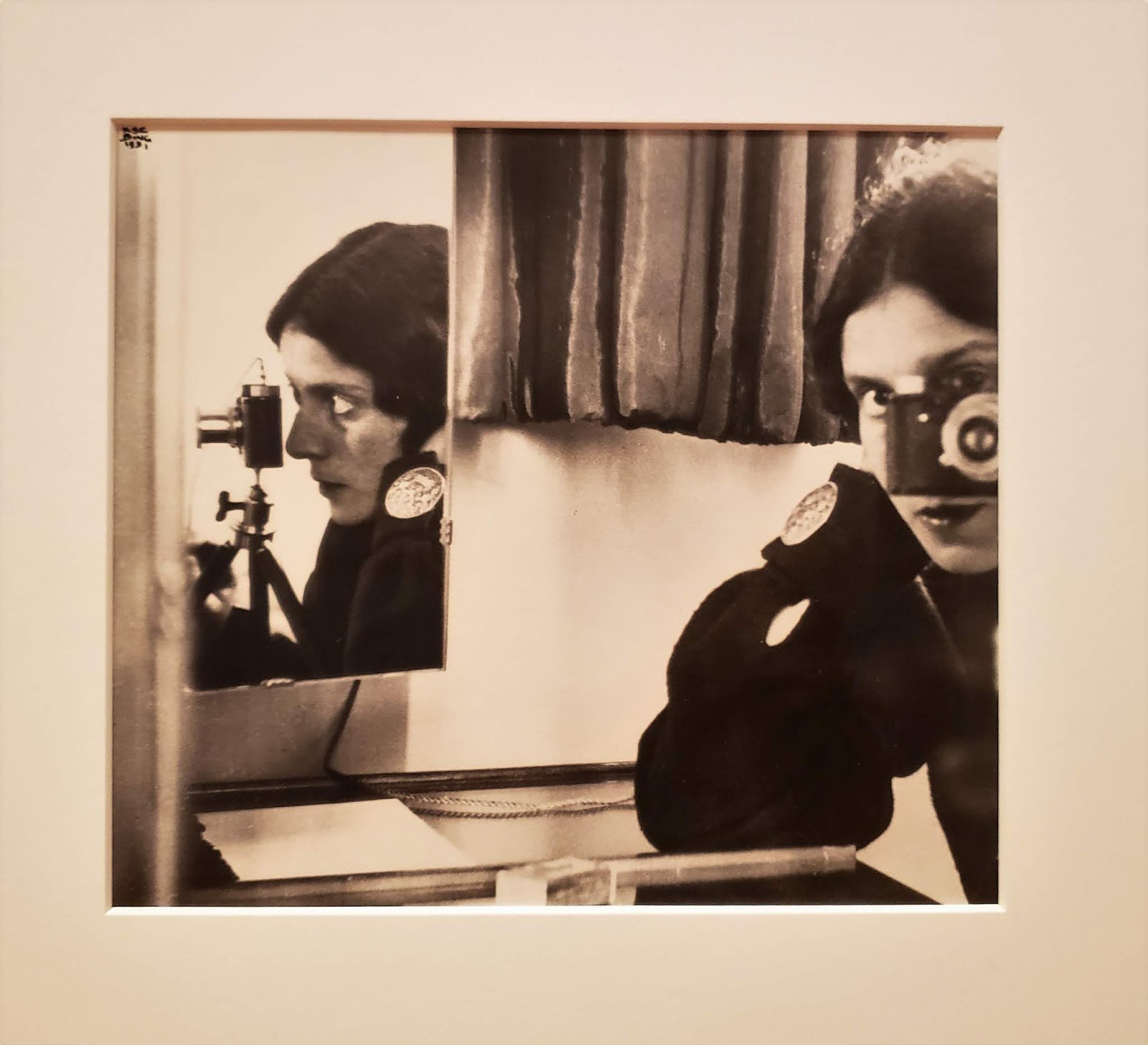
This exhibition highlights photographs from the collection of the Art Gallery of Ontario, along with key loans, and features a range of innovative photographic practices forged during these years of creative vitality. For instance, Germaine Krull produced dramatic close-ups and dizzying views of modernist architecture, and Hannah Höch, a Dadaist, created politically and socially subversive collages from magazine cut outs. Women also appear in front of the camera as compelling subjects and as modern muses for artists like Man Ray. Ilse Bing’s self-portrait demonstrates artists’ unconventional use of the camera to capture the modern experience.


13 August 2021

Andy Warhol

 August 2021 - Toronto ON

We went to the Andy Warhol exihbit at the AGO Art Gallery of Ontario this week.

Click here for the Tate Modern video on the exhibit.

A 20th-century icon at the centre of Pop Art, Andy Warhol was born Andrew Warhola in Pittsburgh, PA, in 1928. Shy, gay and from a working-class, East European immigrant background, Warhol had a unique understanding of American culture and society. Engaging topics such as consumerism, canonical art history, the artist’s Catholic faith and the activities of New York City’s countercultural underground, Warhol’s vast body of work, which includes film and publishing, both reflected and fueled the intense cultural transformations that occurred across the globe in the second half of the twentieth century.


Self-Portrait (1966) was constructed in what would become one of Warhol’s signature styles—a grid of bright, repeated silkscreened portraits. An expert colorist, Warhol paired primary and secondary colors as well as different shades of the same color.


When asked why he chose to paint Campbell’s soup cans, Warhol offered a deadpan reply: “I used to have the same lunch every day, for twenty years, I guess, the same thing over and over again.”


Warhol based this composition on a small advertisement for a plastic surgeon that ran in the National Enquirer in early April 1961, which he had enlarged and projected in order to trace it onto the surface of the canvas—a precursor to the silkscreen technique he pioneered the following year.


Warhol created this work after the Air France Flight 007 accident in which 129 (later 130 after one died of injuries) people aboard were killed with only 2 (initially 3) survivors. The Atlanta Art Association had sponsored a month-long tour of the art treasures of Europe, and 106 of the passengers were art patrons heading home to Atlanta on this charter flight. The tour group included many of Atlanta's cultural and civic leaders. Atlanta mayor Ivan Allen Jr. went to Orly to inspect the crash site where so many important Atlantans perished. The work is a memorial to those who died.


Ethel Scull 36 Times 1963 painting was Warhol's first commissioned work.
n early 1963 Robert Scull asked Warhol to paint a portrait of his wife after the style of the Marilyn Diptych and Warhol's other depictions of Marilyn Monroe. Warhol took Ethel Scull to a Times Square photo booth and prompted her to take 300 black and white photographs of herself. Warhol told her jokes in an effort to make her photographs more candid. One hand-colored photo-strip from the session is in the collection of the J. Paul Getty Museum.


The Marilyn Diptych (1962) is a silkscreen painting depicting Marilyn Monroe.
The monumental work is one of the artist's most noted of the movie star.

The painting consists of 50 images. Each image of the actress is taken from the single publicity photograph from the film Niagara (1953). The underlying publicity photograph that Warhol used as a basis for his many paintings and prints of Marilyn, and the Marilyn Diptych, was owned and distributed by her movie studio. Marilyn Diptych was completed just weeks after Marilyn Monroe's death in August 1962.

Silk-screening was the technique used to create this painting. The twenty-five images on the left are painted in color, the right side is black and white.


Elizabeth Taylor


According to Warhol, the inspiration for the cow image came from art dealer Ivan Karp:
Another time he said, "Why don't you paint some cows, they're so wonderfully pastoral and such a durable image in the history of the arts." (Ivan talked like this.) I don't know how "pastoral" he expected me to make them, but when he saw the huge cow heads — bright pink on a bright yellow background — that I was going to have made into rolls of wallpaper, he was shocked. But after a moment he exploded with: "They're super-pastoral! They're ridiculous! They're blazingly bright and vulgar!" I mean, he loved those cows and for my next show we papered all the walls in the gallery with them.


On June 3, 1968, radical feminist writer Valerie Solanas shot Warhol and Mario Amaya, art critic and AGO chief curator, at Warhol's studio, The Factory. Before the shooting, Solanas had been a marginal figure in the Factory scene. She authored in 1967 the SCUM Manifesto, a separatist feminist tract that advocated the elimination of men; and appeared in the 1968 Warhol film I, a Man. Earlier on the day of the attack, Solanas had been turned away from the Factory after asking for the return of a script she had given to Warhol. The script had apparently been misplaced.

Amaya received only minor injuries and was released from the hospital later the same day. Warhol was seriously wounded by the attack and barely survived. He suffered physical effects for the rest of his life, including being required to wear a surgical corset. The shooting had a profound effect on Warhol's life and art.


In the late 1950s, as the record industry began to expand at an extraordinary rate, Warhol was hired by both Columbia and RCA Records on a freelance basis to create album covers and promotional content and, from there, carried the skill throughout his career.


Photographs personally taken by the man himself, Andy Warhol depicts a series of transvestites in Ladies and Gentlemen, 1975. Provocative, ambiguous, and direct, this series marks his departure from portraiture based on appropriated images.

The 1970s represented the height of Studio 54 as the United States entered a more liberal mindset. During this time, the homosexual and drag community began boldly embracing their sexuality. This atmosphere inspired Warhol to create a series of 10 screenprints titled Ladies and Gentlemen, 1975. The idea for the series originally came from art dealer Luciano Anselmino. Under Warhol’s direction, Bob Colacello, editor of Interview magazine, recruited several black and Hispanic drag queens from the The Gilded Grape in Greenwich village. Warhol was undeniably fascinated by these performers who represented self-fashioned personas in a glamorous, exhibitionist manner. This series was first exhibited in Italy at the Palazzo di Diamente.


Among the models Warhol held in such poisoned esteem—promising them fame while disowning them of their own image—were revolutionary greats from the 1969 Stonewall uprising such as Marsha P. Johnson. Their misrecognition as “anonymous” models reveals the extent of Warhol’s ignorance. This touches one of the sore spots of the Stonewall historical narrative: for decades, its representation and analyses failed to name the ethnicity of the insurgents and thus rendered them invisible. With this misrepresentation, the white queer community deprived figures such as Marsha P. Johnson of an adequate recognition for their historical contribution to gay liberation. 


Interview is an American magazine founded in late 1969 by artist Andy Warhol and British journalist John Wilcock. The magazine, nicknamed "The Crystal Ball of Pop", features interviews with celebrities, artists, musicians, and creative thinkers. Interviews were usually unedited or edited in the eccentric fashion of Warhol's books and The Philosophy of Andy Warhol: From A to B and Back Again.


A couple of Canadians, Wayne Gretzy and Karen Kain.


Weekend Roundup

Welcome to The Weekend Roundup...hosted by Tom The Back Roads Traveller 1. Starts with " Q " 2. A Favorite 3. Queen - chosen by To...