Showing posts with label ROSSI SQ. Show all posts

07 May 2025

Day 15 -16 Lisbon - Amsterdam - Toronto IN TRANSIT

Day 12 April 30 - Madeira Orca Praia Hotel
Day 13 May 1    - Madeira  DIA DO TRABALHADOR Orca Praia Hotel
Day 14 May 2 Madeira - Lisbon Hotel Marquês de Pombal

Day 15 - 16 Lisbon - Amsterdam - Toronto


Destination Amsterdam, Schiphol
Departing 1930
Arriving         2325

The breakfast here was the least impressive of all our hotels. The room was also drab and in the basement.

We were supposed to meet my cousin and husband at 11 in Rossio Square, it was pouring out.
He messaged to say he had woken to a bad case of vertigo and wouldn't be able to make it.
Disappointing.
Check out was noon so we left our bags and went across the street for coffee. The rain had let up.


Walking down Liberdade.


Tram 28 stop on the left.


Tram 28 stop on the right by Restauradores Square. Can you see the line snaking down the street on the left?


A new sign!


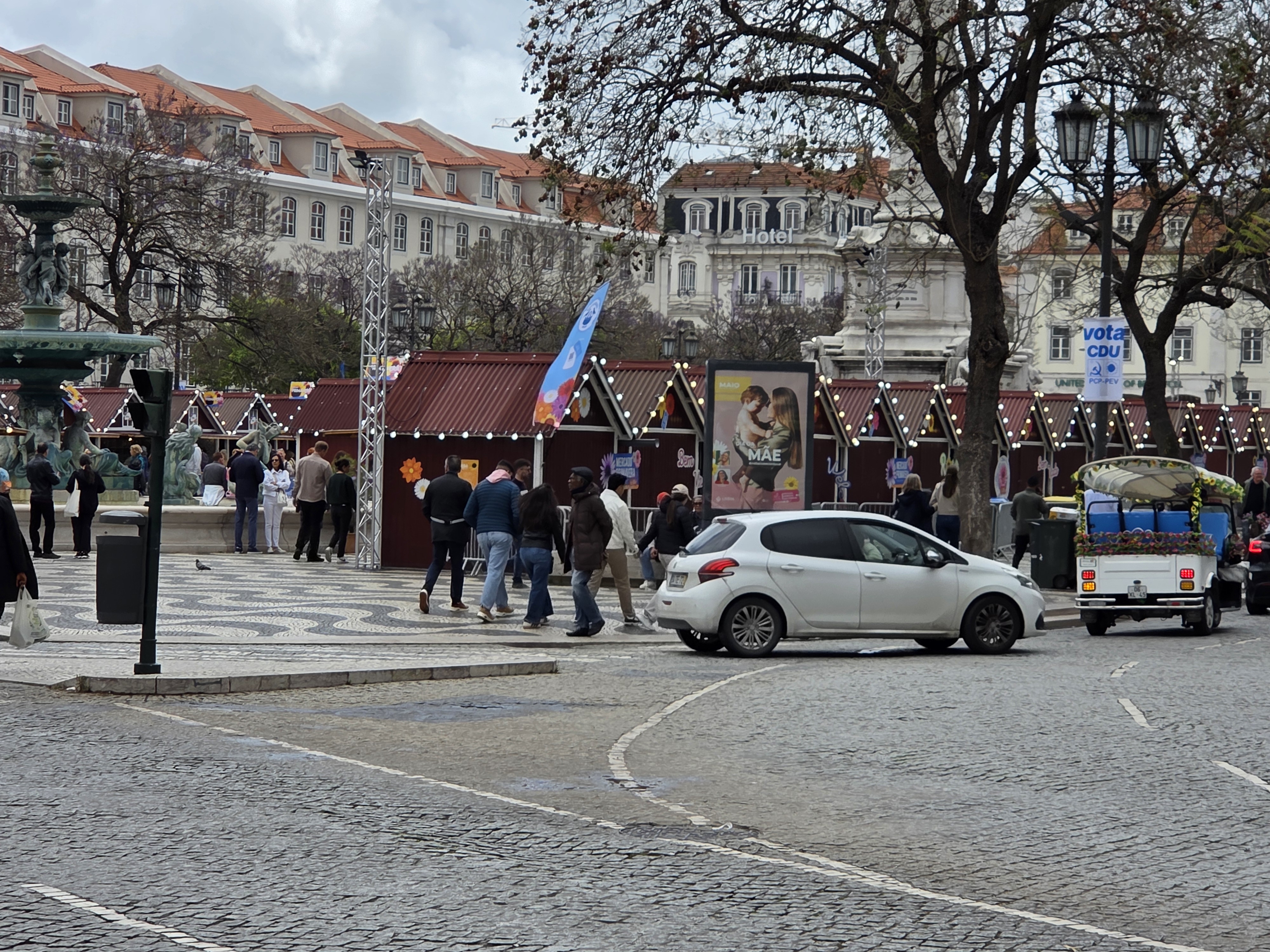
And a spring market set up in Rossio Square.


We decide on a snack before heading back.


The skies opened once again as we scurried inside! Shrimps in garlic and patatas batatas. delicious!


Rolex, anyone?


I had said that we should have a glass of wine at a kiosk before we leave. Who knew it would be the most expensive glass of wine yet? In speaking with a Portuguese friend she said "they saw you coming".


We pick up our bags at the hotel and wait for our driver who happens to be last night's driver (and our first driver). He doesn't speak much English but is happy to see John yet again.


Easy check-in and we said we didn't want to see our luggage again until Toronto.
KLM shares the lounge in Lisbon airport. It was pretty crowded but had good tuna sandwiches!!
John's scotch was a blend Charles House.


We skipped the meal as we weren't hungry to the disconcertion of the flight attendant. 


Arrived in Amsterdam Schiphol Airport. We've flown through this airport before. In 2012 we spent several days in Amsterdam before a river cruise.

It was a challenge finding the Mercure Hotel in a deserted airport. There were hardly any signs but we found an agent who told us to go through passport control and we would find it.

Mercure Hotel Schiphol Terminal is a unique 3-star hotel inside Schiphol Airport, located airside (after security), in the transit area of lounge 3 (upper level) at the beginning of the F gates. To stay at the hotel, you need a valid passport and flight ticket for the same or next day. Both day and night rooms are available. Please note: you can only bring hand luggage to the hotel. Transit passengers should not go to the exit/arrival hall, but remain in the Terminal.
SIGNS PLEASE!
THERE IS AN HOUR DIFFERENCE BETWEEN LISBON AND AMSTERDAM. IF IT IS 2 PM IN LISBON IT IS 3 PM IN AMSTERDAM. So we also lost an hour. No photos so I stole this one.


We had a decent night's sleep and woke to our alarms at 7:30 checked out and headed to the KLM Crown Lounge.


Where should we go?


We should have gone to the upstairs lounge, it was much quieter.


Being in transit and staying overnight in the hotel meant we did not have to do security again.


Destination Toronto, Lester B. Pearson International
Departing 1120
Arriving         1320

We were delayed taking off as several people had been denied boarding and their luggage had to be offloaded.


Apple celery mousse


The side salad contained these red things that I could have eaten all day. Turns out they are Sweety Drop Peppers are small, tear-shaped delicacies from Peru. They are sweet and tangy with a whisper of heat, and contain small crunchy seeds that provide a lovely textural contrast to salads, pizzas, antipasti plates and more.


We watched several movies to pass the 8 hours flying time.
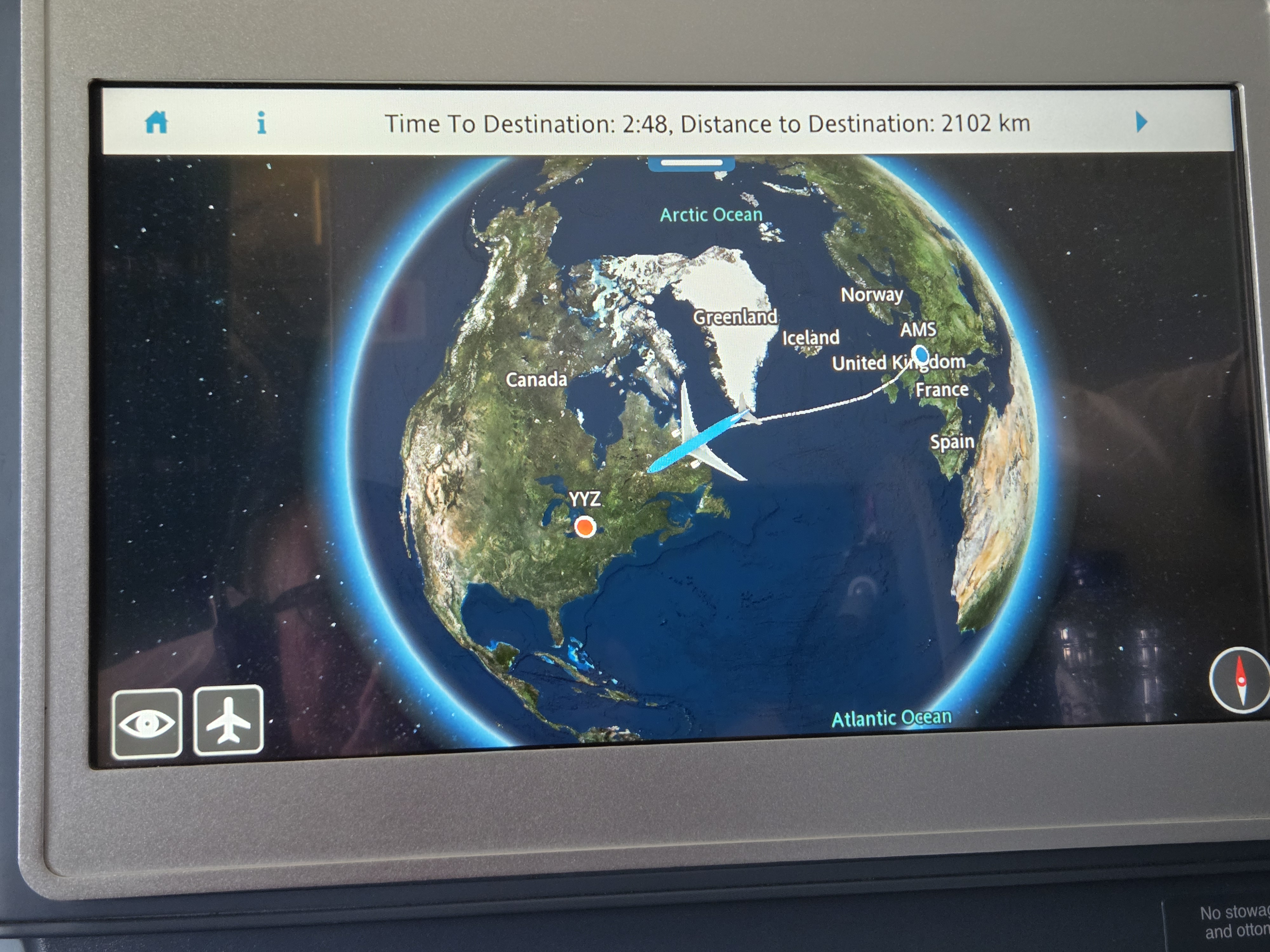


Just before landing an announcement was made regarding two minutes of silence, if we were still on board we were asked to allow anyone who wished to observe the two minutes of silence.

The national observance of Remembrance Day in the Netherlands takes place on 4 May, at 8pm. At that moment, two minutes of silence are observed throughout the country to commemorate Dutch victims of war. A commemoration ceremony is held on Dam Square in Amsterdam in the presence of the head of state and various representatives of both the Council of Ministers of the Kingdom of the Netherlands and the Dutch Parliament. This national observance of Remembrance Day is held simultaneously with local commemoration ceremonies in nearly every town and city in the Netherlands. At 8pm, the entire country is silent for two minutes.

We had already left the plane by 8 PM.

Landed, cleared customs and got an Uber at 2:20 and home by 2:38 $40 with tip.

I had thought we would nap but we managed to stay up until 5 PM (Amsterdam time 11 PM)

30 April 2025

Portugal Day 4

15,000 Steps 2 Ubers 1 Bus Tour

Day 4: Lisbon (Italics tour description)
April 22 2025

After breakfast at your hotel, enjoy a half-day guided tour of Lisbon. You will begin with stunning views from the Edward VII observation deck, then explore Avenida da Liberdade and the vibrant downtown areas of Rossio and Praça do Comércio. You will continue to Belém, where the Portuguese explorers once set sail. Visit the Tower of Belém, the Monument of the Discoveries and the Jerónimos Monastery, each a testament to the city’s golden Age of Discovery. After your visit, you will have some time to taste the renowned Pastéis de Belém.
Lunch and afternoon at leisure. Take your time to wander through Alfama’s charming alleys, where colourful streetcars and historic staircases bring Lisbon’s old town to life.
 Dinner at leisure and overnight at your hotel in Lisbon. (Breakfast)


We set our alarms for 6:30 and were at breakfast by 7:10. It was not too busy, the Quebecers were there as they fly home today as were other Quebecers on the flight to Montreal.
First day of tour.
We were down to meet our 8:30 tour at 8:20. It turns out that Wingbuddy had an English and a French tour, bus 1 and 2. We met a couple from outside Ottawa, seemed nice enough J and W. but they would soon be nicknamed the Homecoming King and Queen aka Busy Bees as they buzzed here and there.
Our tour is 46 people spread over two hotels. The majority were at the Pombal hotel. At our hotel were 2 American (friends) couples who mixed with no one. 2 American sisters?? from Oregon. 1 single woman from Canada, and the Ottawa couple.
As the French tour exited the American couples said "there go the Canucks", not realizing some of us were still in the lobby.
A group of 46 is too many to manage with one guide, Pedro.
It was 8:45 when he arrived. 

Tour description stated city tour first but we went to Belem.
We drove the 20 minutes to Belem, which is just past where we were in Sunday, under the bridge.


Behind us, Connie (American non-Trump) aka Sorority Mother (palsies with the HKQ (Homecoming/Prom King and Queen) and her husband John.


Belem Tower, built in Portuguese Manueline style between 1514 and 1520. Originally conceived as a lighthouse, it was eventually built as a fortress to defend the city from invading ships.


Now they all need a bathroom break, a one seater!!! 5 minutes turned into 30 as we also had to wait for a late arrival from Toronto, coming directly from the airport. It wouldn't have mattered, they were still lining up for the ladies washroom.

Finally time to move on, it was like herding cats.

Estátua "Gago Coutinho e Sacadura Cabral
This replica of the Santa Cruz seaplane that was the first to cross the South Atlantic sits near the Belem Tower and is easy to dismiss. But, it reflects an important accomplishment in history. Much more interestingly, the actual plane can be seen at the Maritime Museum, near the Jeronimos Monastery.


Padrao dos Descobrimentos
Monument to the Discoveries. Inaugurated in 1960 it commemorates the five hundredth anniversary of the death of Henry the Navigator, who discovered the Azores, Madeira and Cape Verde. Henry stands at the front of the monument holding a carrack, a type of sailing ship used by the Portuguese.


Mosterio dos Jeronimos ($ entrance fee included???) took over 100 years to build, beginning in 1501. The monastery is one of the most prominent examples of the late Portuguese Gothic Manueline style of architecture in Lisbon. The Hieronymite monks occupied the monastery for over 4 centuries until 1833, when the religious orders were dissolved and the monastery was abandoned.
MONASTERY CANCELLED DUE TO LONG LINES AS PEOPLE WERE LINING UP TO PAY RESPECTS TO THE POPE.


Pedro collected the 1.50 € per pastry and then went and got them which we ate on the bus.


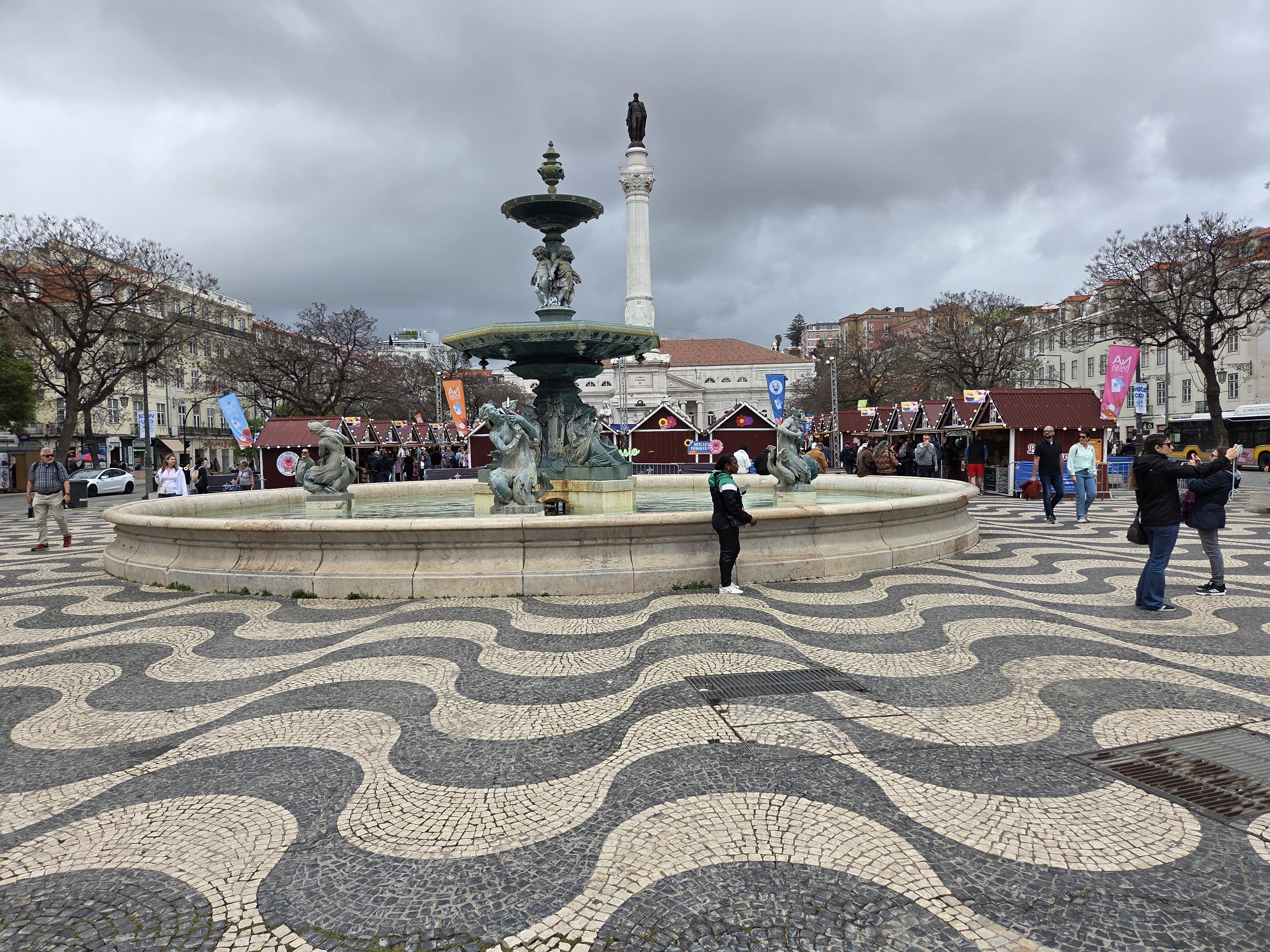
We started the tour at Rossio Square.
Calçada are small stone cubes, either white or black, inlaid on pedestrian paths and sidewalks in many parts of Portugal. Where many countries pour slabs of dull concrete, in Portugal, the streets fairly ripple with patterns in stone. The white blocks are made of limestone, calcário in Portuguese, hence the name calçada. The black ones are most often cut from basalt. Combined, they make dazzling designs, turning even ordinary byways into creative mosaics.


A calceteiro, or paver as it translates into English, is someone who lays down cobblestones by hand to create intricate patterns on streets and sidewalks. This traditional Portuguese craft dates back several centuries and has become synonymous with Lisbon’s urban landscape.

In fact, calçada portuguesa (Portuguese pavement), as it’s known locally, is not just functional but also artistic. It involves arranging small black basalt stones and white limestone pieces into various designs – from simple geometric shapes to complex mosaics depicting historical scenes or nautical themes associated with Portugal’s seafaring past.


At this point we ditched the tour as we had already been around this area on Saturday and Sunday. Plus the half day tour was running into the afternoon. Instead we got an Uber to St. George Castle.
Lisbon’s tallest hill was fortified even before the Roman occupation, and the Visigoths and the Moors all left their mark. The castle is the restored version of the Moorish construction, which largely collapsed in the 1755 earthquake. It was also the royal residence, before the king decided to build a palace on the waterfront, which was also completely destroyed in the earthquake. Today the castle crowns the city as the main landmark of ancient Lisbon, and offers a breathtaking view from its walls and pine-shaded terraces.


Yikes, following Google's directions to the Moorish Quarter. In hindsight we should have ignored her "sharp left turn" and meandered down the slow way.


he Moorish Quarter of Lisbon, known as Mouraria, is considered the birthplace of Fado, a deeply emotional and soulful Portuguese musical genre. It was in this working-class neighborhood, particularly in the 1800s, that the first recorded fado singer, Maria Severa, lived and performed. Mouraria is where the musical genre of fado emerged, fueled by the passionate voices of its residents, and where the spirit of "saudade" (a Portuguese expression for intense longing) was first embodied through music. 


Fernando Maurício (1933-2003) was a significant figure in the world of Fado, often referred to as the "King of Fado" and the "King of Mouraria". Born and raised in the Mouraria neighborhood of Lisbon, he began his professional career at the age of 13. Maurício was known for his original voice and his deep connection to his roots, remaining a humble man throughout his life despite his fame. He was recognized for bringing Fado to television in the late 1960s and received several awards during his career. 
Coincidentally, he was born in the house opposite that of another fadista who had enjoyed notoriety 100 years previously. Maria Severa was a local prostitute with an amazing voice who, thanks to the patronage of her lover, a count, became something of a diva and brought fado to the fringe of ‘respectable’ audiences. 


One of the most curious national symbols of Portugal is the “Galo de Barcelos” (Barcelos rooster), usually represented by a colourful ceramic rooster decorated with hearts and flowers…
Legend has it that a long time ago, in the northern town of Barcelos, an unknown Galician was arrested and accused of a crime. However, the man swore innocence, alleging that he was only passing through those lands on pilgrimage to Santiago de Compostela.

Sentenced to death on the gallows, the man asked to be brought before the judge who had sentenced him. When permission was granted, they took him to the residence of the magistrate, who was feasting with some friends at the time. The Galician reaffirmed his innocence and, faced with the incredulity of those present, pointed to the roasted rooster that was on the table and exclaimed:
“As certain as I am innocent, that rooster will sing when they hang me!”

All those present laughed at the absurdity of such a claim, but no one touched the rooster. And what seemed impossible happened: when the pilgrim was hung, the rooster stood up on the table and sang.
Realizing that he had made a mistake, the judge ran to the gallows and discovered that the Galician could still be saved thanks to a badly made knot. The man was immediately released and sent away in peace.


How did the Moorish Quarter or Mouraria neighbourhood come about? Essentially, after the Reconquista, in which Christian forces took control over the territory now known as Portugal, the resident Muslim population was forced to live outside the city walls.
Always a place for ‘outsiders’, the ancient neighbourhood currently has the highest ethnic diversity in the city. The square itself is named after the king’s knight, Martim Moniz, who martyred himself by squeezing into a gap in the citadel gates and preventing the Muslims from closing it. This enabled King Afonso’s army to break through the defenses and conquer St. Jorge’s Castle.


Martim Moniz's heroic act, where he sacrificed himself by blocking the castle gates during the Reconquista of Lisbon, is commemorated by this fountain.


We came across this square full of food and drink vendors.

The Praça da Figueira (Square of the Fig Tree) is a large square in the centre of Lisbon, in Portugal. It is part of the Lisbon Baixa, the area of the city reurbanised after the 1755 Lisbon earthquake.


A monthly food market, "Figueira Marca-te" (Figueira Marks You), is held there on the last weekend of each month. 


We wandered down another street to find lunch. Yes, we know, you should never choose a restaurant based on being wooed in by a server.


John had shrimp rice.


I had cod.


Having a beer at the Beer Museum...


Very cool glasses!


Time for some dessert.


Morning Reflections