August 2018 - Niagara on the Lake ON
We went to see Shaw Festival The Hound of the Baskervilles last week.
Niagara-on-the-Lake is a town in southern Ontario. It sits on the shores of Lake Ontario, at the mouth of the Niagara River. It's known for its wineries and the summer Shaw Festival, a series of theatre productions. The flower-filled, tree-lined old town features 19th-century buildings, mainly along Queen Street. Near the river, 19th-century Fort George was built by the British to defend against American attacks.
It is the only town in Canada to have a Lord Mayor.
Niagara-on-the-Lake is important in the history of Canada: it served as the first capital of the Province of Upper Canada, the predecessor of Ontario, called Newark from 1792 to 1797. During the War of 1812, the town, the two former villages of St. David's and Queenston, and Fort George were the site of numerous battles following the American invasion of Upper Canada, and the town was razed. Niagara-on-the-Lake is home to the oldest Anglican and Catholic churches in Ontario, and the oldest surviving golf course in North America.
Spotted as we entered town.
Plaque Text
Here stood a Baptist church erected in 1830 through the exertions of a former British soldier. John Oakley, who although white, became pastor of a predominantly negro congregation. In 1793 Upper Canada had passed an act forbidding further introduction of slaves and freeing the children of those in the colony at twenty-five. This was the first legislation of its kind in the British Empire. A long tradition of tolerance attracted refugee slaves to Niagara, many of whom lie buried here.
The town gave many African-Americans their first taste of freedom, both as a stop on the Underground Railroad for those travelling further into Upper Canada, and as a refuge in its own right.
Our first priority was to find a parking space. The town was packed with tourists, all wandering aimlessly, getting under your feet.
We wandered Queen St. for a while.
Niagara District Court House, better known as the Court House Theatre, is a former court house and venue for the Shaw Festival (until 1973) in Niagara-on-the-Lake, Ontario.
The neo-classical three-storey building was constructed between 1846 and 1847 to designs by the Toronto architect William Thomas (and built by Garvie and Co.) for the then Niagara District. The building replaced an earlier court house removed for fear of it being in-range of cannon fire from Fort Niagara. Inside it had a courtroom, town hall chambers, offices and jail cells.
The building was used as one of a few venues for the 1850 Provincial Agricultural Fair of Canada West. The court-house function remained until judicial courts moved to St. Catharines in 1863; the building then served as town hall and jail until 1866. It became an orphanage for girls from England from 1869 to the early 20th century.
In 1962 the court house became home to the Shaw Festival. It received designation as a National Historic Site in 1981.
Designed by Toronto architect Charles Wilmott, it was unveiled on 3 June 1922. The cenotaph is dedicated to the memory of Canadians who died in the service of their country.
The Owl and the Pussycat circa 1830.
Prince of Wales Hotel, Niagara-on-the-Lake is a historic Victorian hotel built in 1864, the three storey 110 room hotel went by several names (Long's Hotel, Arcade Hotel, The Niagara House)and was renamed with the current name in 1901 after royal guests The Duke and Duchess of Cornwall and York(afterwards known as The Prince and Princess of Wales until 1910) stayed.
Queen Elizabeth II stayed at the hotel during her visit to the area in 1973. Later owned by the Wiens family, the current building was acquired by Si Wan Lai. Lai renovated the hotel, now managed by Lais Hotel Properties Limited.
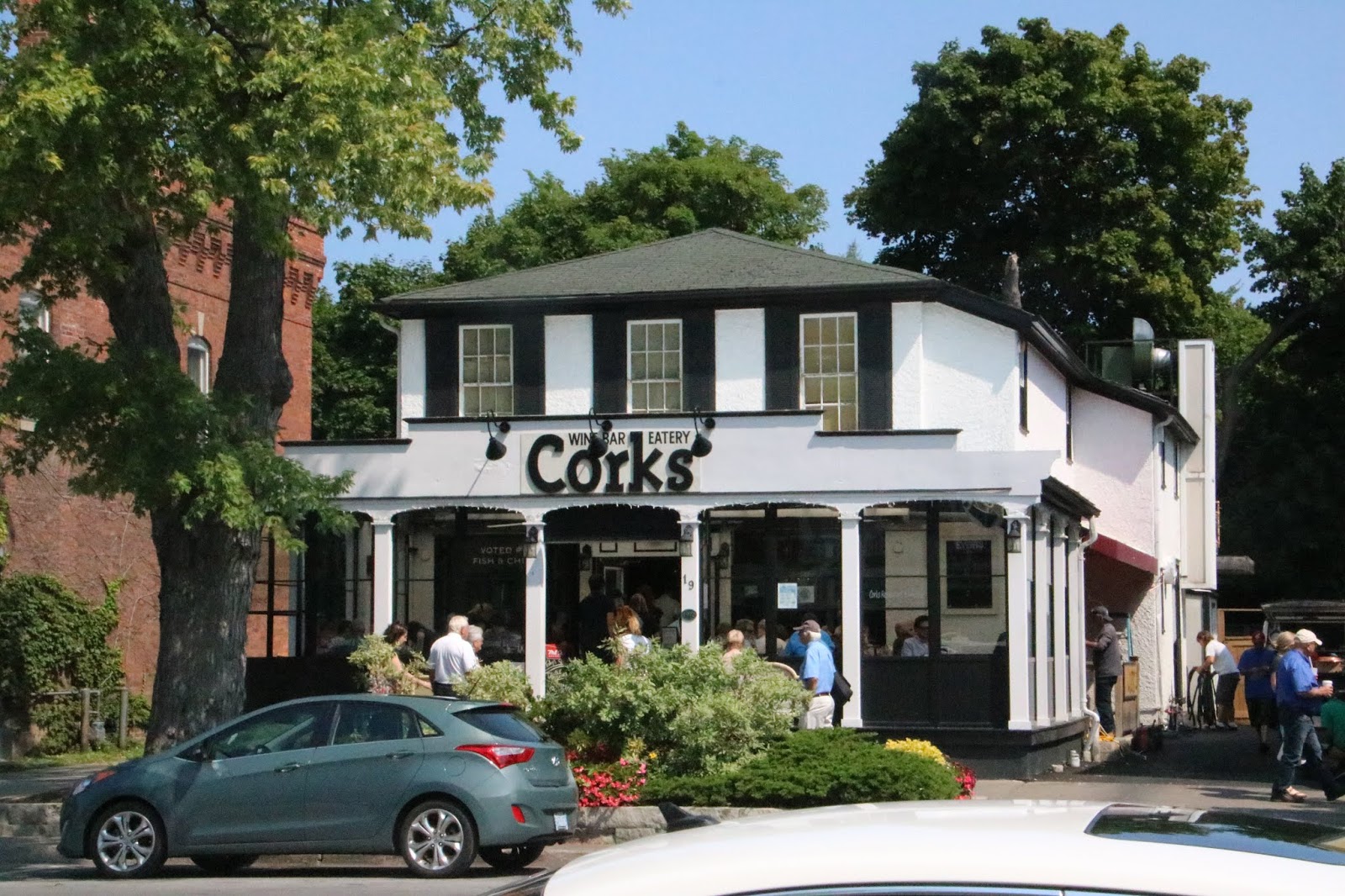
There are plenty of dining options within walking distance of theatres.
Following the introduction of English Civil Law into this province in 1792, legislation was passed in 1797 authorizing the establishment of the Law Society of Upper Canada. A founding meeting was held in Wilson's Hotel in this community on July 17th, 1797. It was attended by ten practitioners, including the Attorney General, the Honourable John White, who was appointed Treasurer; the Society's principal officer. The Society was responsible for setting standards for admission and regulating the province's legal profession. after relocating to York (now Toronto) in the late eighteenth century, the Society moved into its newly-constructed quarters - Osgoode Hall - in 1832. The Society continues to regulate and control Ontario's legal profession.

The Shaw Festival is a major not for profit /charitable theatre festival, the second largest repertory theatre company in North America. Founded in 1962, its original mandate was to stimulate interest in George Bernard Shaw and his period, and to advance the development of theatre arts in Canada.
We foolishly thought there was only one festival theatre and showed up at the Royal George only to be told The Hound of the Baskervilles was 1/2 a mile away!
Dates listed are when the theatre's association with the Shaw Festival began; The Court House and Royal George theatres predate the festival.
Festival Theatre (1973, 856 seats)
Court House Theatre (1962, 327 seats, not be used for performances after the 2017 season
Royal George Theatre (1980, 313 seats)
Jackie Maxwell Studio Theatre (2004, 200 seats)
The flower arrangements are stunning.
The first organization devoted to the improvement of agriculture in Ontario was founded at Niagara. Its original name, the Agricultural Society of Upper Canada, reflected Lieutenant-Governor John Graves Simcoe's hope that it would become a province-wide organization. Its members, mostly merchants, politicians, clergymen and gentlemen farmers, met regularly for dinner and discussion. They imported new varieties of fruit trees to the Niagara peninsula in 1794 and sponsored the province's first agricultural fair in Queenston in 1799. The society folded in 1805 and left its collection of reference books to the Niagara Library. Although the society was short-lived, its scientific approach to farming anticipated the work of regional agricultural societies run by farmers after 1820.

Known at various times as Butlersburg, West Niagara and Newark, its first permanent settlers, including Butler's Rangers and other loyalists, arrived about 1780. The first five sessions of Upper Canada's Legislature met here under Lieutenant-Governor Simcoe between September 17th, 1792, and June 3rd, 1796. The town was captured by American forces May 27th, 1813, which burnt it during their withdrawal December 13, 1813. It was the administrative and judicial centre of the Niagara District and Lincoln County until 1866.
Making jam for over 70 years.
The Upper Canada Gazette or American Oracle, first newspaper in what is now Ontario, was published in the town of Niagara. Its first issue, edited by Louis Roy, appeared April 18, 1793. On this site was published the Gleaner which from 1817 to 1837, under the editorship of Andrew and Samuel Heron, was one of the most prominent newspapers in Upper Canada.
Old Fort Niagara in Youngstown New York on the edge of the Niagara River.